
The Chronicles of Stone: How the Earth Writes its History #
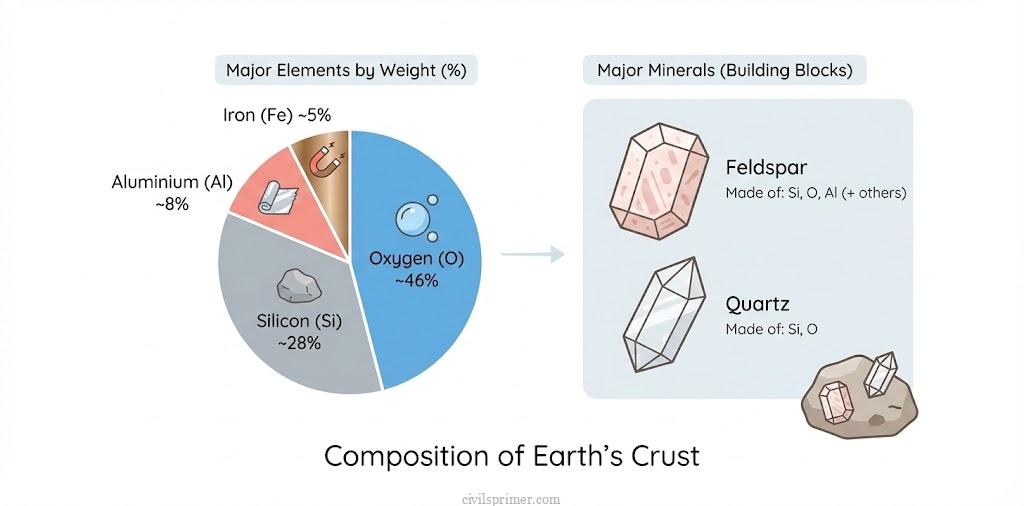
The Crusty Ingredients: Imagine the Earth as a giant kitchen. To bake the “crust” we live on, nature uses specific ingredients. These ingredients are Minerals. A mineral is a naturally occurring organic or inorganic substance, having an orderly atomic structure and a definite chemical composition. Just as flour, sugar, and eggs mix to form a cake, different minerals mix to form Rocks. A rock is simply an aggregate of one or more minerals. It doesn’t need a definite chemical composition like a mineral does.
The Chef’s Favourites: Although there are thousands of minerals, the Earth mainly uses a few “Rock-Forming Minerals” like Feldspar (half the crust!), Quartz, Mica, and Amphibole.
Part 1: Igneous Rocks – The First Born #
The Fiery Beginning: Long ago, the Earth was a ball of fire. Even today, deep beneath our feet, it is hot enough to melt stone. This molten rock underground is called Magma. When it erupts onto the surface, it becomes Lava. When this hot liquid cools down and solidifies, it forms the very first type of rock: Igneous Rocks (from the Latin Ignis meaning Fire). Since they formed first, they are called Primary Rocks.
The Tale of Two Cooling Speeds:
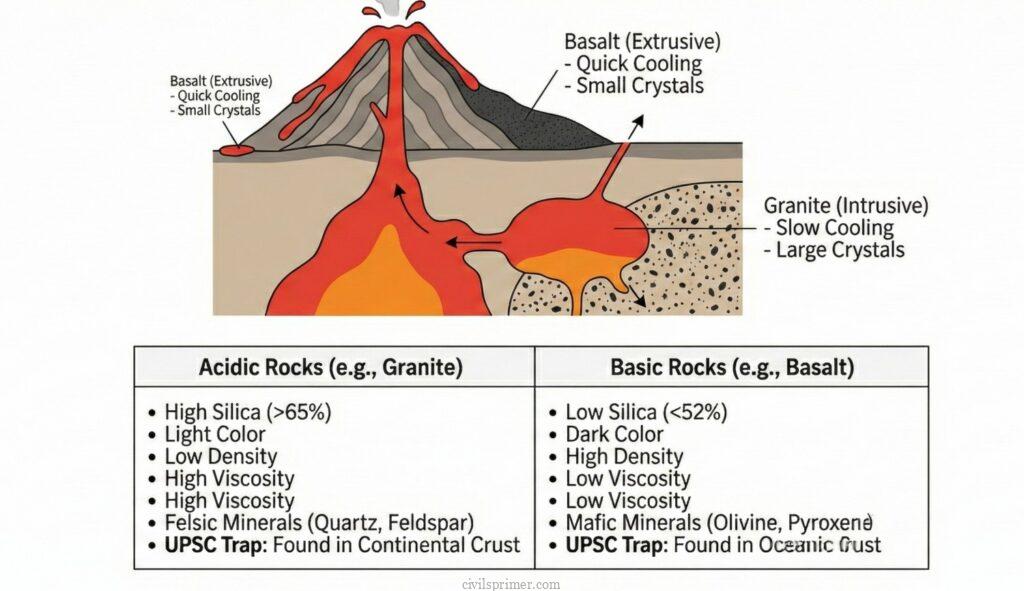
- Intrusive/Plutonic – The Slow Cooker: Sometimes, magma gets trapped deep inside the crust. It cools very slowly—over thousands of years. This slow cooling allows large crystals to grow.
- Extrusive/Volcanic – The Fast Freezer: When lava erupts from a volcano, it meets the cool air and solidifies instantly. There is no time for crystals to grow, so the rock is fine-grained and smooth.
- Result: Basalt.
- India Connection: The Deccan Traps (Maharashtra plateau) are made of thick layers of basaltic lava.
The Personality of Magma : Acid vs. Basic –
- Acidic Rocks: Rich in Silica (Quartz/Feldspar). They are light in colour and less dense (e.g. – Granite).
- Basic Rocks: Poor in Silica but rich in Iron and Magnesium. They are dark and dense (e.g. – Basalt, Gabbro)
Global & Indian Reserves (Igneous):
- Basalt: The Deccan Traps in India contain massive reserves.
- Granite: Found in Rajasthan, Jharkhand, and Karnataka.
- Metals: Igneous rocks are the source of precious metals. The Kimberley pipes in South Africa (diamonds) and Kolar Gold Fields in Karnataka are volcanic origins.
Part 2: Sedimentary Rocks – The Layered Archives #
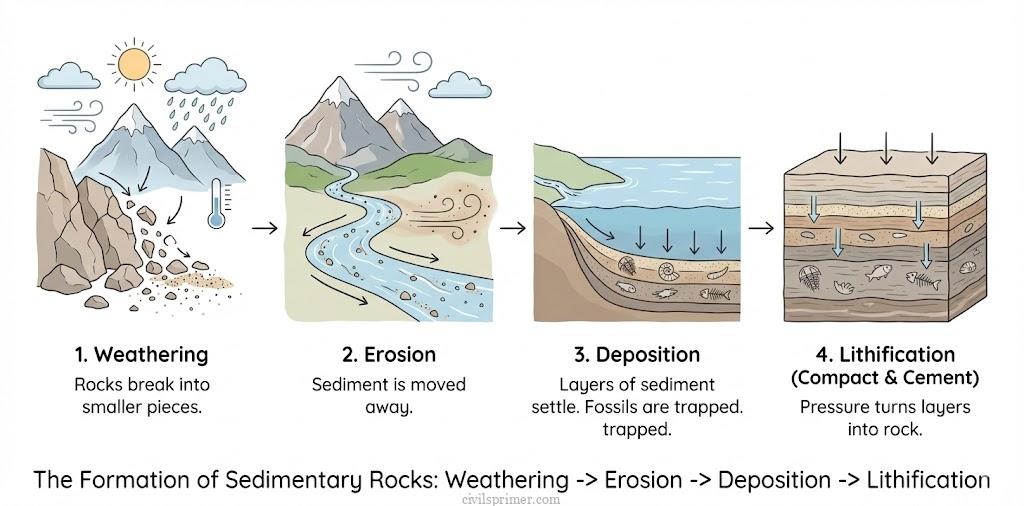
The Great Erosion: Nature hates permanence. As soon as Igneous rocks appear, the sun, rain, wind, and rivers attack them. This process is called Denudation. The rocks break into small fragments called sediments. These sediments are carried away by water and wind and deposited in layers (stratified) in depressions like lakes or seas. Over millions of years, the weight of the upper layers compresses the lower layers, turning loose sand into hard rock. This process is called Lithification.
The Three Methods of Creation:
- Mechanically Formed: Nature acts like a grinder. Sand grains are pressed to form Sandstone; clay is pressed to form Shale. The famous Red Fort in Delhi and Agra Fort are built of Sandstone (mostly from the Vindhyan Rock System).
- Organically Formed: These are the graveyards of ancient life. For example – Limestone: Formed from the skeletons of tiny marine animals (Coral/Polyps) | Coal: Formed from ancient forests buried underground. The Gondwana rocks in India hold 98% of our Coal reserves.
- Chemically Formed: Water evaporates, leaving minerals behind. Examples include Potash, Salt, and Gypsum (found in Rajasthan).
The Fossil Keepers: Unlike Igneous rocks, which are too hot, Sedimentary rocks are cool and layered. They are the only rocks that contain Fossils—the remains of plants and animals.
Global & Indian Reserves (Sedimentary):
- Coal: The Damodar and Mahanadi valleys (Jharkhand/Odisha) are the Coal belts of India. Globally, USA, Russia, and China hold massive reserves.
- Limestone: Abundant in Karnataka, Andhra Pradesh, and Rajasthan.
- Petroleum: Oil is found in the pore spaces of sedimentary rocks (like Sandstone/Limestone) in anticlines or Fault traps. Major reserves are in the Gulf of Mexico, Middle East, and Mumbai High in India.
Part 3: Metamorphic Rocks – The Shape Shifters #
The Pressure Cooker: What happens when you take an Igneous or Sedimentary rock and bury it deep underground, subjecting it to immense Heat (Thermal) and crushing Pressure (Dynamic)? It changes! It doesn’t melt (that would make it magma); it just transforms. It recrystallizes. These are Metamorphic Rocks (“Change of Form”).
The Transformations:
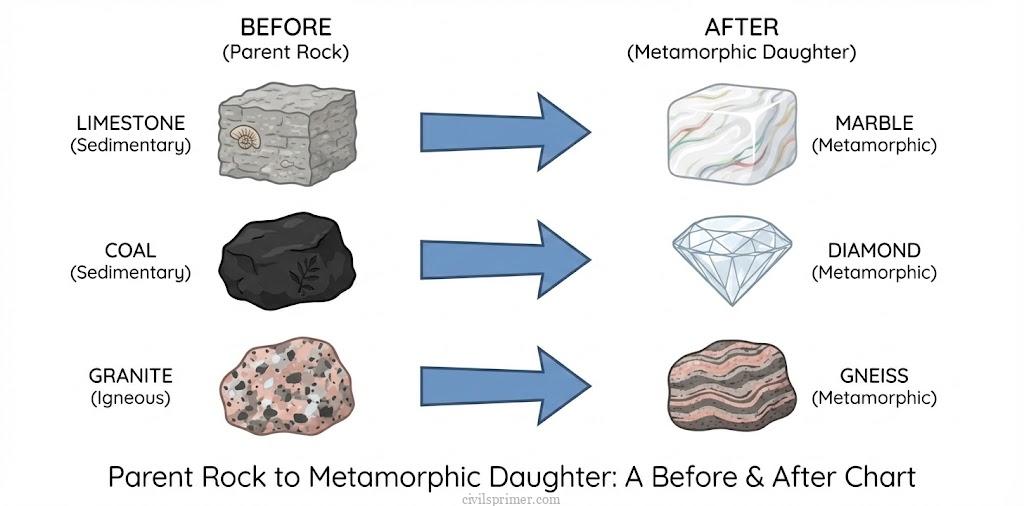
- Clay/Shale (Sedimentary) ➔ squeezed into Slate or Schist.
- Sandstone (Sedimentary) ➔ heated into Quartzite.
- Limestone (Sedimentary) ➔ baked into Marble.
- Granite (Igneous) ➔ crushed into Gneiss.
- Coal (Sedimentary) ➔ compressed into Graphite or Diamond,.
Characteristics: Sometimes, the minerals in these rocks get arranged in alternating thin and thick layers. This beautiful banding is called Foliation.
Global & Indian Reserves (Metamorphic):
- Marble: The Makrana Marble from Rajasthan (used in Taj Mahal) is world-famous.
- Graphite: Found in Odisha and Tamil Nadu.
- Diamonds: Formed under extreme pressure in the mantle, found in Panna (MP) and Golconda region.
Part 4: The Rock Cycle – The Circle of Life #
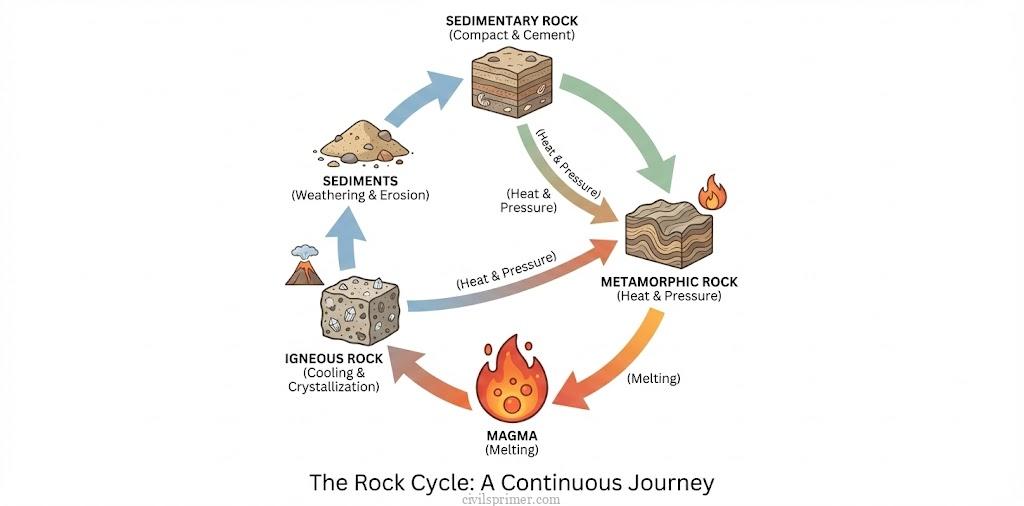
Nothing on Earth is permanent 😂. Rocks are constantly changing from one form to another in a cyclical process.
- Magma cools to form Igneous Rocks.
- Igneous rocks break down into sediments to form Sedimentary Rocks.
- Igneous and Sedimentary rocks, under heat/pressure, become Metamorphic Rocks.
- Metamorphic rocks, if pushed deeper into the mantle (subduction), melt and become Magma again.
This is the Rock Cycle. It is powered by the Earth’s internal heat and the sun (erosion).
Part 5: Economic Utility & The Development vs. Conservation Debate #
The Wealth Beneath Our Feet: Civilization is built on rocks.
- Energy: Sedimentary rocks give us Coal (Thermal power accounts for ~60% of India’s installed capacity) and Petroleum (transportation).
- Industry: Metallic minerals (Iron, Copper, Bauxite) found in Igneous/Metamorphic rocks are the backbone of manufacturing,.
- Agriculture: Sedimentary rocks like Limestone and Phosphates are crucial for fertilizers.
- Construction: Granite, Marble, and Sandstone are essential building materials.
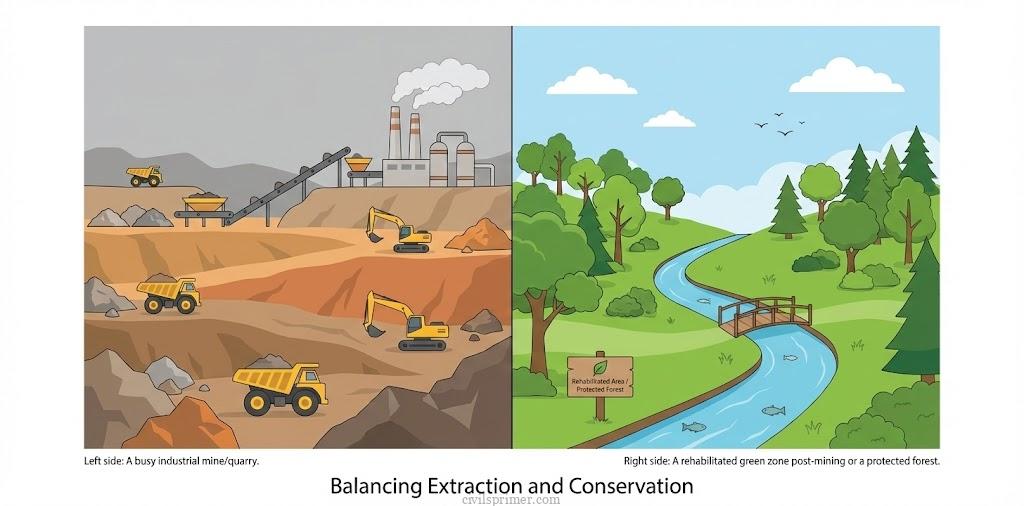
The Conflict: Extracting these resources often comes at a heavy price.
- The Conflict: Mining often overlaps with our richest forests (e.g., Hasdeo Arand Coal fields in Chhattisgarh).
- Ecological Impact: Open-cast mining destroys topsoil, pollutes rivers (e.g., Damodar river pollution due to Coal washeries), and causes health issues (e.g., Rat-hole Mining in Meghalaya).
- The Debate: India needs minerals for development (Make in India, Infrastructure), but mining in eco-sensitive zones (like Western Ghats) threatens biodiversity and water security.
The Way Forward: Sustainable mining practices, intergenerational equity (leaving resources for the future), and policies like the District Mineral Foundation (DMF) are attempting to balance this hunger for resources with the health of the planet.
UPSC Mains Subjective Previous Years Questions #
- 2017: In spite of adverse environmental impact, Coal mining is still inevitable for development. Discuss.
Introduction and Conclusion for Mains Answers #
Introduction: “Rocks and minerals form the backbone of a nation’s industrial and economic development. From the energy security provided by sedimentary fossil fuels to the infrastructure supported by igneous and metamorphic aggregates, the geological structure of a region determines its resource potential. In India, the distribution of these resources is governed by rock systems ranging from the ancient Dharwar system to the tertiary Gondwana formations.”
Conclusion: “Conclusively, while the extraction of mineral resources is indispensable for economic growth, it must be balanced with ecological sustainability. Adopting the principles of intergenerational equity, as highlighted in the National Mineral Policy, and ensuring scientific mining practices are essential to mitigate environmental degradation while securing the nation’s resource future.”
Related Latest Current Affairs #
- October 2025: Classification of Limestone as a Major Mineral The Ministry of Mines reclassified Limestone as a Major Mineral, removing its dual status. Limestone is a sedimentary rock composed primarily of calcium carbonate (CaCO3) in the form of calcite or aragonite, formed via biogenic precipitation or mechanical deposition,.
- October 2025: Discovery of Jarosite in Kachchh (Mars Analog) Scientists identified Jarosite, a hydrous sulphate mineral, in the acidic clay-rich environments of Kachchh, Gujarat. This mineral, also found on Mars, serves as a geological marker for acidic and oxidizing conditions, often formed through the oxidation of iron sulphides like pyrite,.
- August 2025: Eruption of Krasheninnikov Volcano and Dacite Formation The eruption of the Krasheninnikov volcano in Russia produced Dacite, an extrusive igneous rock. Dacite is silica-rich (63–69% : SiO2) and compositionally intermediate between andesite and rhyolite, commonly found in Subduction Zone environments,.
- August 2025: Vision Document for Bauxite (Aluminium Ore) India unveiled a vision document for Aluminium, highlighting Bauxite, a sedimentary rock that serves as the primary ore for aluminium. Odisha was noted as the largest producer, holding the majority of the nation’s Bauxite reserves.
- August 2025: Discovery of Mafic-Ultramafic Intrusives in Chhattisgarh A potential mineral zone was identified in the Bhalukona–Jamnidih block containing Ni–Cu–PGE mineralization. This zone hosts mafic-ultramafic igneous rocks like Gabbro and Pyroxenite, which are formed from the cooling of magnesium- and iron-rich magma,.
- July 2025: Inclusion of Deccan Traps and St. Mary’s Island in UNESCO Tentative List India added geological sites to the UNESCO Tentative List, including the Deccan Traps (massive basaltic igneous lava flows) and St. Mary’s Island, known for its rare Columnar Basalt formations formed during the Late Cretaceous period,.
- February 2025: Star HOPS315 and the “Birth” of Rocks Astronomers observed the condensation of solid crystals from vapor around the protostar HOPS315. They detected minerals like Forsterite (Olivine) and Enstatite (Pyroxene), providing the first direct evidence of rock formation from gas, a foundational process in the creation of rocky planets,.