
Imagine looking at the Earth from space. You see swirling clouds, vast blue oceans, and patches of green and brown land. It looks chaotic, doesn’t it? But down on the surface, there is a rhythm to this chaos. This rhythm dictates what we eat, what we wear, and how we build our homes. To understand this, we must walk in the footsteps of a climatologist named Vladimir Koeppen.
In 1918, Koeppen looked at the world’s vegetation—the forests, the grasslands, the deserts—and realized they were the visible “fingerprints” of the invisible climate. He understood that if you know the temperature and the rainfall of a place, you can predict its life.
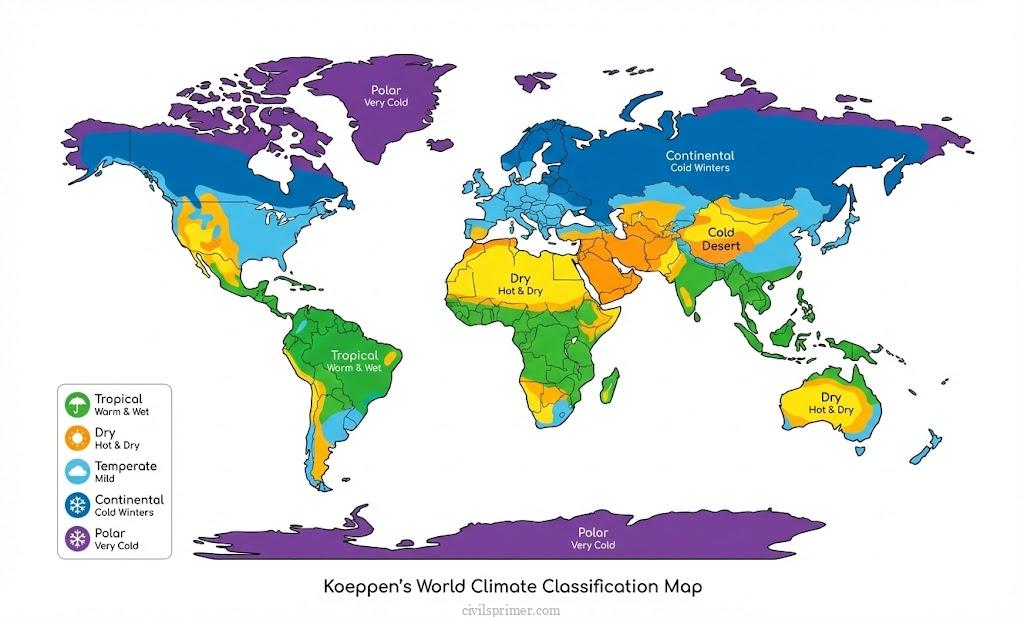
To decode the world, Koeppen gave us a “Secret Alphabet” of five major groups:
- A (Tropical): Winter is a myth here. It is hot all year (Coldest month >18 C).
- B (Dry): The thirsty lands where evaporation wins over rain.
- C (Warm Temperate): Mild winters, distinct summers. The comfort zone.
- D (Cold Snow Forest): Severe winters. Snow is a permanent guest for months.
- E (Polar): Summer never truly comes (Warmest month <10 C).
Let us pack our bags and travel through these zones, from the Equator to the Poles.
Group A: The Steam Engine of the Earth #
We begin our journey at the Equator (0°). The sun is overhead; the air is thick and heavy. This is the Tropical Humid Climate (Group A).
The Eternal Summer (Af – Tropical Wet) : Standing in the Amazon basin or the Congo, you realize there is no seasonal rhythm here. It rains almost every afternoon. This is the Af climate (f = fehlt or missing dry season).
- The Biome: This heat and moisture create the Tropical Rainforest. The trees here fight for sunlight, growing tall and forming a thick Canopy that blocks the sky.
- Life & Economy: It feels claustrophobic. The soil is often leached and poor. Historically, tribes practiced shifting cultivation here. But today, valuable hardwoods like Mahogany and Ebony are extracted. In Southeast Asia, this climate supports vast rubber plantations.

The Rhythm of the Winds (Am – Tropical Monsoon) : Moving slightly away towards India and Southeast Asia, the rain is no longer daily; it waits for the wind. This is the Am climate. Here, the “Monsoon” (seasonal reversal of wind) dictates life.
- The Biome: The forests are Tropical Deciduous. Teak and Sal trees shed their leaves during the dry season to survive.
- Life & Economy: This is one of the most densely populated regions on Earth. The rhythm of the rain sets the rhythm of agriculture—rice, tea, and jute thrive here.
The Savannah (Aw – Tropical Wet and Dry) : Further away from the Equator (towards the tropics), the rain gets lazy. It only comes in summer. This is the Aw climate, or the Savanna.
- The Biome: You are now in the land of “Parkland topography”—tall grasses scattered with short, fire-resistant trees. This is the home of the “Big Game” animals.
- Life & Economy: The soil is hard laterite. Agriculture is difficult, but cattle rearing is common, though the cattle here are often lean compared to temperate zones.
Group B: The Thirsty Lands #
Leaving the tropics, we enter the zones where the sun is fierce, but the clouds are missing. We are in the Dry Climates (Group B).
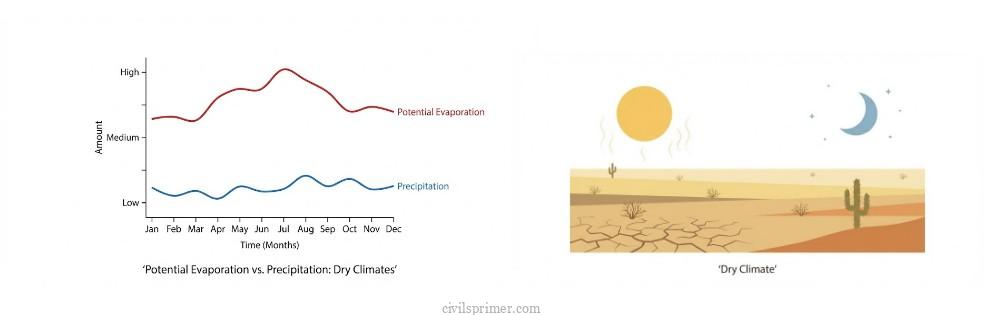
The True Desert (BWh) : Under the influence of the Sub-Tropical High-Pressure belts (latitudes 20°-30°), the air descends and warms up, drinking all moisture. This creates the Subtropical Deserts (BWh) like the Sahara or the Thar.
- The Biome: Vegetation is xerophytic—long roots, thick stems, and thorns (like Cacti) to store water.
- Life & Economy: Life clings to Oases, where date palms grow. However, the discovery of Oil (black gold) has transformed deserts like those in the Middle East from barren lands to economic hubs.
The Grassland Bridge (BS) : Between the desert and the forest lies a transition zone—the Steppe (BS). It receives just enough rain to support grass but not trees. Nomadic herding is the traditional way of life here.
Group C : The Zone of Comfort #
Moving beyond 30° latitude, we enter the Warm Temperate Climates (Group C). Here, seasonality is distinct.
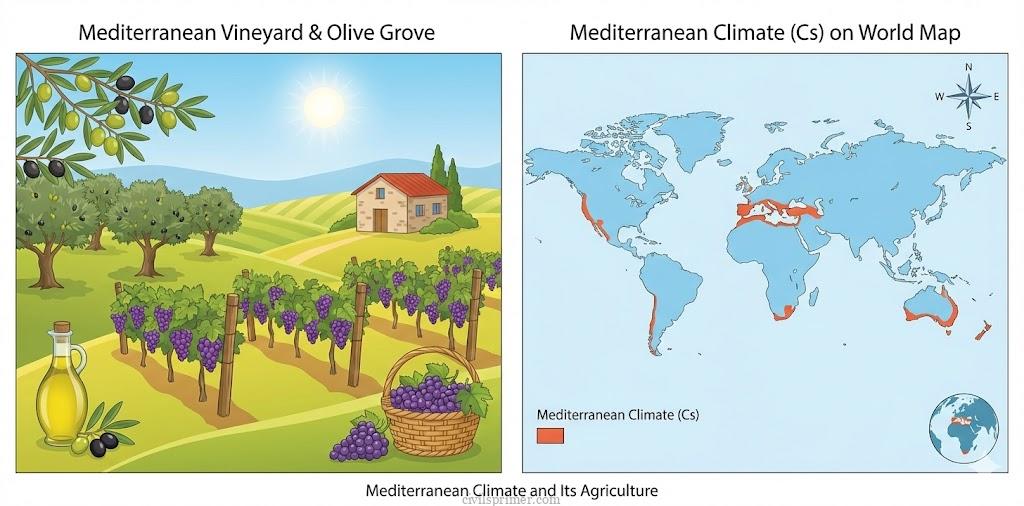
The Winter Rain Anomaly : Cs – Mediterranean – On the western margins of continents (like California, Cape Town, Central Chile, and Southern Europe), a unique phenomenon occurs. It rains in winter and is dry in summer! This is the Mediterranean Climate (Cs).
- The Biome: Trees here are stunted with thick barks (like cork oaks) to survive the hot, dry summer.
- Life & Economy: This is the world’s orchard. Citrus fruits, olives, and vineyards (viticulture) dominate the landscape. It is distinct because pastoral farming is less important due to the lack of summer grass.
Cfb – Marine West Coast : The Year-Round Drizzle – Travel further north to Northwestern Europe or New Zealand. The Westerly winds blow from the ocean all year round. The climate is mild and damp. This is the British Type (Cfb).
- Life & Economy: The grass is always green, making this the capital of Dairy Farming. In places like Tasmania and British Columbia, the timber industry (lumbering) is highly profitable due to pure stands of trees.
The Eastern Margin (Cfa/Cwa – China Type) – On the eastern side of continents, the summers are hot and wet (monsoon-like), and winters are cool. This is the China Type.
- Life & Economy: It is the “Rice Bowl” of the temperate world. Intensive agriculture supports massive populations in China and Southern Japan.
Group D: The Kingdom of Conifers #
Crossing the 40°N latitude, we enter the continental interiors of the Northern Hemisphere. The winters here are severe. This is the Cold Snow Forest Climate (Group D). Note: This group is missing in the Southern Hemisphere because there is no land at these latitudes there!
The Taiga (Df/Dw) – In Canada, Sweden, and Russia (Siberia), the winter is long and bitter.
- The Biome: This is the home of the Taiga—the endless belt of evergreen coniferous forests (Pines, Firs, Spruce). The leaves are needle-shaped to shed snow.
- Life & Economy: The soil is acidic and poor (Podzol). Agriculture is hard. Instead, the economy runs on Lumbering. The softwoods here are harvested for paper, pulp, and rayon. Fur trapping was historically significant here.

Group E : The Frozen Ends #
Finally, we reach the poles. The Polar Climate (Group E).
- Tundra (ET): The ground is permafrost (permanently frozen). Only mosses, lichens, and flowering plants grow during the very short summer.
- Ice Cap (EF): Temperatures never rise above freezing. It is a lifeless desert of ice (Greenland, Antarctica).
Our journey reveals that climate dictates the biosphere. However, this map is not static. Human interference—deforestation in the Af zones, melting glaciers in the E zones, and expanding deserts in the B zones—is rewriting Koeppen’s map. As we study these regions, we must remember that we are not just observers of this tapestry; we are active weavers, currently pulling at its fragile threads.
UPSC Mains Subjective Previous Years Questions #
• 2019 → The process of desertification does not have climate boundaries. Justify with examples.
Answer Writing Minors #
Introduction : Climate is the principal determinant of the biosphere, dictating the distribution of vegetation, soil types, and human economic activities across the globe. Vladimir Koeppen’s empirical classification, based on temperature and precipitation data, provides a structured framework to analyze these diverse climatic zones and their associated biomes, ranging from the humid Equator to the frozen poles.
Conclusion : In conclusion, while climatic regions have historically determined the natural vegetation and lifestyle patterns of human settlements, modern anthropogenic activities are increasingly altering these boundaries. Understanding the delicate equilibrium of these biomes is essential not only for economic geography but for formulating sustainable strategies to combat the pressing challenges of global climate change and desertification.
Related Latest Current Affairs #
- November 2025: AmazonFACE Experiment Launched in Tropical Rainforests Scientists launched a “climate time machine” experiment near Manaus, Brazil, to simulate future atmospheric conditions (CO2 levels of 2050). This study focuses on the Tropical Rainforest biome (Koeppen’s Af) to understand how these ecosystems and their carbon sink capacity will respond to climate change.
- October 2025: Mass Bloom in the Atacama Desert (Desierto Florido) Unusual winter rains triggered a rare mass bloom of wildflowers in Chile’s Atacama Desert, one of the world’s driest non-polar deserts. This phenomenon highlights the latent biodiversity in Hot Desert biomes (Koeppen’s BWh) and their sensitivity to precipitation anomalies.
- October 2025: Forest Declaration Assessment 2025 on Tropical Primary Forests The assessment revealed that global deforestation reached 8.1 million hectares in 2024, with Tropical Primary Forests accounting for significant loss. This highlights the critical state of Equatorial and Tropical biomes, which are essential for biodiversity and carbon storage, yet remain under severe threat from agricultural expansion.
- August 2025: Call to Recognize India’s “Open Ecosystems” (Savannas/Grasslands) Ecologists emphasized the need to recognize Open Natural Ecosystems (ONEs) like Savannas, Scrublands, and Grasslands as distinct biomes rather than “wastelands.” These ecosystems, often misclassified, support unique biodiversity like the Great Indian Bustard and support millions of pastoralists, challenging traditional forest-centric conservation views.
- August 2025: Decline of Arctic Reindeer Populations A study warned that Arctic Reindeer (Caribou) populations could decline by 80% by 2100. This highlights the fragility of the Tundra biome (Koeppen’s ET), where climate change is altering vegetation patterns (shrubification) and disrupting the delicate balance of this treeless, cold ecosystem.
- July 2025: Cold Desert Biosphere Reserve Added to UNESCO Network India’s Cold Desert Biosphere Reserve (Himachal Pradesh) was included in the UNESCO World Network of Biosphere Reserves. This site represents a unique High-Altitude Cold Desert biome, characterized by harsh sub-Arctic climatic conditions, sparse alpine vegetation, and endangered fauna like the Snow Leopard.
- July 2025: Global Wetland Outlook 2025 The Ramsar Convention released the Global Wetland Outlook, noting that 35% of the world’s wetlands have been lost since 1970. This underscores the rapid degradation of Wetland biomes (often azonal but critical), which are vanishing three times faster than forests due to agriculture and urbanization.