
Introduction: A Tale of Two Indias #
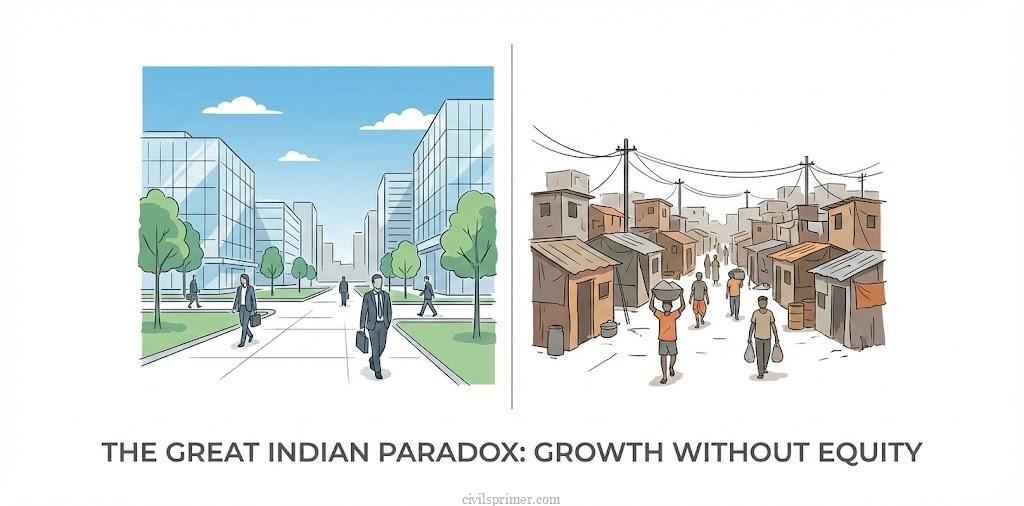
Imagine standing on a bustling street in Mumbai. On your left, a towering glass skyscraper reflects the story of one of the world’s fastest-growing economies, home to a booming billionaire class. On your right, the sprawling labyrinth of Dharavi, Asia’s largest slum, buzzes with the daily struggle for basic survival. This stark contrast forms the heart of India’s developmental paradox.
For a UPSC aspirant, understanding poverty goes far beyond memorizing income thresholds. Historically, society often fell into the trap of “naturalistic” explanations—believing people are poor because they are “afraid of work” or “suffer from low intelligence”. However, sociological analysis reveals that poverty is not a personal failure but a structural outcome. As Nobel Laureate Dr. Amartya Sen argues, poverty must be viewed through the “Capability Approach”—it is not merely an economic insufficiency, but the deprivation of basic human capabilities like literacy, longevity, and political voice.
1. The Measurement Maze: How Do We Count the Poor? #
To solve a problem, the State must first measure it. Post-independence, India’s quest to draw a “Poverty Line” has been a long evolutionary journey.
- The Calorie Era to the Holistic Era Initially, poverty estimation was based purely on calorie intake.
- Y.K. Alagh Committee (1979): Defined poverty by a daily calorie requirement (2400 kcal in rural areas, 2100 kcal in urban areas).
- Tendulkar Expert Group (2009): Realized that man does not live on bread alone. It shifted the focus from merely calorie norms to “targeted outcomes,” incorporating private expenditure on health and education.
- Rangarajan Committee (2014): Reverted to separate rural and urban baskets, factoring in protein, fat, and non-food items like transport and housing.
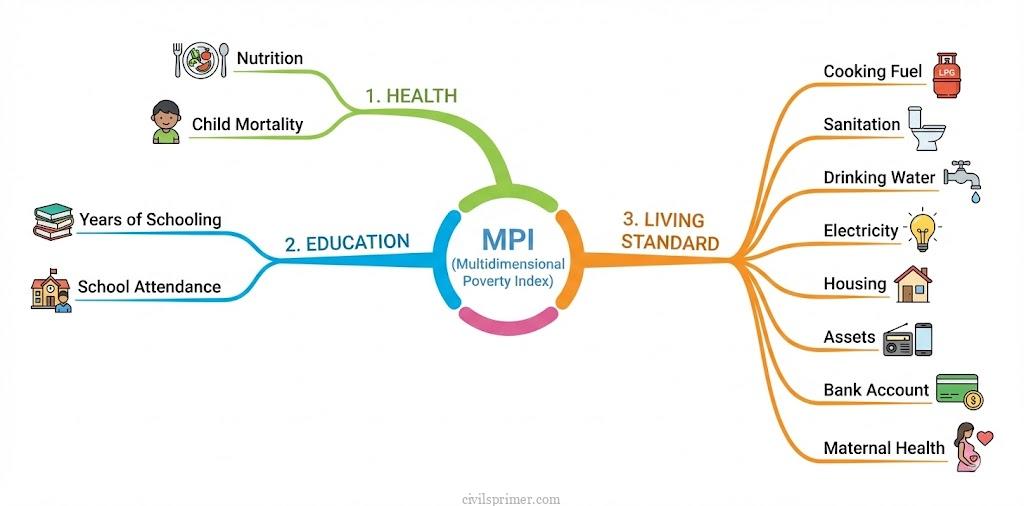
- The Paradigm Shift: Multidimensional poverty Index (MPI) Today, the definition has evolved. NITI Aayog now calculates the National Multidimensional poverty Index (MPI), recognizing that a person might have income but still lack sanitation or education. The MPI measures deprivation across three dimensions: Health, Education, and Standard of Living.
The Good News (Current Data): India has made historic strides. According to the 2023 NITI Aayog report, a staggering 24.82 crore Indians escaped Multidimensional poverty in the last nine years. The national Multidimensional poverty rate plummeted from 29.17% (2013-14) to just 11.28% (2022-23).
2. Rural vs. Urban Poverty: The Two Faces of Deprivation #
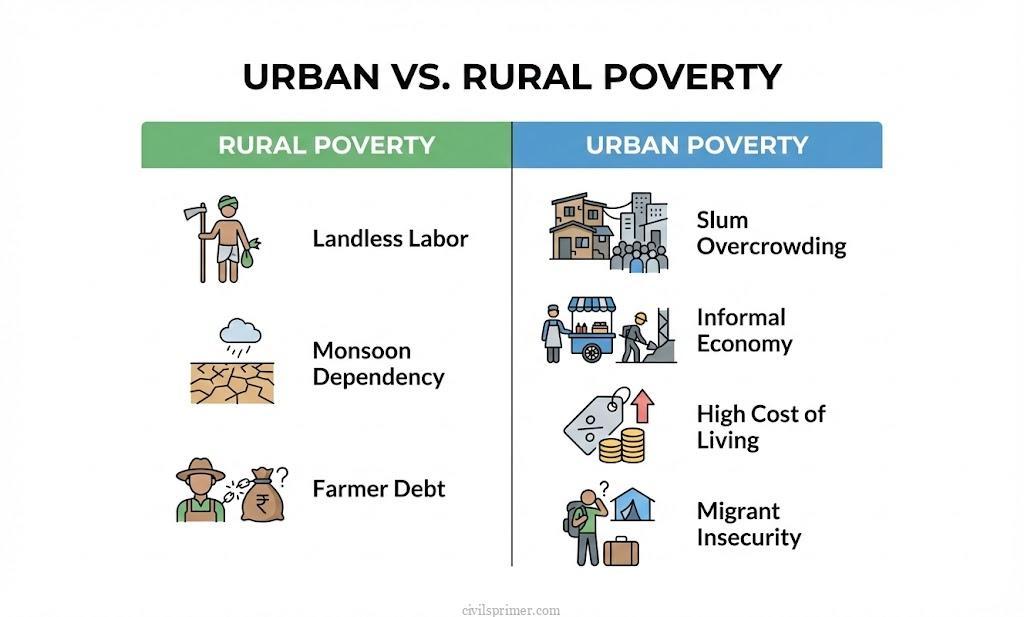
Poverty wears different masks depending on the geography. While rural poverty is declining faster (dropping to 19.28%) than urban poverty (now at 5.27%), the core characteristics of both regions present distinct challenges.
- Rural Poverty: The Agrarian Distress – In rural India, poverty is deeply tied to the land. 70% of India’s population lives in rural areas but contributes only 25% to the GDP.
- The Structural Crisis: Indian agriculture is plagued by land fragmentation, monsoon dependency, and a lack of diversification. The National Sample Survey Office indicates that most Indian farmers possess less than one hectare of land, making subsistence farming practically unviable.
- The Tragic Climax: This vulnerability has led to a severe agrarian crisis. Sociologists view farmers’ suicides not as isolated incidents but as “matrix events”—where factors like the high cost of Green Revolution inputs, market instability, and lack of safety nets coalesce into fatal distress for marginal farmers.
- Urban Poverty: The Migration of Misery – Urban poverty is largely the spillover of rural distress. When agriculture fails, landless laborers migrate to cities, leading to the “Ruralization of Poverty”.
- The Slum Reality: Migrants are pushed into exclusionary urbanization. Cities like Mumbai have up to 41% of their population living in slums. These settlements face severe insecurity of tenure and a massive infrastructure deficit.
- The Basic Amenities Crisis: Despite shining cityscapes, a 2024 survey revealed that only 6% of urban homes receive safe tap water.
- The Informal Trap: The urban poor predominantly end up in the informal sector or the Gig Economy—working as waste pickers, domestic helps, or street vendors—facing high inflation impacts and completely lacking social security.
3. Causes of Poverty: The Invisible Webs #
Why does poverty persist in a country boasting high GDP growth? Because growth does not automatically mean equity.
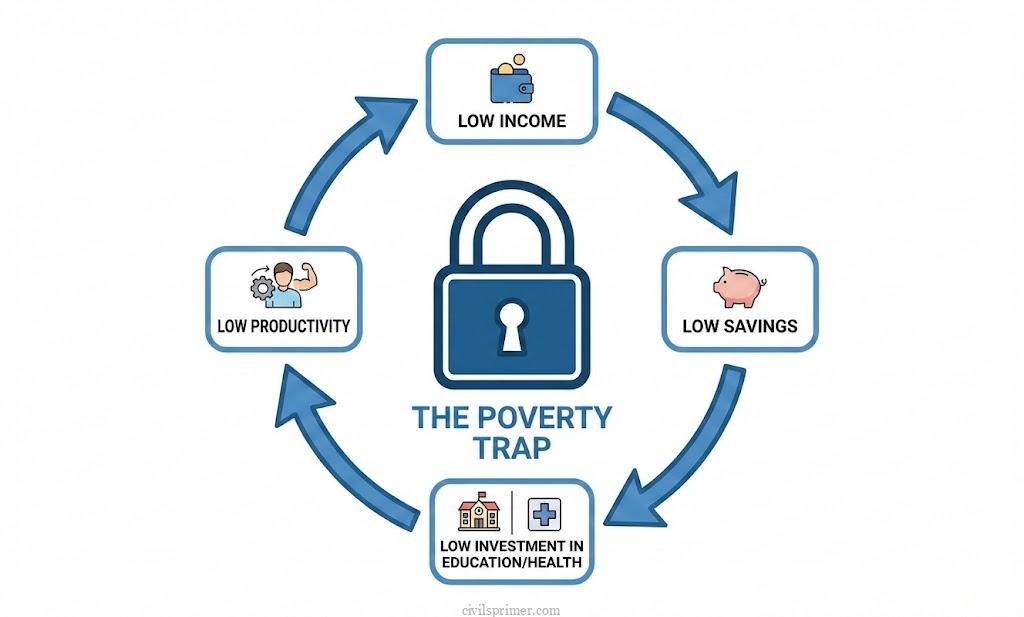
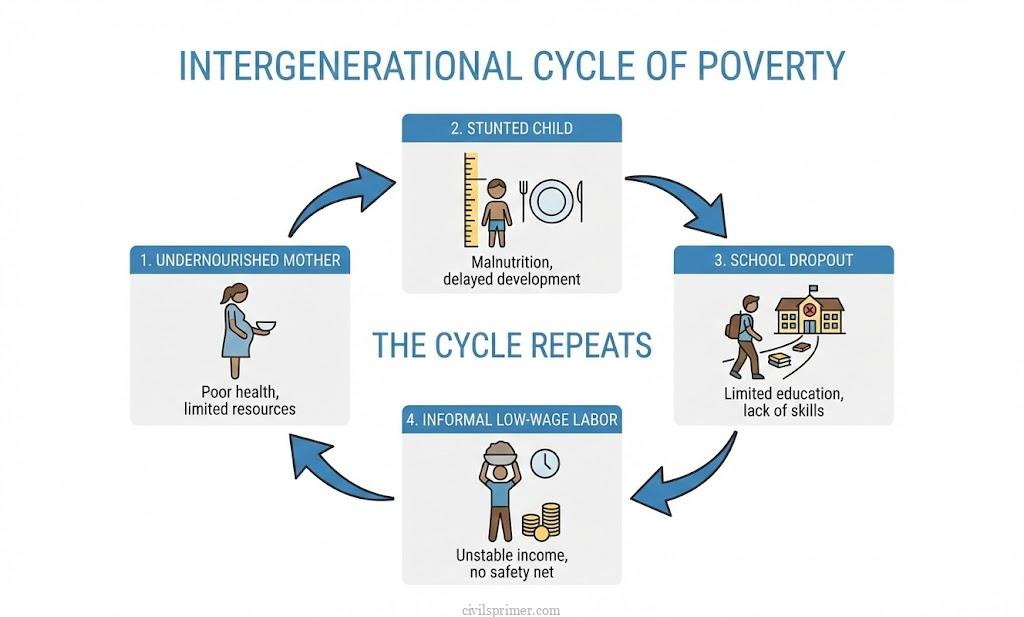
1. The Vicious Circle of Poverty Economists describe a “Poverty Trap.” Low income means families cannot save; low savings lead to low investment in health and education (low Human Capital); this results in low productivity, which circles back to low wages.
2. Extreme Inequality and “Jobless Growth” India suffers from deeply unequal distribution of resources. The World Inequality Report 2022 highlights that the top 10% of Indians hold 57% of the total national income, while the bottom 50% hold a mere 13%. Furthermore, Oxfam (2023) notes the richest 1% own more than 40% of the country’s total wealth. This signals “Jobless Growth,” where economic booms in sectors like IT do not create enough mass employment for the vast semi-skilled population.
3. Social Causes: The Burden of Identity Poverty in India is inextricably linked to social identity.
- Caste: The Multidimensional poverty ratio is highest among Scheduled Tribes (50.6%) and Scheduled Castes (33.3%), revealing how historical discrimination blocks access to modern economic mobility.
- Feminization of Poverty: Women constitute a disproportionate share of the poor. The burden of unpaid care work, lack of property rights, and early marriage severely restrict their economic independence.
4. Impacts of Poverty: The Ripple Effects #
Poverty doesn’t just empty wallets; it damages the societal fabric and future Human Capital.
1. The “Culture of Poverty” Sociologist Oscar Lewis coined the term “Culture of Poverty,” arguing that prolonged deprivation breeds a sense of marginalization, powerlessness, and hopelessness that can be passed down through generations, effectively discouraging individuals from breaking the cycle.
2. Stolen Childhoods and Lost Capital The most tragic victims are children. Poverty forces families to pull children out of school, pushing them into child labor or early marriages. Physically, it manifests as severe undernutrition. As per NFHS-5, 35.5% of children under 5 are stunted (low height-for-age) and 57% of women are anemic. This stunts cognitive development, ensuring the next generation remains locked in the poverty trap.
3. The COVID-19 Amplifier The pandemic acted as a brutal stress test for India’s poor. It accelerated class inequalities, causing catastrophic income shocks. Informal workers bore the brunt, with millions facing sudden unemployment, forcing reverse migration. It highlighted the deep digital divide, where children from poorer households were completely cut off from online education.
5. The Road to Emancipation – Developmental Interventions #
India, as a Welfare State, has launched numerous poverty alleviation programs.
- Employment: MGNREGA guarantees 100 days of rural wage employment, acting as a crucial safety net. The National Urban Livelihood Mission (NULM) focuses on self-help groups and skill development in cities.
- Food Security: The Public Distribution System (PDS) and Mid-Day Meal Scheme aim to tackle the hunger dimension of poverty.
- Financial Inclusion: Pradhan Mantri Jan Dhan Yojana (PMJDY) brought millions into the banking fold, enabling Direct Benefit Transfers (DBT) to plug leakages.
Why are there still gaps? Despite massive funding, challenges persist.
- Implementation Bottlenecks: Many programs function in silos without synergy.
- Inclusion/Exclusion Errors: Identifying the correct beneficiaries remains tough. BPL (Below Poverty Line) card systems often suffer from ghost beneficiaries while excluding genuinely destitute families.
- Output vs. Outcome: Bureaucracies often track “outputs” (e.g., money spent or schools built) rather than “outcomes” (e.g., actual improvement in learning or health).
The Way Forward To permanently eradicate poverty, interventions must shift from mere charity to genuine empowerment.
- Focus on the Bottom 30%: Instead of rigid poverty lines, track the economic progress of the most vulnerable 30% dynamically.
- Universalize Basic Services: Ensure quality healthcare and education, as out-of-pocket health expenditure is a major factor pushing families back into poverty.
- Address the Agricultural Base: Reform tenancy laws, improve irrigation, and invest in food processing to make rural economies resilient.
- Embrace Urban Realities: Urban planning must integrate the informal sector and slum redevelopment into the core of “Smart City” projects, recognizing migrants as city-makers, not burdens.
Development must be inclusive; otherwise, as the famous saying goes, “Poverty anywhere is a threat to prosperity everywhere”.
UPSC Mains Previous Year Questions (PYQs) #
- In dealing with socio-economic issues of development, what kind of collaboration between government, NGOs and private sector would be most productive? (2024, 10 Marks)
- Despite comprehensive policies for equity and social justice, underprivileged sections are not yet getting the full benefits of affirmative action envisaged by the Constitution. Comment. (2024, 15 Marks)
- Does urbanization lead to more segregation and/or marginalization of the poor in Indian metropolises? (2023, 15 Marks)
- The incidence and intensity of poverty are more important in determining poverty based on income alone. In this context analyze the latest United Nations Multidimensional poverty Index Report. (2020, 15 Marks)
- COVID-19 pandemic accelerated class inequalities and poverty in India. Comment. (2020, 10 Marks)
- ‘Despite the implementation of various programmes for the eradication of poverty by the government in India, poverty is still existing’. Explain by giving reasons. (2018, 10 Marks)
Related Latest Current Affairs #
| (October, 2025): Global Multidimensional poverty Index (MPI) 2025 Report – Released by UNDP and OPHI, the report highlights that 1.1 billion people live in acute poverty, with 83.5% of them residing in rural areas. It underscores a dangerous “climate-poverty nexus,” revealing that nearly 80% of the world’s poor are exposed to severe climate hazards like droughts and floods. |
| (October, 2025): Urban Poverty and the Need for Inclusive Development – Analyses highlighted that nearly half of India’s urban population lives in slums deprived of secure housing and basic services. Despite economic growth, a “paradox of poverty” persists in cities, where informal migrant workers are pushed into precarious, low-paying jobs and remain highly vulnerable to displacement. |
| (October, 2025): Agriculture in the Age of Inequality – Reports exposed how systemic inequalities and corporate capture are eroding India’s farm economy, causing severe rural distress. This agrarian decline is forcing a rural exodus, swelling informal labour and urban poverty belts, while simultaneously worsening child malnutrition and food insecurity. |
| (September, 2025): Restructured PM SVANidhi Scheme for Street Vendors – The government expanded the PM SVANidhi scheme beyond statutory towns to include census towns and peri-urban areas. The initiative aims to tackle urban poverty by providing Working Capital loans, promoting digital inclusion, and ensuring the holistic socio-economic development of informal street vendors. |
| (August, 2025): The Path to Ending Global Hunger and Poverty – Based on the UN FAO’s SOFI 2025 report, poverty remains the biggest driver of global hunger. While India reduced its undernourishment rate, Multidimensional poverty, weak infrastructure, and high inflation keep healthy, protein-rich diets unaffordable for the poorest populations. |
| (August, 2025): Re-evaluating Inequality Measurement (Gini Index) – Economic debates questioned the reliance on consumption-based Gini Index data to measure inequality, as it often underestimates top incomes. Experts recommended adopting the Palma Ratio and integrating income tax data to better capture wealth distribution and frame Inclusive Growth policies. |
| (July, 2025): Extreme Poverty in India Drops to 5.3% (World Bank) – The World Bank revised its global extreme poverty line to $3/day (2021 PPP). Under this new metric, India recorded a sharp decline in extreme poverty from 27.1% in 2011-12 to 5.3% in 2022-23, successfully lifting nearly 270 million people out of extreme deprivation. |
| (July, 2025): NSO Household Consumption Expenditure Surveys and Poverty – The latest NSO surveys confirmed a massive reduction in the national poverty ratio to 4.9% by 2023-24, driven by GDP growth and reduced consumption inequality. However, over 50% of the poor remain clustered just below the poverty line, leaving them highly vulnerable to falling back due to health or climate shocks. |