
Imagine the year is 1991. India’s economy is heavily guarded, television means a single channel (Doordarshan), and a trunk call to relatives abroad requires booking hours in advance. Then, the gates opened. The Liberalisation, Privatisation, and Globalisation (LPG) reforms act as a watershed moment. Suddenly, the world comes rushing in.
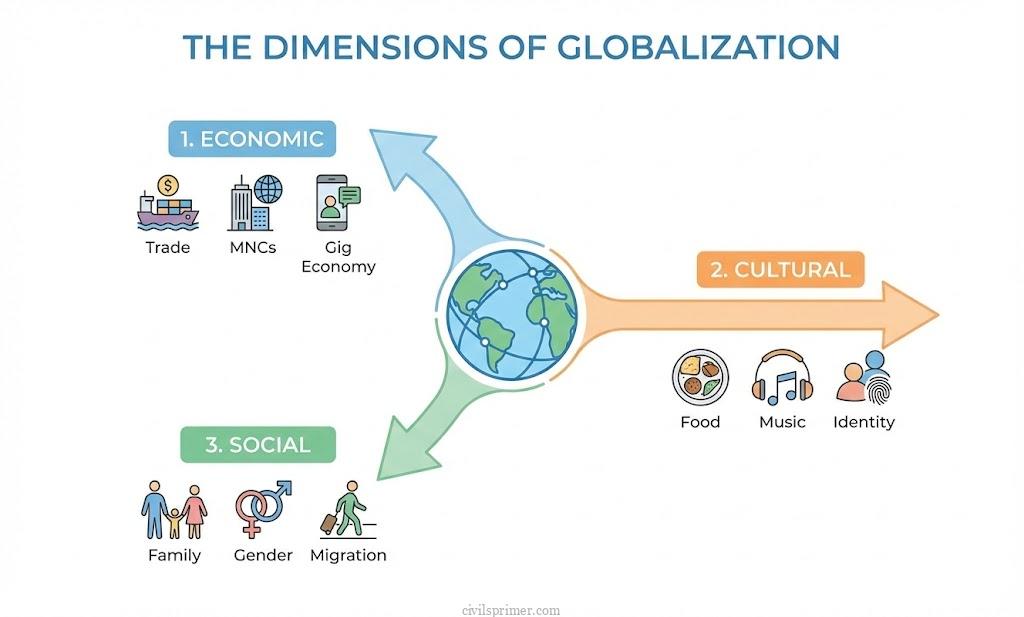
For a UPSC aspirant, understanding globalization requires looking beyond economics. Globalization is the profound “time-space compression” where the world shrinks due to rapid transport and communication, integrating economies, cultures, and societies. It is not just about foreign direct investment (which surged to a record $84 billion in 2021-22) or the fact that India’s Trade-to-GDP ratio jumped to around 45%. It is about how a young professional in Bengaluru can be a proud Kannadiga, an Indian citizen, and a global “netizen” all at once.
This is the story of how the ancient, deeply rooted “Banyan Tree” of Indian society is interacting with the unstoppable winds of the global village.
1. Homogenization vs. Glocalization #
When global forces meet local traditions, a fascinating clash occurs. Initially, sociologists feared Cultural Homogenization—the idea that the entire world would eventually adopt a uniform, Westernized monoculture. We worried that the proliferation of American fast food, Hollywood, and the English language (often called a “killer language” of local dialects) would erase Indian identity.
However, the Indian story took a different turn. Indian culture did not collapse; it adapted. This brings us to the most crucial concept for your Mains exam: Glocalization. The Magic of Glocalization and Cultural Hybridity Glocalization is the mixing of the global with the local to enhance marketability.
- The Culinary Mix: When McDonald’s entered India, it couldn’t sell beef. So, it adapted by creating the “McAloo Tikki” burger and offering Navratri-special vegetarian menus.
- The Linguistic Blend: We did not just adopt English; we created “Hinglish” (or Tanglish, Minglish), a cultural hybridity where words like jugaad or chaddis entered the global lexicon alongside English.
- The OTT Revolution: Platforms like Netflix and Amazon Prime bring Korean dramas to Indian homes, but they also take regional Malayalam and Tamil cinema to a massive global audience.
Furthermore, globalization has facilitated a “reverse cultural flow”. Yoga and Ayurveda, once localized spiritual and health practices, have been packaged into multi-billion-dollar global wellness industries, celebrated via the UN’s International Yoga Day.
2. The New Middle Class and the Culture of Consumption #
As India integrated globally, a massive shift occurred in the nature of work. Leveraging its English-speaking population, India became the “back office of the world,” capturing over 55% of the global IT-BPM outsourcing market.
This economic boom birthed the New Middle Class. Unlike the older middle class, which valued thrift and savings, this new class is defined by the “Culture of Consumption”.
- Conspicuous Consumption: Buying goods is no longer just about utility; it is about displaying social status. Malls, multiplexes, and international brand outlets have mushroomed.
- The “Big Fat Indian Wedding”: The traditional religious sacrament of marriage has increasingly transformed into a commercial spectacle. Elaborate pre-wedding shoots, destination weddings, and designer wear have overshadowed core rituals, perfectly illustrating how global consumerism alters local traditions.
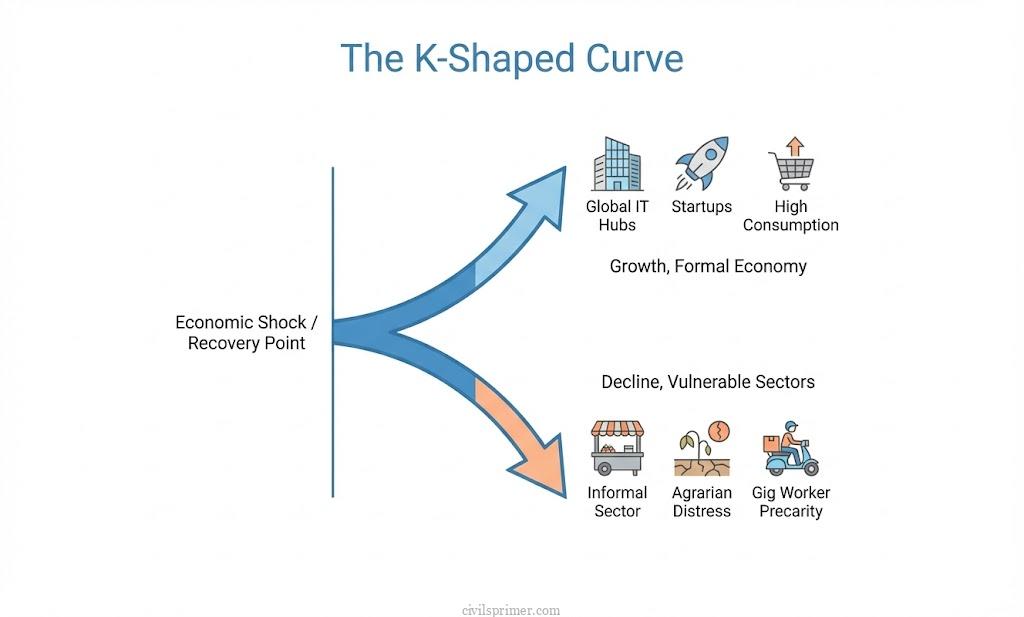
Yet, this economic story has a dark shadow. We are witnessing a “K-Shaped” impact. While formal IT workers thrive, the informal sector (comprising ~90% of the workforce) struggles with casualization and low wages. Moreover, globalization has birthed the Gig Economy (Uber, Zomato). While it offers flexibility and is projected to employ 23.5 million Indians by 2029-30, it creates deep precarity, stripping workers of traditional social security nets.
3. Changes in Family and Marriage #
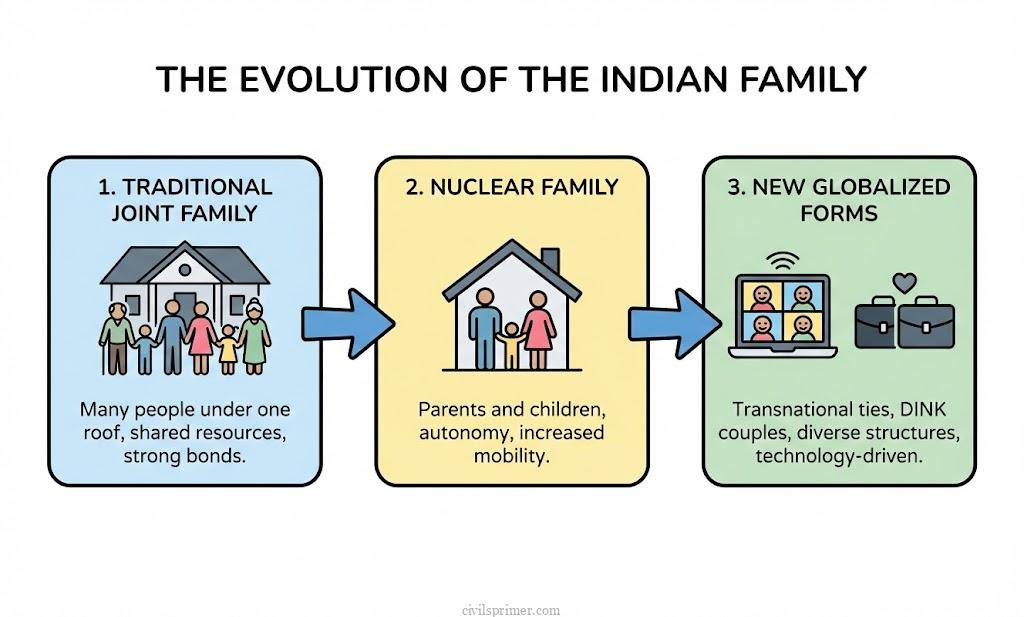
The forces of globalization, urbanization, and migration have deeply penetrated the four walls of the Indian home. The traditional multi-generational joint family is structurally giving way to the nuclear family (which now comprises roughly 50% of households). But globalization has birthed entirely new family dynamics:
1. The Transnational Family & “Skype Parents” The global demand for Indian labor has scattered families across continents. Grandparents in India often rely on ICT (Information and Communication Technology) like WhatsApp and video calls to maintain a “virtual co-presence” with their grandchildren abroad. This creates the phenomenon of “Skype Parents,” leading to emotional distance and fragmented identities for children.
2. The Rise of DINKs and Live-in Relationships Influenced by global values of individualism and high urban living costs, new family forms are emerging.
- DINKs (Double Income, No Kids): This lifestyle is growing at roughly 30% per annum in India. Couples are prioritizing career mobility and global travel over traditional child-rearing.
- Live-in Relationships: Once a taboo, cohabitation without marriage is gaining ground in urban centers, reflecting a shift from treating marriage as an indissoluble “sacrament” to viewing relationships through the lens of emotional compatibility and personal autonomy.
3. The Digital Socialization Crisis With parents working demanding global-economy jobs, primary socialization is suffering. Grandparents telling traditional tales are being replaced by digital screens. With Indian internet users spending over 2.5 hours daily on social media, children face issues of reduced attention spans and “Cognitive Outsourcing” (relying on Google rather than human memory).
4. The Generational Divide – Youth, Women, and the Elderly #
Globalization acts as a double-edged sword, slicing through different demographic groups in highly unequal ways.
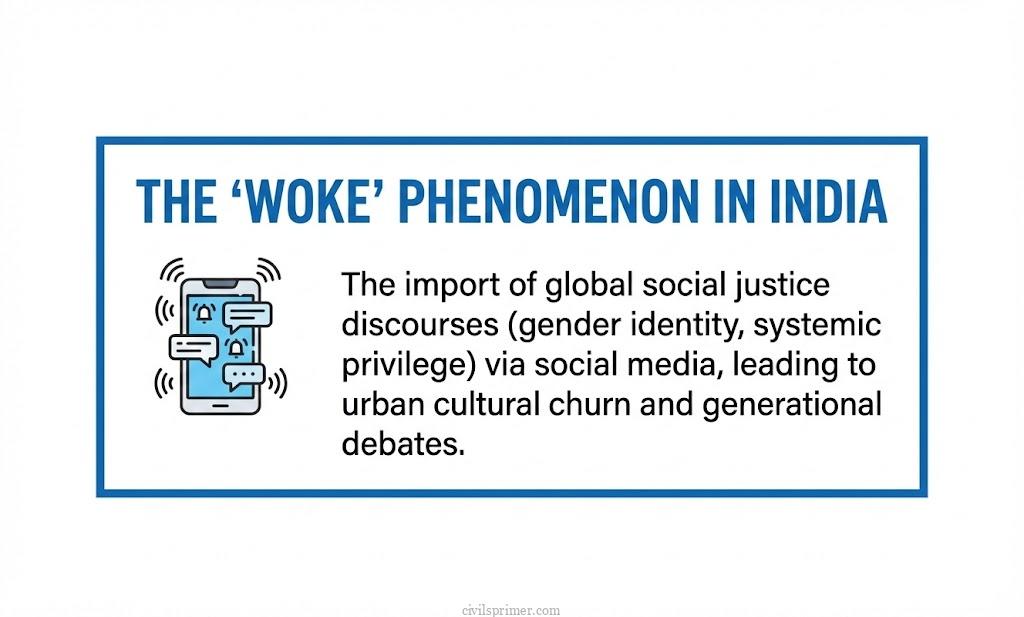
The Youth: A Cosmopolitan Reality and The “Kota Factory” The youth are the primary carriers of globalization. They enjoy unprecedented access to global education and internet connectivity (with India expected to hit 900 million internet users by 2025). However, this also brings immense pressure. The globalization-fueled aspiration to secure elite global jobs creates severe stress, famously encapsulated in the “Kota Factory” phenomenon, leading to alarming mental health crises and student suicides. Furthermore, global social media has introduced the “Woke” phenomenon to India. Western discourses on gender fluidity, pronouns, and systemic privilege are sparking intense “culture wars” in urban India, leading to a massive generational gap in understanding social justice.
Women: Empowerment Meets Precarity For women, globalization has opened doors. BPOs, IT, and export manufacturing have provided economic independence and delayed the age of marriage for millions of young women migrating to urban hubs. Conversely, globalization has led to the “feminization of agriculture” as men migrate for urban jobs. In the digital sphere, the deep gender divide (only 31% of women own mobile phones compared to 61% of men) limits their access to the global economy and exposes them to Tech-Facilitated Gender-Based Violence (TFGBV) like cyberstalking.
The Elderly: The Care Crisis As youth migrate globally and families nuclearize, the elderly are left behind. Despite economic remittances providing financial security, thousands of elderly citizens in states like Kerala face profound emotional loneliness, neglect, and a massive deficit in physical geriatric care.
Conclusion: Navigating the Global Tides #
The story of globalization in India is not a simple narrative of losing our identity. It is a story of continuous negotiation. Indian society has demonstrated an incredible capacity for Cultural Resilience. We eat global fast food, but we flavor it with local spices; we work for multinational corporations, but we use the wealth to celebrate regional festivals with unprecedented grandeur.
However, the socio-economic Fault lines cannot be ignored. The rise of a hyper-consumerist middle class sits uncomfortably alongside the struggles of informal gig workers and the emotional isolation of the elderly. For a future civil servant, the challenge lies in leveraging “Globalization 4.0” (AI, data, and digital economies) to eradicate poverty while implementing robust social safety nets to preserve the empathetic, communal soul of the Indian Banyan tree.
UPSC Mains Previous Year Questions (PYQs) #
- Do you think that globalization results in only an aggressive consumer culture? Justify your answer. (2025, 10 Marks)
- How do you account for the growing fast food industries given that there are increased health concerns in modern society? Illustrate your answer with the Indian experience. (2025, 15 Marks)
- Globalization has increased urban migration by skilled, young, unmarried women from various classes. How has this trend impacted upon their personal freedom and relationship with family? (2024, 15 Marks)
- Elucidate the relationship between globalization and new technology in a world of scarce resources, with special reference to India. (2022, 15 Marks)
- What is Cryptocurrency? How does it affect global society? Has it been affecting Indian society as well? (2021, 15 Marks)
- Is diversity and pluralism in India under threat due to globalization? Justify your answer. (2020, 15 Marks)
Related Latest Current Affairs #
| (December, 2025): India’s Diet Paradox and the Rise of Processed Foods – Reports highlighted a major dietary shift in India from traditional home-cooked meals to ultra-processed foods. This reflects the globalization of food markets and changing urban lifestyles, where processed foods have become daily necessities due to time poverty. |
| (October, 2025): Globalisation, Consumerism, and “McDonaldization” – Debates surfaced on how globalization promotes uniform consumption patterns, linking buying to happiness and identity. Transnational media and massive advertising industries play a critical role in creating “false needs” and accelerating an aggressive consumer culture in India. |
| (October, 2025): Dopamine Overdose — Modern Lifestyles Rewiring Brains – Mental health experts warned of a “Dopamine overdose” epidemic driven by social media and digital hyper-stimulation. This reflects the deep socio-cultural impact of globalized tech platforms, which are causing rising anxiety, depression, and attention disorders among Indian youth. |
| (September, 2025): Loneliness & India’s Working Young – A rising “corporate disease” of loneliness was identified among India’s working youth (25–35 years). Driven by rapid urbanization and modern, westernized work cultures, this trend is eroding traditional community networks and fundamentally altering kinship and family structures. |
| (May, 2025): The Debate on Modernisation vs. Westernisation – Public discourse emphasized the need to embrace modernization while resisting blind Westernisation to preserve India’s cultural identity. The adoption of Western lifestyles has led to the weakening of joint family structures, traditional festivals, and a clash between Western individualism and Indian collectivism. |
| (May, 2025): Social Media Defining Self-Worth – Triggered by the tragic suicide of a young entrepreneur due to a drop in followers, urgent conversations began around how global social media platforms are reshaping Indian identities. Online spaces have become a dangerous mirror of self-worth, highlighting the psychological costs of a digitally globalized society. |
| (February, 2025): Debates on the Regulation of Live-In Relationships – The push to legally mandate the registration of live-in relationships sparked debates over state interference and individual privacy. This highlights the ongoing socio-cultural evolution and the clash between modern, western-influenced relationship norms and traditional Indian family values. |