
On November 25, 1949, Dr. B.R. Ambedkar stood before the Constituent Assembly and delivered a stark warning: “On the 26th of January 1950, we are going to enter into a life of contradictions. In politics we will have equality and in social and economic life we will have inequality.”
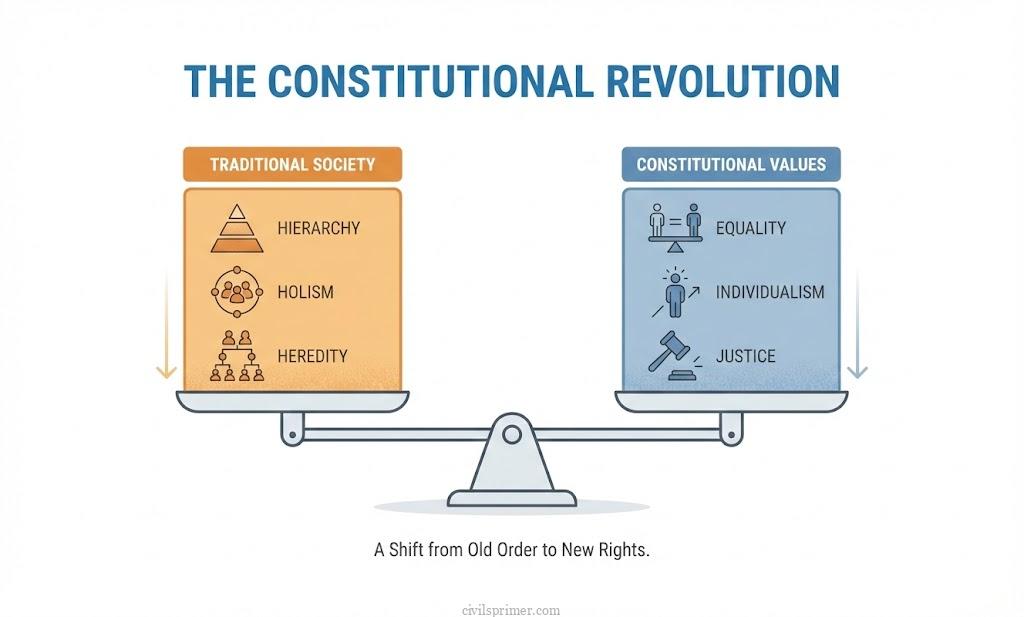
For centuries, traditional Indian society was built on the principle of Hierarchy—where your birth determined your worth, occupation, and rights. The Indian Constitution was not just a legal rulebook; it was a manifesto for a massive “Social Revolution”. It sought to replace this hierarchy with the modern values of liberty, equality, and fraternity.
For your UPSC preparation, understand that Social Empowerment is not about charity. It is about creating an environment where historically marginalized groups—Scheduled Castes (SCs), Scheduled Tribes (STs), Other Backward Classes (OBCs), Minorities, and Persons with Disabilities (PwDs)—gain the power to control their own lives, access resources, and participate fully in society.
1. Breaking the Chains – SCs, OBCs, and the Fight Against Caste #
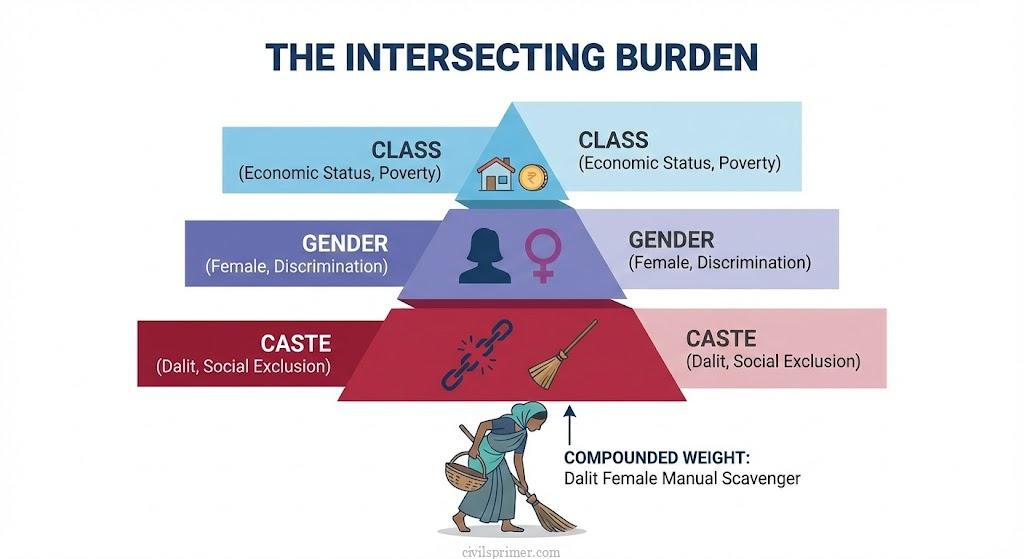
The caste system is India’s deepest Fault line. While the rigid theoretical structure of the four-fold Varna system existed in texts, the lived reality is the Jati—thousands of closed communities. Historically, SCs and OBCs faced severe social exclusion and economic deprivation.
1. The Constitutional Shield
- To right these historical wrongs, the state employed Affirmative Action.
- Article 14 & 15: Guarantee equality before the law and prohibit discrimination based on religion, race, caste, sex, or place of birth.
- Article 17: Abolished the practice of “untouchability,” making it a punishable offense. This was a direct attack on the core of caste-based purity and pollution.
- Reservations: Articles 15(4) and 16(4) paved the way for reservations in educational institutions and public employment, a structural intervention designed to promote upward social mobility.
2. The Contemporary Reality and Current Affairs – Despite progress, the shadow of caste remains long.
- Wealth & Poverty: There is a stark correlation between caste and marginality. According to the NITI Aayog Multidimensional poverty Index (MPI), the poverty ratio is highest among STs (50.6%), followed closely by SCs (33.3%) and OBCs (27.2%), compared to just 15.6% for ‘Others’. Furthermore, India’s top 10% own 77% of the national wealth, heavily skewed towards upper castes.
- Violence: Assertion of rights by Dalits often meets with violent backlash. NCRB 2022 data shows over 67,000 cases were registered under the SC/ST (Prevention of Atrocities) Act.
- The OBC Sub-Categorization Debate: A major current affairs topic is the Justice Rohini Commission, established under Article 340. Its mandate was to look into the sub-categorization of OBCs. It found a glaring inequality: 97% of all jobs and educational seats reserved for OBCs went to just 25% of the sub-castes, while 983 OBC communities had almost zero representation. Sub-categorization aims to ensure that the benefits of empowerment reach the most marginalized within the backward classes.
2. Jal, Jangal, Zameen – The Tribal Story (STs) #
India has over 700 distinct ethnic groups notified as Scheduled Tribes, comprising 8.6% of the population (2011 Census). Unlike caste, tribal identity is rooted in geographical isolation, a distinct culture, and a close symbiotic relationship with nature.
1. The Tragedy of “Development” – For tribes, “development” has often meant displacement. STs constitute around 8.6% of the population but make up over 50% of people displaced by dams, mining, and infrastructure projects. They lost their traditional rights over Jal, Jangal, Zameen (Water, Forest, Land), pushing them into poverty and bonded labor.
2. Legal Mechanisms for Tribal Empowerment – To protect indigenous populations, the Constitution and Parliament created specific shields:
- Fifth and Sixth Schedules: Create special administrative frameworks for tribal-majority areas to protect their land and autonomy.
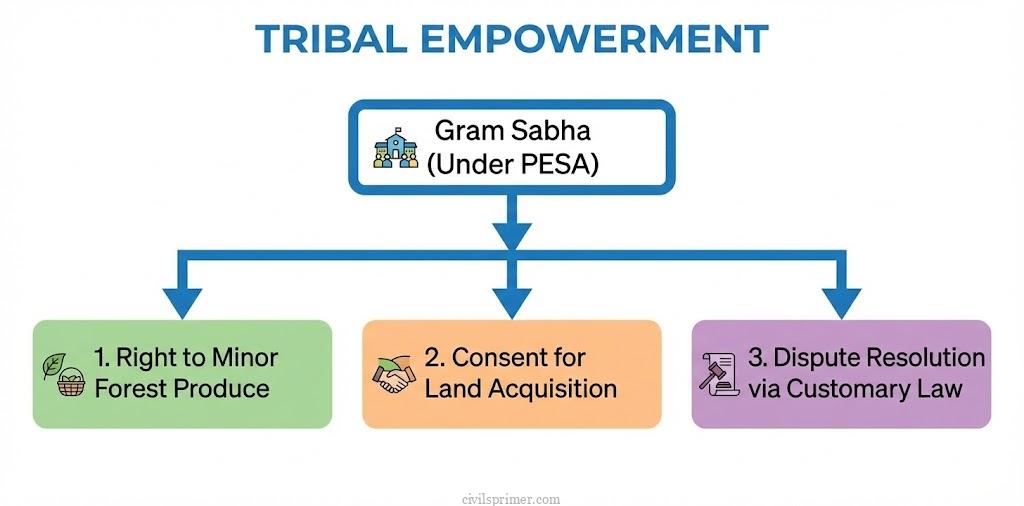
- PESA Act, 1996: The Panchayats (Extension to Scheduled Areas) Act is revolutionary. It makes the Gram Sabha (village assembly) the absolute authority. Under PESA, the Gram Sabha has ownership over minor forest produce, power to prevent land alienation, and the right to be consulted before any land acquisition.
- Forest Rights Act (FRA), 2006: A landmark law that seeks to correct historical injustices by recognizing the rights of forest-dwelling communities to land and other resources, which were previously denied by colonial forest policies.
- PVTGs (Particularly Vulnerable Tribal Groups): Within STs, 75 groups (highest in Odisha) are identified as PVTGs due to their pre-agricultural tech, stagnant populations, and extreme backwardness. They require highly specialized, non-intrusive welfare schemes.
3. The Tapestry of Pluralism – Empowering Minorities #
India is a multi-religious and multi-linguistic society. Muslims, Christians, Sikhs, Buddhists, Parsis, and Jains constitute the religious minorities. True empowerment in a diverse society means moving beyond mere tolerance to Pluralism—a positive appreciation of diversity where minority groups can preserve their distinct identities.
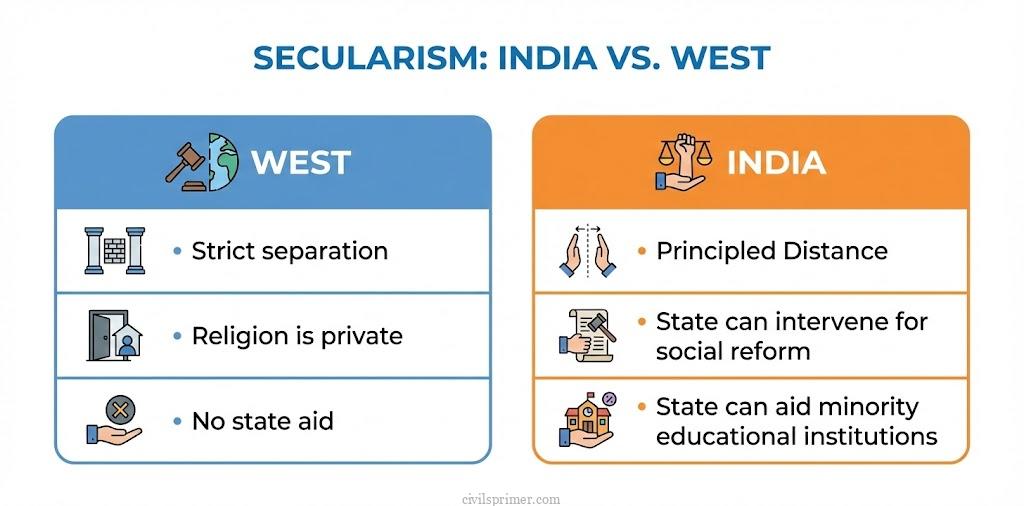
1. The Constitutional Safeguards – Indian Secularism is unique. It is not a strict wall separating state and religion (like in the West), but a concept of “Principled Distance.” The state respects all religions but intervenes to protect fundamental rights (e.g., banning Triple Talaq).
- Article 29: Protects the right of any section of citizens to conserve their distinct language, script, or culture.
- Article 30: Grants all religious and linguistic minorities the right to establish and administer educational institutions of their choice, ensuring their cultural survival.
Note for Prelims/Mains: The Supreme Court ruled in the TMA Pai case that the unit to determine a linguistic or religious minority is the State, not the whole of India.
2. The Socio-Economic Reality
While cultural rights are protected, socio-economic marginalization remains a challenge. Reports like the Sachar Committee highlighted the educational and economic backwardness of certain minority communities, particularly Muslims, leading to targeted government interventions like scholarships and the Nai Roshni scheme for leadership development among minority women.
4. From Charity to Rights – Persons with Disabilities (PwDs) #
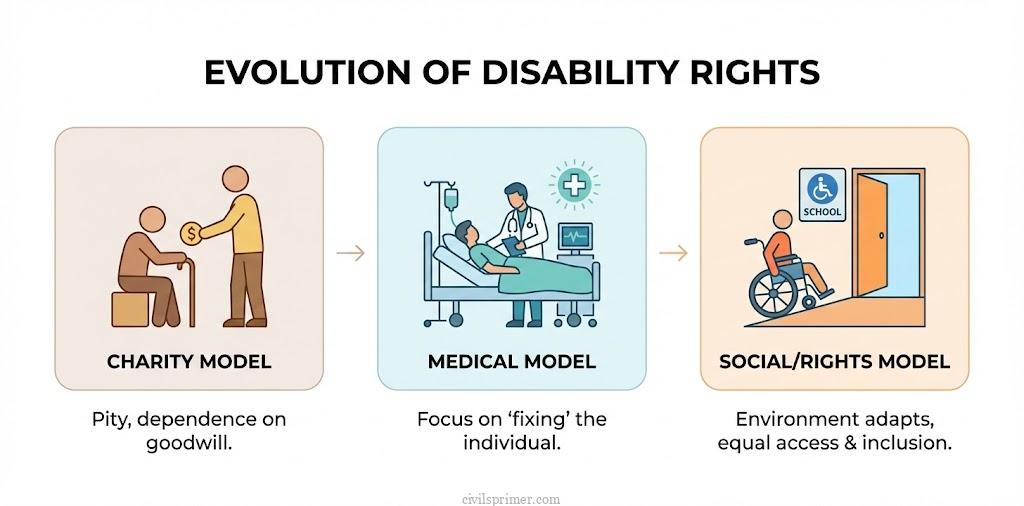
Historically, persons with disabilities (comprising roughly 4-8% of India’s population) were viewed through a “medical” or “charity” model. They were kept hidden away, denied property rights, locked out of education, and viewed purely as dependents suffering from “karma” or “illness”. The new paradigm views disability through a “Rights-based” or “Social” model—recognizing that an individual is disabled not merely by their physical or mental condition, but by a society that builds stairs instead of ramps, and stereotypes instead of inclusive policies.
1. The Paradigm Shift: RPwD Act, 2016 – The Rights of Persons with Disabilities (RPwD) Act, 2016 is the cornerstone of their empowerment, aligned with the UN Convention on the Rights of Persons with Disabilities.
- Expanded Scope: It expanded the list of recognized disabilities from 7 to 21, including intellectual disabilities, acid attack victims, and specific learning disabilities.
- Reservations: It increased the quantum of reservation for people with benchmark disabilities in government jobs from 3% to not less than 4%, and in higher education to not less than 5%.
- Right to Free Education: Every child with a benchmark disability between 6 and 18 years has the right to free education in an inclusive environment.
2. Current Initiatives and Challenges
- Accessible India Campaign (Sugamya Bharat Abhiyan): A flagship campaign to ensure universal accessibility in public buildings, transport, and websites.
- The Hurdles: Despite progressive laws, implementation is weak. Public spaces remain largely inaccessible. Furthermore, intersectionality makes it worse; a woman with a disability faces a double burden—denied education because of her gender and restricted mobility because of the threat of violence and lack of safe transport.
Conclusion: The Journey from De Jure to De Facto #
India has established a robust de jure (in law) framework for social empowerment through its Constitution, laws like the RPwD Act, PESA, and reservations. However, the De Facto (in reality) empowerment remains elusive for millions.
As the World Bank notes, human development policies often fail if they lack synergy. True social empowerment will not be achieved merely by opening bank accounts (PMJDY) or building toilets (Swachh Bharat); it requires the eradication of “obscurantism” (resistance to reason) and deep-seated prejudices. It requires transforming our institutions so that a tribal youth from Jharkhand, a Dalit woman in Uttar Pradesh, and a visually impaired student in Delhi can all access the same horizons of opportunity as anyone else. Only then will Ambedkar’s dream of an India free from social contradictions be truly realized.
UPSC Mains Previous Year Questions (PYQs) #
- Despite comprehensive policies for equity and social justice, underprivileged sections are not yet getting the full benefits of affirmative action envisaged by the Constitution. Comment. (2024, 15 Marks)
- Given the diversities among tribal communities in India, in which specific context should they be considered as a single category? (2022, 10 Marks)
- Examine the uniqueness of tribal knowledge systems when compared with mainstream knowledge and cultural systems. (2021, 10 Marks)
- Whether National Commission for Scheduled Castes (NCSCJ) can enforce the implementation of constitutional reservation for the Scheduled Castes in the religious minority institutions? Examine. (2018, 15 Marks)
- Does the Rights of Persons with Disabilities Act, 2016 ensure effective mechanism for empowerment and inclusion of the intended beneficiaries in the society? Discuss. (2017, 15 Marks)
Related Latest Current Affairs #
- (November, 2025): Welfare Reforms for Transgender Rights – Discussions around the implementation of the Transgender Persons (Protection of Rights) Act, 2019, and the SMILE scheme highlighted ongoing efforts to provide legal identity, gender-affirming healthcare, and employment quotas to the transgender community, ensuring their fundamental right to live with dignity under Article 21.
- (October, 2025): SC Upholds Equal Inheritance Rights for Tribal Women – In the landmark Ramcharan vs Sukhram case, the Supreme Court ruled that Gond tribal women have the right to inherit ancestral property. This judgment supplements statutory lacunae with equity, marking a massive step toward gender justice for Scheduled Tribes.
- (October, 2025): Strict Enforcement of Anticipatory Bail Bar under SC/ST Act – The Supreme Court quashed a Bombay High Court order that had granted anticipatory bail to an accused in a caste atrocity case. The ruling strongly reaffirmed the absolute statutory bar on anticipatory bail under Section 18 of the SC/ST (Prevention of Atrocities) Act, 1989.
- (October, 2025): Separate Census Enumeration for PVTGs – The Ministry of Tribal Affairs requested the Census Commissioner to conduct a separate enumeration of the 75 Particularly Vulnerable Tribal Groups (PVTGs) in the upcoming Census. This distinct categorization aims to plug data gaps and improve the targeted delivery of constitutional safeguards and socioeconomic welfare.
- (October, 2025): Sickle Cell Anaemia and Disability Justice – The government implemented revised guidelines under the Rights of Persons with Disabilities (RPwD) Act, 2016, to properly assess the disability extent of individuals suffering from Sickle Cell Anaemia. This legal clarification aims to end their exclusion and help them access the mandated 4% public employment and 5% educational reservations.
- (September, 2025): SC Examines ‘Creamy Layer’ for SC/ST Reservations – The Supreme Court issued a notice regarding a petition to introduce a ‘creamy layer’ criterion for SCs and STs, similar to the existing OBC framework. This has reignited legal debates on sub-categorization and ensuring that affirmative action and reservation benefits reach the most disadvantaged sub-castes.
- (September, 2025): Launch of ‘Adi Vaani’ for Tribal Linguistic Inclusion – An AI-based language translation tool named Adi Vaani was launched to serve as a foundational model for tribal languages. The initiative functions as a digital empowerment tool to preserve indigenous culture, bridge the digital divide, and improve governance accessibility for ST communities.
- (August, 2025): Creamy Layer Equivalence in OBC Quota – The Centre deliberated on establishing “equivalence” in evaluating the creamy layer status for Other Backward Classes (OBC) across central and state institutions, PSUs, and aided bodies. This administrative reform seeks to remove arbitrary exclusions and bring fairness and uniformity to reservation benefits.