
The View from Space Imagine you are an astronaut floating in the vast, dark emptiness of the cosmos. As you look down at Earth, you are struck by a dominant, brilliant hue: blue. Our home is affectionately called the ‘Blue Planet’ because more than 71 per cent of its surface is covered with water. It appears as though we have an infinite, inexhaustible supply of this life-giving liquid. Water is, after all, a rare commodity in our solar system; it does not exist on the sun or anywhere else in our planetary neighbourhood in such abundance.
However, as a UPSC aspirant, you must learn to look past the illusions of nature. This story is about the greatest magic trick our planet plays on us. It is a story of how water moves, how it is hidden, and why a planet covered in water is currently facing a thirst crisis of unprecedented proportions.
1. The Birth of the Hydrosphere #
To understand water, we must travel back in time to the Hadean Eon (4,540 – 4,000 million years ago). During this time, the Earth was an extremely hot, molten rock. Through a process called volcanic outgassing, the hot interior of the Earth released various gases, including water vapour, to form the primordial atmosphere,.
As the Earth slowly cooled, a solid crust was formed. The atmospheric water vapour began to condense. Because the Earth’s atmosphere was heavily loaded with carbon dioxide, the temperature dropped further, causing massive, continuous rainstorms. This rainwater filled the massive depressions on the newly solidified crust, merging to form the mighty oceans,. This incredible event happened within 500 million years of the Earth’s formation, meaning our oceans are incredibly ancient.
Since that time, water has neither been added nor subtracted from the Earth; its total volume remains entirely constant.
2. The Hydrological Cycle – The Ultimate Recycler #
If the total amount of water on Earth is constant, how do rivers keep flowing, and why does it keep raining? The answer lies in nature’s ultimate recycling mechanism: the Hydrological Cycle.
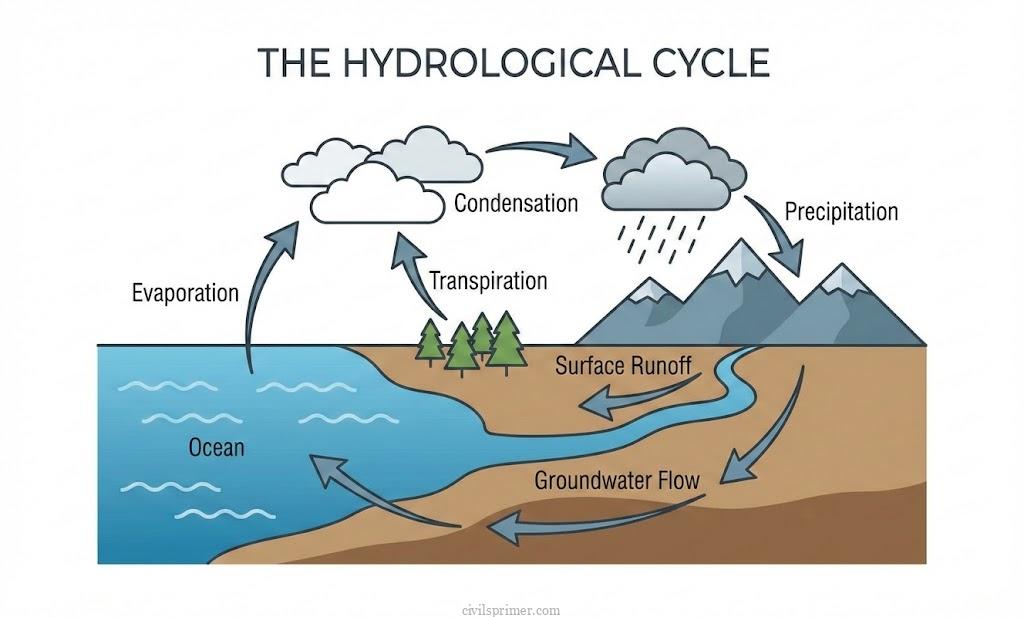
The hydrological cycle has been working for billions of years, and all life on Earth depends entirely upon it. It is the continuous circulation and exchange of water within the Earth’s hydrosphere—between the atmosphere, the oceans, the land surface, the subsurface, and living organisms,.
Here is how the journey works:
1. Evaporation & Transpiration: Driven by heating from solar energy, water from the oceans, lakes, and rivers transforms from a liquid into a gaseous state (water vapour),. The oceans contribute 84% of the annual total evaporation, while continents contribute 16%. Simultaneously, plants release moisture into the air through transpiration.
2. Condensation: As warm, moisture-laden air rises into the atmosphere, it cools. The water vapour condenses to form clouds,.
3. Precipitation: When the clouds reach saturation and can no longer hold the moisture, water falls back to the Earth as rain, snow, or hail,.
4. Runoff & Infiltration: The water that falls on land either flows over the surface as runoff into streams and rivers or infiltrates into the ground to become subsurface groundwater,. Eventually, this water finds its way back to the oceans, and the cycle begins anew.
3. Distribution of Water – The Grand Illusion #
Now we reach the crux of the illusion. While we have massive amounts of water, it is notoriously poorly distributed. The distribution of water on Earth is quite uneven, both spatially and temporally,.
Let us break down the global water vault:
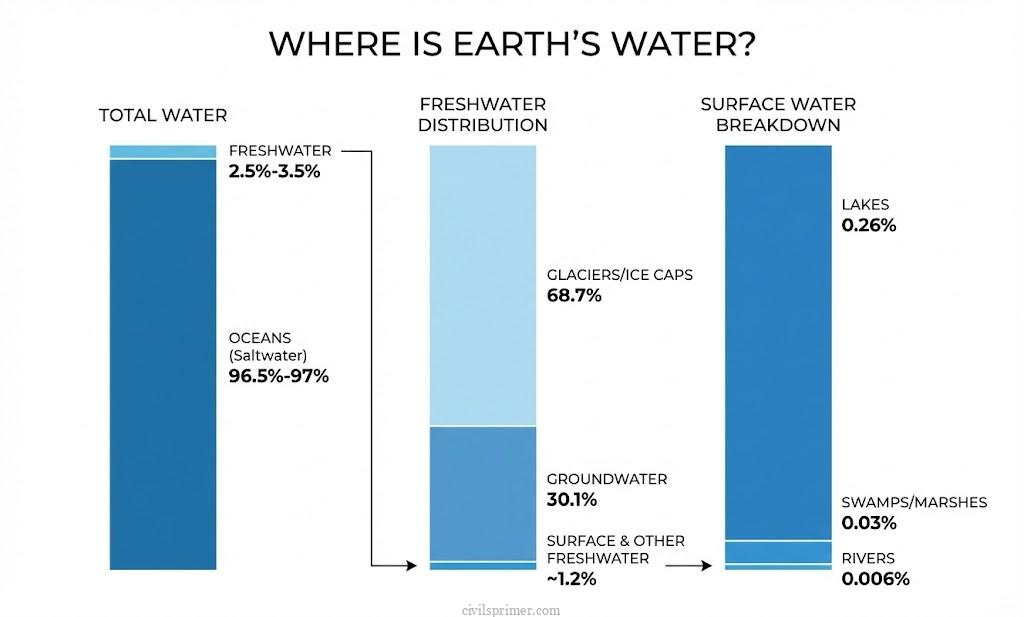
- The Salty Giants (97.25%): More than 97% of the Earth’s water is held in the oceans,. Because of its high salinity, it is completely unfit for human consumption or agriculture,.
- The Frozen Reserves (2.05%): Out of the remaining minuscule fraction of freshwater (about 2.5% to 2.75%), nearly 70% is locked away as ice sheets and glaciers in Antarctica, Greenland, and high mountain regions,,. Due to their remote locations, they are inaccessible to humans.
- The Hidden Treasure (0.68%): Roughly 30% of global freshwater is stored underground as groundwater in aquifers.
- The Accessible Drop (Less than 1%): Surface water—the water in rivers, lakes, and soil moisture that humanity relies on for survival—makes up less than 1% of the total water on Earth.
To put it in perspective: If all the world’s water were shrunk down to a 1-litre bottle, the usable freshwater would be less than a single drop. Fresh water is, therefore, the most precious substance on Earth.
4. Water-Demographics & Current Affairs #
Let us bring the story home to India. India is geographically blessed with mighty perennial rivers like the Ganga and Brahmaputra, yet it is currently staring down the barrel of an unprecedented water crisis. Why?
The Demographic Mismatch: India is home to roughly 17% of the world’s total population. However, the country receives only 4% of the global precipitation. Consequently, India ranks a dismal 133rd in the world in terms of water availability per person per annum. The total renewable water resources of India are estimated at only 1,897 sq km per annum.
The Falkenmark Index & Water Stress: To understand the severity, we use the Falkenmark Index, developed by a Swedish expert. According to this index:
- Water Stress occurs when annual water availability per person falls below 1,700 cubic metres.
- Water Scarcity happens when it falls below 1,000 cubic metres,.
- Absolute Scarcity is when it dips below 500 cubic metres.
In 1951, the water availability per person in India was a comfortable 5,177 cubic metres. By 2011, it plummeted to 1,545 cubic metres, pushing India into the “Water Stress” category. By 2030, it is projected to fall further to 1,300 cubic metres. It is predicted that by 2025, large parts of India will join regions having absolute water scarcity.
The Crisis of “Day Zero”: We are witnessing a phenomenon known as “Day Zero”—the dreaded day when a city’s taps completely dry out, and citizens must stand in lines for a daily ration of water. While this gained global infamy in Cape Town (South Africa) between 2016 and 2018, it has arrived in India. Chennai, one of India’s major megacities, recently faced an acute, unprecedented water shortage, representing a domestic Day Zero.
According to a stark report titled “Composite Water Management Index (CWMI)” released by NITI Aayog in 2018:
- India is experiencing the worst water crisis in its history.
- Almost 600 million Indians (nearly half the population) face high to extreme water stress,.
- 21 major cities, including Delhi, Bengaluru, and Hyderabad, are racing toward running out of groundwater entirely,.
- With 70% of its water being contaminated, India ranks 120th out of 122 nations in terms of water quality.
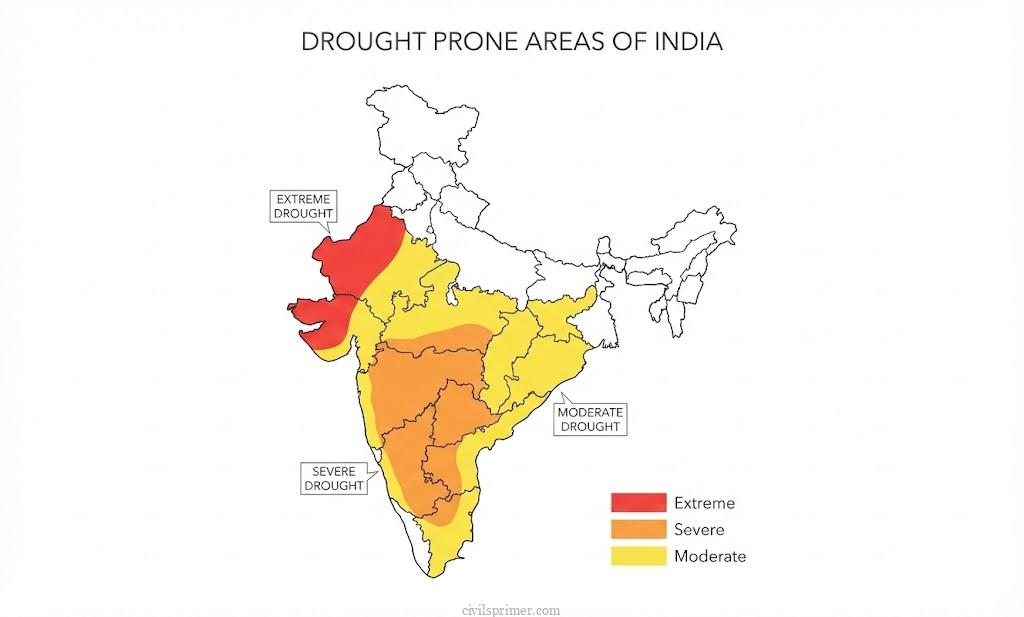
The Groundwater Tragedy: Our rivers carry huge volumes of water, but it is unevenly distributed in time and space. Because India’s rainfall is highly cyclical (75% of rainfall happens during the short monsoon window), agriculture relies heavily on irrigation,. To fuel the Green Revolution, India resorted to the massive exploitation of groundwater using tube wells.
Today, India is the largest extractor of groundwater in the world, accounting for a massive 25% of the global total,. Over the past forty years, nearly 85% of our groundwater has been utilized. According to the Central Ground Water Board, 256 out of India’s 700 districts have “critical” or “over-exploited” groundwater levels.
6. The Way Forward – Water Resource Management (WRM) #
If India is to survive this crisis, the nation must shift its paradigm from merely finding water to effectively managing water. Water Resource Management (WRM) is the process of planning, developing, and managing water resources in terms of both quantity and quality.
1. Government Interventions:
- Jal Shakti Ministry (2019): The government integrated two water-related ministries to create a unified approach to water management.
- Jal Jeevan Mission (2019): A flagship initiative aimed at providing piped, potable water to every rural household by 2024.
- Atal Bhujal Yojana (ABHY): Launched to improve the management of critically depleted groundwater resources in selected states.
- Interlinking of Rivers Project (NRLP): An ambitious project aiming to link 37 rivers through 3000 storage dams. It seeks to transfer water from water-abundant basins (like the Brahmaputra) to water-deficient basins (like the Cauvery), combating both droughts and floods simultaneously,. The Ken-Betwa link is a primary example.
- AMRUT 2.0 & Bharat Tap: Promoting water-saving fixtures and establishing a star rating system for water efficiency in urban areas.
2. Reviving Traditional Wisdom: India has a rich history of water management dating back to the Indus Valley Civilization (e.g., the exceptional rainwater harvesting systems in Dholavira) and Kautilya’s Arthasastra. We must revive traditional structures like Baolis (intricately crafted stepwells built for civic consumption) and Jhalaras (rectangular stepwells used for communal and religious water supply).
3. Modern Techniques:
- Rainwater Harvesting: Capturing and storing rainwater to replenish the groundwater table.
- Greywater Recycling: Reusing wastewater from showers and kitchen sinks for flushing toilets and watering plants, drastically reducing urban freshwater demand.
- Micro-irrigation: Implementing “Per Drop, More Crop” strategies under the PM Krishi Sinchayi Yojana to enhance water use efficiency in agriculture, our biggest water consumer.
Mains PYQs #
- 2021: What are the environmental implications of the reclamation of the water bodies into urban land use? Explain with examples.
- 2020: How will the melting of Himalayan glaciers have a far-reaching impact on the water resources of India?
- 2020: The interlinking of rivers can provide viable solutions to the multi-dimensional inter-related problems of droughts, floods and interrupted navigation. Critically examine.
- 2019: What is water stress? How and why does it differ regionally in India?
- 2018: “The ideal solution of depleting groundwater resources in India is water harvesting system.” How can it be made effective in urban areas?
- 2015: India is well endowed with fresh water resources. Critically examine why it still suffers from water scarcity.