
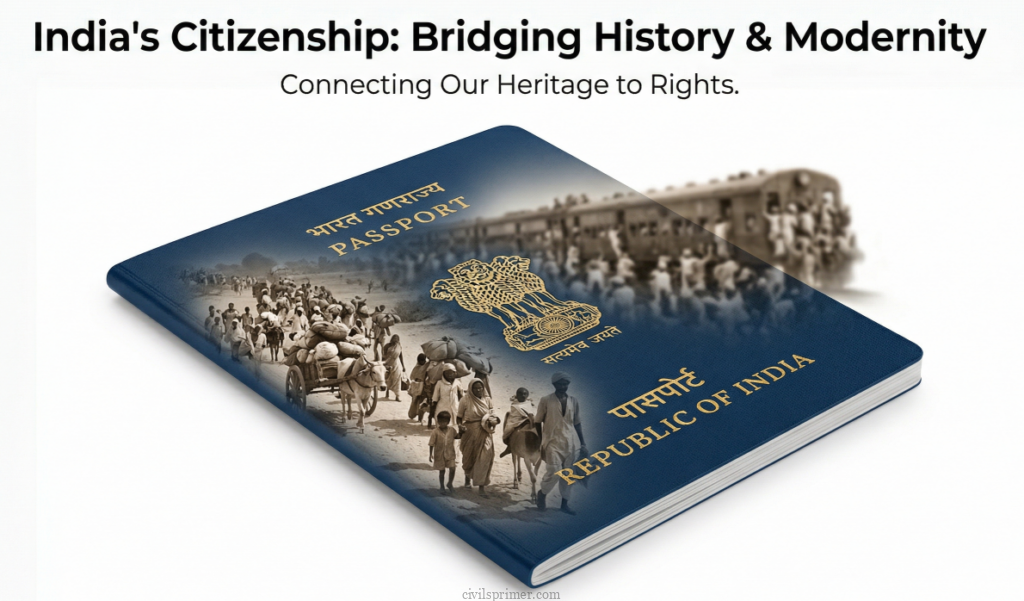
Imagine the subcontinent in August 1947. The British had drawn a line through the map, triggering one of the largest and bloodiest mass migrations in human history. Millions of people were crossing the newly formed borders—some fleeing violence, others seeking a new homeland. Amidst this chaos, the framers of the Indian Constitution, sitting in the Constituent Assembly, faced a monumental question: Who is an Indian?
They had to draft rules for a population that was moving, terrified, and undocumented. The result was Part II of the Indian Constitution (Articles 5 to 11) and later, the Citizenship Act of 1955. Let us embark on a journey to understand how India defines its citizens, how this definition has evolved, and the demographic and political crises that continue to shape it today.
The Constitutional Framework (Articles 5 to 11) #
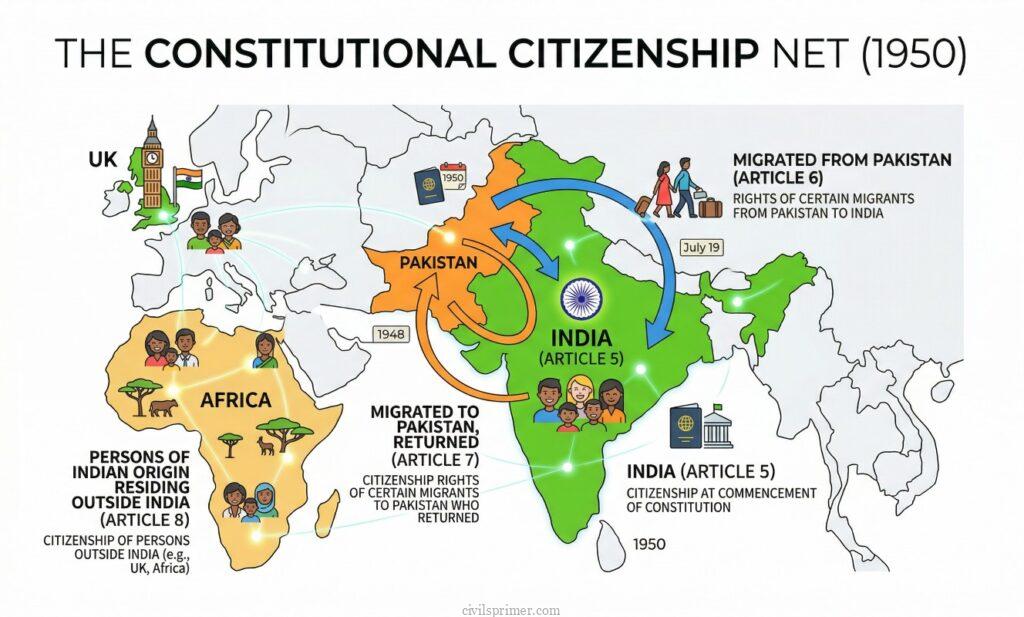
The framers realized that drafting a permanent citizenship law in 1949 was impossible given the ongoing migration. Therefore, Articles 5 to 8 only defined who became a citizen at the commencement of the Constitution (January 26, 1950).
1. The Foundation: Article 5 (Citizenship by Domicile) If you had your domicile (permanent home) in India and met any one of three conditions: you were born in India, OR either of your parents was born in India, OR you had been ordinarily resident in India for at least five years before the Constitution commenced, you became a citizen.
2. The Partition Migrants: Articles 6 & 7
- Article 6: Dealt with people who migrated from Pakistan to India. If they or their parents/grandparents were born in undivided India and they migrated before July 19, 1948, they were citizens. If they came after, they had to register.
- Article 7: Dealt with people who migrated to Pakistan after March 1, 1947, but later returned to India under a permit of resettlement.
3. The Diaspora: Article 8 This covered Persons of Indian Origin (PIOs) residing outside India. If they or their parents/grandparents were born in undivided India, they could register as Indian citizens through diplomatic missions abroad.
4. Single Loyalty: Article 9 India does not allow dual citizenship. Article 9 states that if any person voluntarily acquires the citizenship of a foreign state, they will no longer be a citizen of India.
5. The Power of Parliament: Articles 10 & 11 Article 10 guarantees the continuance of citizenship rights, subject to parliamentary laws. Article 11 is the most crucial: it empowered the Parliament to make any provision regarding the acquisition and termination of citizenship. The framers basically handed over the baton to future governments to deal with citizenship as the nation evolved.
The Citizenship Act, 1955 #
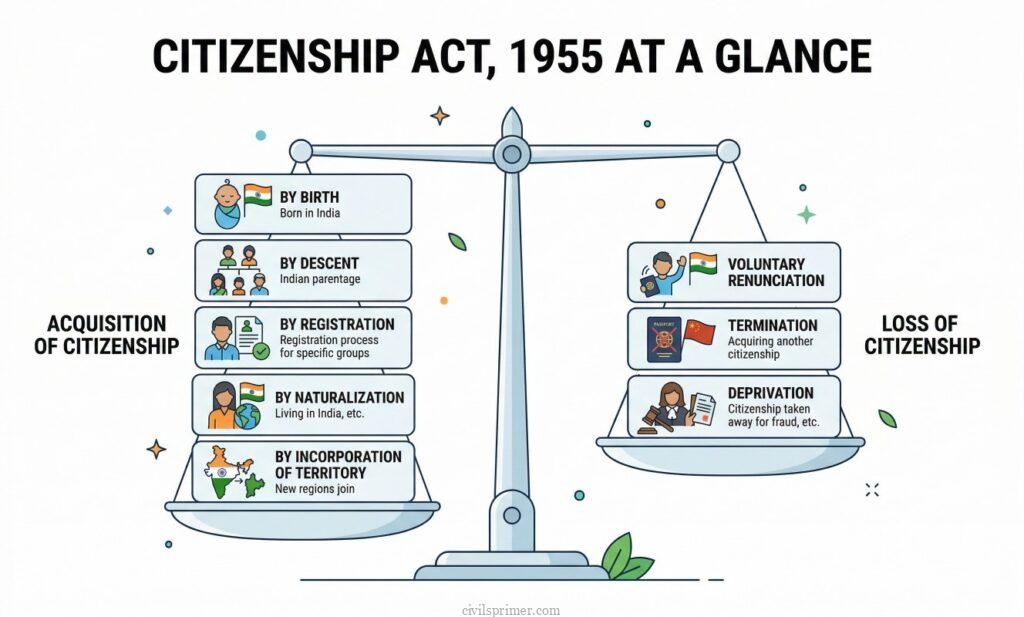
Using the power granted by Article 11, the Parliament passed the Citizenship Act, 1955. This Act prescribes five ways to acquire citizenship and three ways to lose it.
A. Acquisition of Citizenship
- By Birth (Jus Soli): Initially, anyone born in India was a citizen. However, due to illegal infiltration, this was tightened. Today, a person born in India is a citizen only if both parents are citizens, or one is a citizen and the other is not an illegal migrant.
- By Descent (Jus Sanguinis): For those born outside India. Currently, a person born abroad is an Indian citizen if at least one parent is an Indian citizen and the birth is registered at an Indian consulate within one year.
- By Registration: For Persons of Indian Origin (PIOs) or spouses of Indian citizens who have resided in India for at least 7 years.
- By Naturalization: For foreigners who have resided in India for a prolonged period (usually 12 years), renounce their previous citizenship, are of good character, and have adequate knowledge of a language in the 8th Schedule of the Constitution.
- By Incorporation of Territory: If a new territory becomes part of India (e.g., Puducherry or Sikkim), the Government of India specifies who among the people of that territory shall be Indian citizens.
UPSC Prelims Pointer
In India, both a citizen by birth and a naturalised citizen are eligible for the office of the President. In the USA, only a citizen by birth is eligible for the Presidency.
B. Loss of Citizenship
- Renunciation: Voluntarily giving it up.
- Termination: Automatically losing it upon acquiring the citizenship of another country.
- Deprivation: Compulsory termination by the Central Government if citizenship was acquired by fraud, if the citizen showed disloyalty to the Constitution, or unlawfully traded with the enemy during a war.
The Modern Demographic Challenge and Amendments #
Citizenship laws cannot remain static because demography and geopolitics are always shifting. Today, India is facing a severe Demographic Divide. The northern states (like UP and Bihar) are in a population expansion phase with high birth rates, while the southern states (like Kerala and Tamil Nadu) are aging, with Total Fertility Rates (TFR) dropping below the replacement level of 2.1. The overall national TFR has dropped to 1.9, and the population stands at around 146.39 crore.
This demographic transition, combined with massive internal and cross-border migration, has forced the government to repeatedly amend the 1955 Act.
1. The Citizenship (Amendment) Act, 2019 (CAA)
One of the most debated amendments in recent history. The CAA 2019 provided that Hindus, Sikhs, Buddhists, Jains, Parsis, and Christians facing religious persecution in Afghanistan, Bangladesh, and Pakistan, who entered India on or before December 31, 2014, will not be treated as illegal migrants. Furthermore, it reduced the period of naturalization for these groups from 11 years to 5 years.
- The Debate: Critics argue it violates the secular fabric of the Constitution (Article 14) by linking citizenship to religion, while the government maintains it is a humanitarian effort to protect persecuted minorities in neighboring Islamic states.
2. Overseas Citizen of India (OCI) Scheme and 2025 Amendments
Introduced in 2005, the OCI scheme allows foreign nationals of Indian origin a lifelong, multiple-entry visa to live and work in India without granting dual citizenship or voting rights. However, in July 2025, the Ministry of Home Affairs (MHA) strictly amended the rules. An OCI card can now be canceled if the cardholder is convicted and sentenced to two years or more, or even charge-sheeted for offenses punishable with seven years or more, irrespective of whether the offense occurred in India or abroad.
3. The Migrant Citizen Crisis and Demographic Security (2025-2026)
While we talk about foreign migrants, India’s internal migrant citizens are facing a severe crisis. According to a 2020-21 report, India’s migration rate is 28.9%. However, these migrants often fall into a “political limbo”. For example, during the Special Intensive Revision (SIR) of electoral rolls ahead of the 2025 Bihar elections, nearly 3.5 million voters (mostly migrants) were deleted because they were absent during physical verification. This highlights a massive failure in our democratic framework to protect the fundamental political rights of mobile citizens.
To address external demographic threats, the Prime Minister announced the Demographic Mission on Independence Day 2025. This high-powered mission aims to use data analytics and satellite mapping to counter illegal infiltration in border regions, monitor fertility and mortality rates, and ensure that localized demographic shifts do not pose a threat to national security. Simultaneously, to handle suspected illegal immigrants, the MHA empowered Foreigners Tribunals (FTs) in 2025 to issue arrest warrants and send individuals directly to detention centers if they fail to prove their citizenship.
Conclusion: The Soul of Citizenship #
Citizenship is famously described as the “right to have rights”. From the traumatic border crossings of 1947 to the technologically driven Demographic Mission of 2025, India’s approach to citizenship reflects its struggle to balance humanitarian compassion with national security. As a UPSC aspirant, understanding the mechanics of Articles 5-11 and the Citizenship Act is not just about memorizing the law; it is about grasping the very fabric that holds 1.46 billion diverse people together under a single, sovereign identity.
UPSC Mains Previous Year Questions #
(Directly based on the topic keywords & themes. Note: As per instructions, some standard UPSC PYQs related to the broad themes of Citizenship, Migration, and Demography are included below. )
- 2021: “Discuss the constitutional provisions regarding citizenship in India. How does the Citizenship (Amendment) Act, 2019 alter the fundamental principles of Indian citizenship?” (External UPSC Model/PYQ)
- 2020: “Indian diaspora has a decisive role to play in the politics and economy of America and European Countries. Comment with examples.” (Assesses the understanding of OCI/PIO dynamics)
- 2019: “What are the challenges to our cultural practices in the name of secularism?” (Linked to the debates surrounding the CAA and secularism)
- 2017: “In the context of the diversity of India, can it be said that the regions form cultural units rather than the States? Give reasons with examples for your viewpoint.” (Linked to demographic divides and state reorganization)
- 2015: “Discuss the changes in the trends of labour migration within and outside India in the last four decades.”
- 2014: “How illegal transborder migration does pose a threat to India’s security? Discuss the strategies to curb this, bring out the factors which give impetus to such migration.”
Latest Important Current Events #
- Jan, 2026: India’s Demographic Dividend is Turning into a Divide → Highlights the sharp regional transition where the South is aging (TFR < 2.1) and the North remains youthful, threatening to reshape federalism and political representation during the upcoming delimitation.
- Nov, 2025: Constitution 131st Amendment Bill 2025 → A legislative development reflecting the continuous use of parliamentary power to amend administrative structures and rights frameworks within the Union.
- Oct, 2025: Foreigners Tribunals (FTs) Empowered → The MHA granted FTs powers equivalent to a first-class judicial magistrate, enabling them to issue arrest warrants and deport suspected illegal immigrants to detention centers.
- Oct, 2025: Special Intensive Revision (SIR) 2025 → A massive house-to-house verification drive by the ECI to update electoral rolls and weed out ineligible voters or illegal immigrants, strictly governed by the Representation of the People Act.
- Aug, 2025: Launch of the Demographic Mission → Announced by the PM on Independence Day, this high-powered mission will use satellite mapping and data analytics to counter illegal border infiltration and manage regional population imbalances.
- Aug, 2025: Migrant Disenfranchisement Crisis in Bihar → During the Special Intensive Revision, over 3.5 million internal migrant workers were deleted from voter rolls due to their absence, sparking debates on portable voting rights.
- Aug, 2025: UAE Nomination-Based Golden Visa Scheme → The UAE introduced a new residency scheme allowing skilled Indian professionals to obtain a lifetime visa without the need for property or business investments, boosting diaspora mobility.
- July, 2025: Stringent Amendments to OCI Rules → The MHA amended the Citizenship Act rules allowing the cancellation of OCI registration if a cardholder is convicted for 2+ years or even charge-sheeted for offenses carrying a 7+ year penalty.
- July, 2025: The Changing Patterns of India’s Student Migration → A sharp rise in self-financed student migration (expected to reach 13.8 lakh in 2025) is causing a reverse brain drain and economic strain on middle-class households.
- July, 2025: State of the World Population 2025 Report → UNFPA report noted India’s population at 146.39 crore with the TFR dropping to 1.9 (below replacement level), officially entering a demographic transition phase.