131st Constitutional Amendment: 850-Seat Cap for Lok Sabha & Women’s Quota
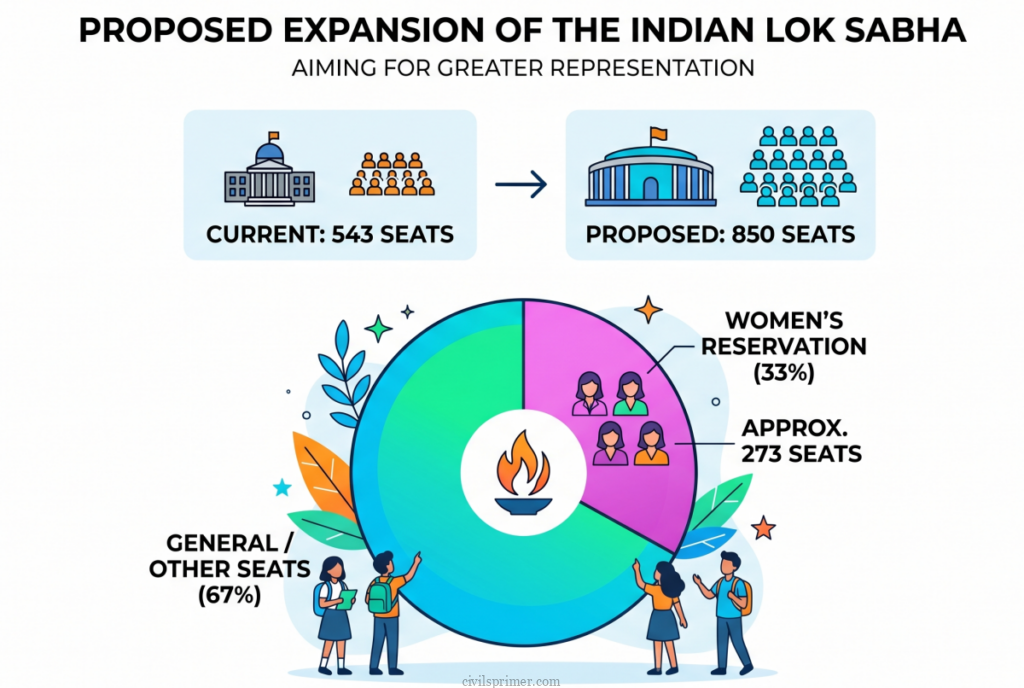
Core Issue: The Centre has proposed a legislative package to redraw India’s electoral map, capping Lok Sabha seats at 850 to operationalize the 33% women’s reservation quota from the 2029 elections.
Historical Significance: Prime Minister Narendra Modi noted that the concept of reserving legislative seats for women is a century old, originally proposed by Sardar Vallabhbhai Patel during his tenure as the president of the Ahmedabad Municipality.
Current Developments & Implications (Polity & Society): The circulated package includes the Constitution (131st Amendment) Bill, the Delimitation Bill 2026, and the UT Laws (Amendment) Bill 2026. The framework plans a near-uniform 50% increase in seats for Parliament and state assemblies. It crucially removes the obligation to carry out delimitation after every census, allowing the government to initiate it via a simple law based on the ongoing 2027 census data.
The Way Forward: Getting consensus is key, as opposition parties have flagged concerns that using newer census data over the 2011 census may penalize states that successfully implemented family planning.
UPSC Prelims Pointers:
- Article 81 (Composition of the Lok Sabha) is slated for amendment to expand seats.
- Passage of these amendments requires a special majority (two-thirds of members present and voting) and ratification by at least 50% of states.
Aatmanirbhar 2.0: Building Structural Resilience Amidst War
Core Issue: In response to the global supply chain and energy shocks caused by the US-Iran war, the Indian government is redrawing its self-reliance framework to insulate critical supplies.
Historical Significance: This builds on the original Aatmanirbhar Bharat initiative launched during the Covid-19 pandemic, which aimed to reduce import dependencies and boost domestic manufacturing.
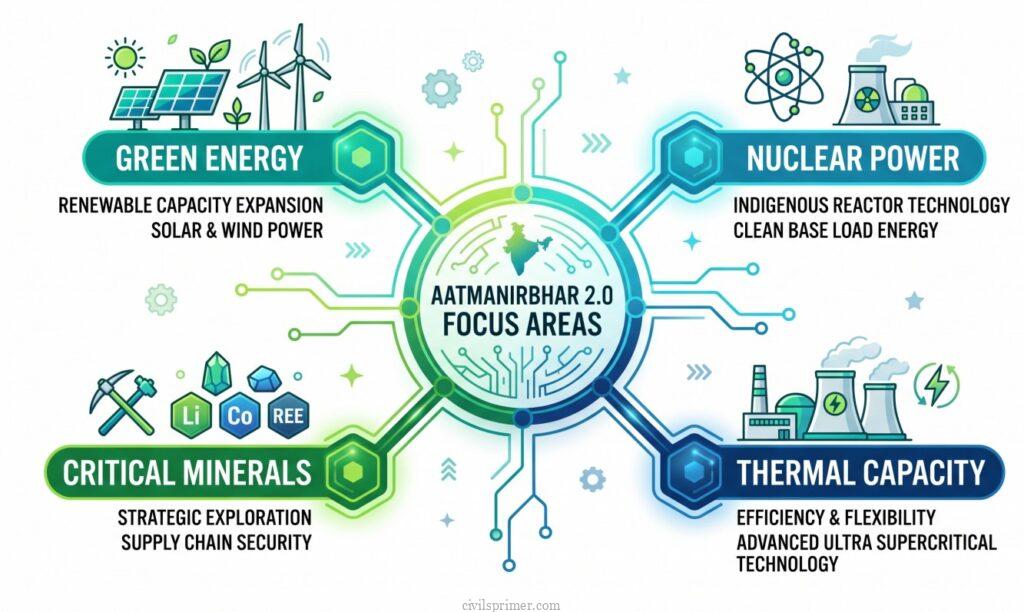
Current Developments & Implications (Economy): Following high-level meetings by the Cabinet Committee on Security, the government is shifting from “firefighting” to establishing long-term “structural resilience”. Aatmanirbhar 2.0 heavily focuses on scaling up green energy, nuclear power, and thermal capacities to cut reliance on imported oil, gas, rare earths, and chemicals.
The Way Forward: Ministries are mandated to draw up targeted, sector-specific interventions to ensure the uninterrupted availability of industrial inputs and transition faster to renewable energy alternatives.
UPSC Prelims Pointers:
- The Cabinet Committee on Security (CCS) is chaired by the Prime Minister and includes the Ministers of Defence, Home Affairs, External Affairs, and Finance
Geopolitical Crisis: US-Iran Conflict & Strait of Hormuz Blockade
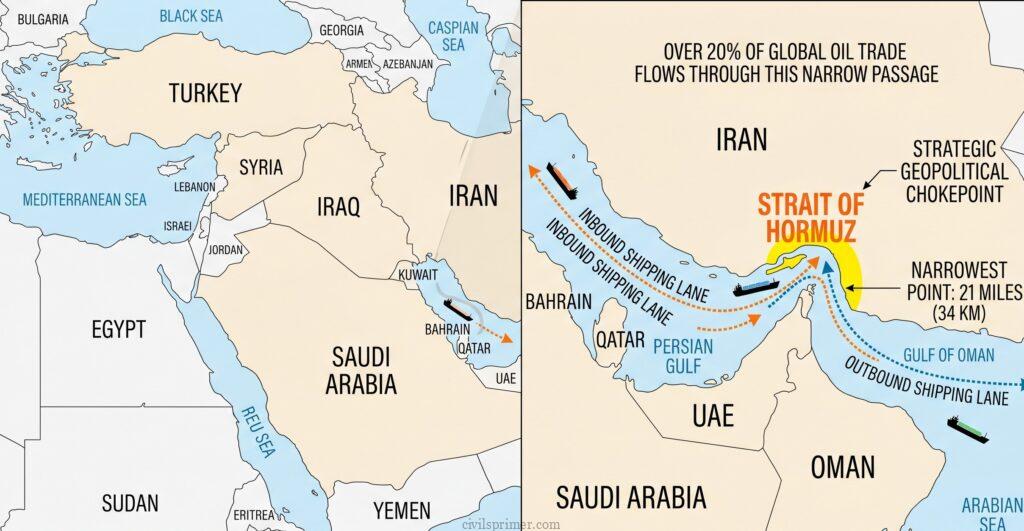
Core Issue: The US has initiated a blockade of the Strait of Hormuz following the breakdown of peace talks with Iran in Islamabad, severely impacting global energy supply chains.
Historical Significance: Historically, Western interventions in West Asia (like in Libya and Iraq) have dismantled central authorities, leading to long-term regional chaos. The Strait of Hormuz has long been the most critical chokepoint for global oil transit.
Current Developments & Implications (Economy & International Relations): The blockade has led to extreme oil price volatility and demand destruction. However, India has managed to maintain safe passage for its tankers through quiet diplomacy with Iran. The crisis is also accelerating the “de-dollarization” trend, as countries increasingly buy gold and consider trading oil in alternative currencies like the Renminbi.
The Way Forward: India must utilize its strategic autonomy to balance relations between the US and Iran while actively participating in BRICS initiatives to safeguard its energy and financial interests.
UPSC Prelims Pointers:
- Map tracking: Strait of Hormuz connects the Persian Gulf to the Gulf
E-Commerce Exports: India Mulls FDI in Inventory-Based Model
Core Issue: The Commerce and Industry Ministry is evaluating a proposal to allow Foreign Direct Investment (FDI) in the inventory-based model of e-commerce, strictly limited to export purposes.
Historical Significance: To protect local mom-and-pop stores, India’s FDI policy has historically barred foreign investment in inventory-led e-commerce models for the domestic market, only allowing 100% FDI in the “marketplace” model.
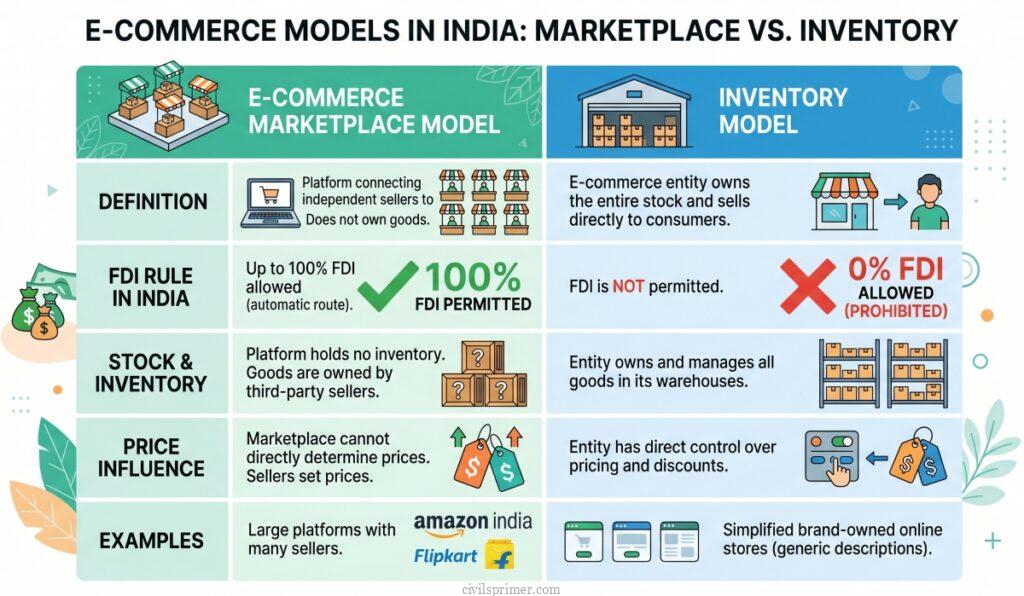
Current Developments & Implications (Economy): A dedicated export entity affiliated with an FDI-funded marketplace would buy goods directly from Indian sellers to ship to international buyers. To prevent these goods from leaking into the domestic market, the government will mandate strict physical segregation in warehouses. Around 70% of Indian SMEs in sectors like fashion, gems, and handicrafts are expected to benefit from this policy easing.
The Way Forward: Establish robust frameworks for GST refunds and duty remissions for these export entities, and implement strict safeguards regarding seller-level data misuse.
UPSC Prelims Pointers:
- FDI Policy on E-commerce: 100% FDI is permitted under the automatic route in the marketplace model, but FDI is not permitted in the inventory-based model for domestic retail.
Delays in Operationalizing the Data Protection Board of India (DPBI)
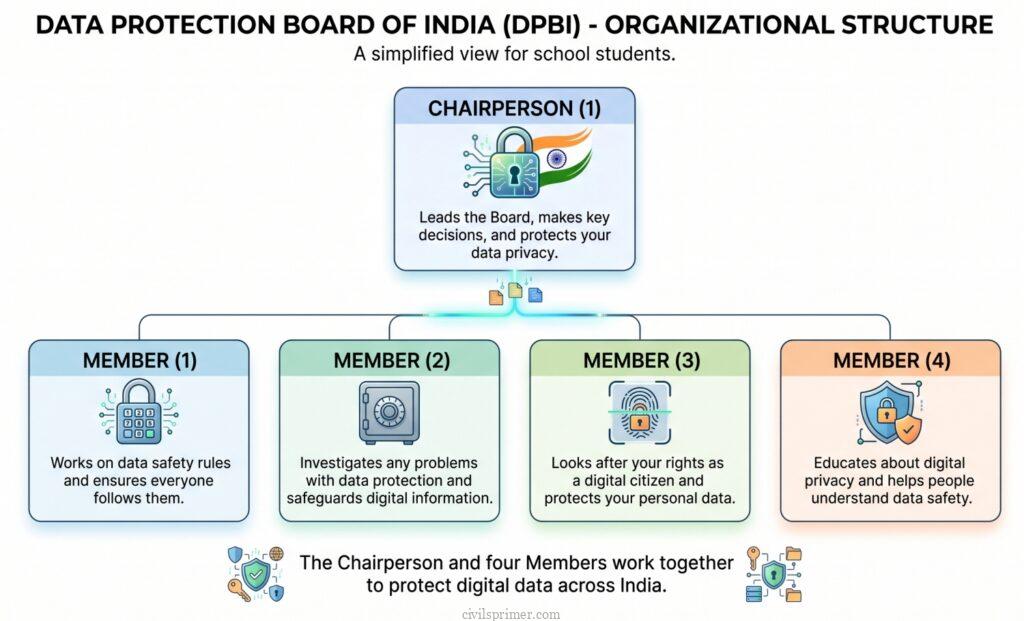
Core Issue: Five months after the Digital Personal Data Protection (DPDP) rules were notified, the government has yet to form search-cum-selection committees to appoint the chairperson and members of the DPBI.
Historical Significance: The DPDP Act represents India’s landmark shift toward a comprehensive personal data governance regime to regulate how data fiduciaries process personal data.
Current Developments & Implications (Polity & Society): The DPBI was established as a statutory compliance watchdog with the authority to investigate data breaches and impose penalties of up to Rs 250 crore. The delay in its operationalization comes at a time when the National Human Rights Commission (NHRC) is issuing notices to the tech ministry regarding child data protection lapses by major tech firms.
The Way Forward: Expediting the appointment process is crucial, as the delay is hindering the rollout of the broader “consent manager ecosystem”.
UPSC Prelims Pointers:
- The DPBI Selection Committee will be chaired by the Cabinet Secretary and include the MeitY and Legal Affairs secretaries.
- The National Human Rights Commission (NHRC) derives its mandate from the Protection of Human Rights Act.
IMF Upgrades India’s FY27 Growth Forecast to 6.5%
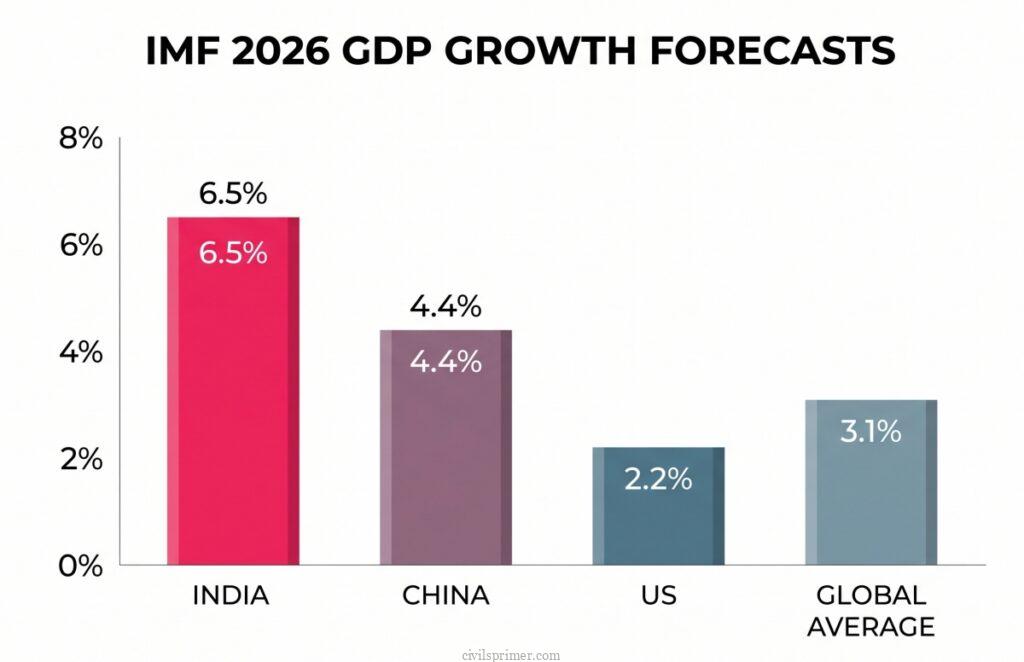
Core Issue: The International Monetary Fund (IMF) has raised India’s economic growth forecast for the 2026-27 financial year to 6.5%.
Historical Significance: Despite severe global disruptions (like the Covid-19 pandemic and recent wars), India has successfully maintained its status as the world’s fastest-growing major economy through structural macro-economic reforms.
Current Developments & Implications (Economy): This upward revision from the previously projected 6.4% is driven by a strong carryover from 2025 and reductions in US tariffs (from 50% down to 10%), which effectively offset the negative shocks of the West Asian war. Meanwhile, global growth is slated to slow to 3.1% due to ongoing geopolitical fragmentation.
The Way Forward: India must leverage its strong domestic demand and corporate balance sheets to cushion against sustained global oil price shocks and currency volatility.
UPSC Prelims Pointers:
- The ‘World Economic Outlook‘ report is published by the International Monetary Fund (IMF).
Bridging the Divestment Gap: National Monetisation Pipeline 2.0
Core Issue: To counter a potential shortfall in the Rs 80,000 crore divestment target for FY27 (due to a delayed IDBI Bank sale and war-induced stock market volatility), the government is accelerating its asset monetisation program.
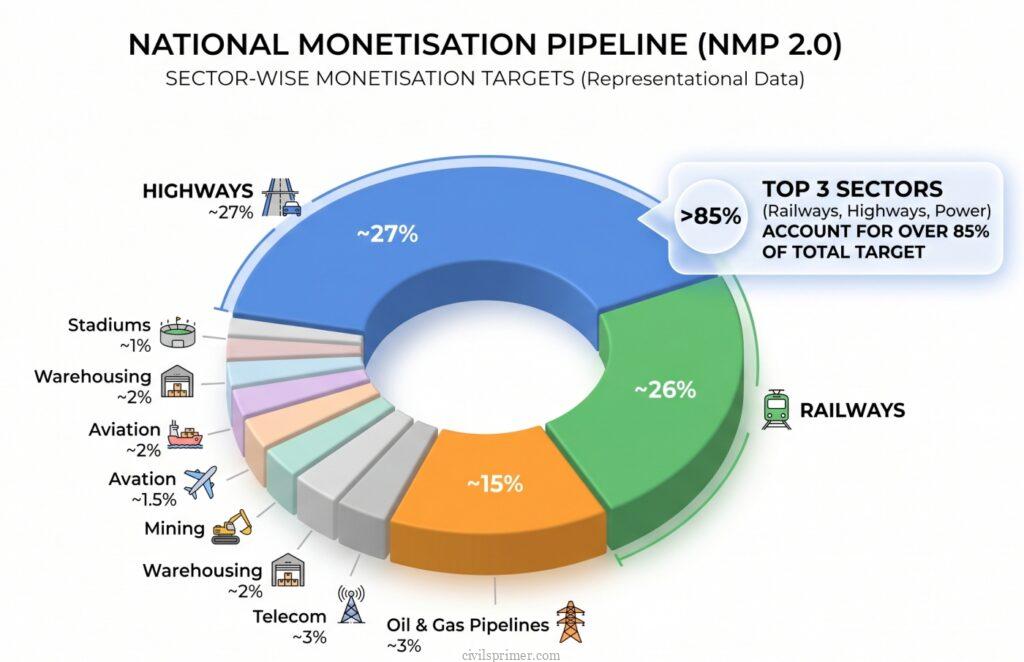
Historical Significance: Finance Minister Nirmala Sitharaman previously launched the second phase of the National Monetisation Pipeline (NMP 2.0), estimating a monetisation potential of Rs 16.7 lakh crore through 2029-30.
Current Developments & Implications (Economy): The overall asset monetisation target for ministries in 2026-27 is Rs 3.26 lakh crore, with railways, highways, logistics, ports, and power accounting for over 85% of this goal. An empowered core group of secretaries is closely monitoring this to ensure the government’s tax revenue and infrastructure spending requirements are not derailed by the West Asian crisis.
The Way Forward: Rapid execution of NMP 2.0 is required to generate non-debt capital receipts, ensuring that public infrastructure creation continues without expanding the fiscal deficit
UPSC Prelims Pointers:
- The National Monetisation Pipeline (NMP) is developed by NITI Aayog to unlock value in brownfield public sector assets.