
Imagine the midnight of August 15, 1947. India awoke to life and freedom, but it was a fractured, impoverished land. The British had left behind a country where life expectancy was barely 32 years, literacy was abysmal, and extreme inequality was woven into the social fabric through caste and deeply entrenched feudal systems. When the architects of our Constitution sat down to draft the rulebook for this new nation, they realized that merely granting political freedom—the right to vote or the right to free speech (Fundamental Rights)—was not enough. A starving citizen cannot eat a ballot paper.
To make political democracy truly meaningful, it had to be backed by social and economic democracy. Thus, inspired by the Irish Constitution, they embedded a visionary compass into Part IV of the Constitution: the Directive Principles of State Policy (DPSP).
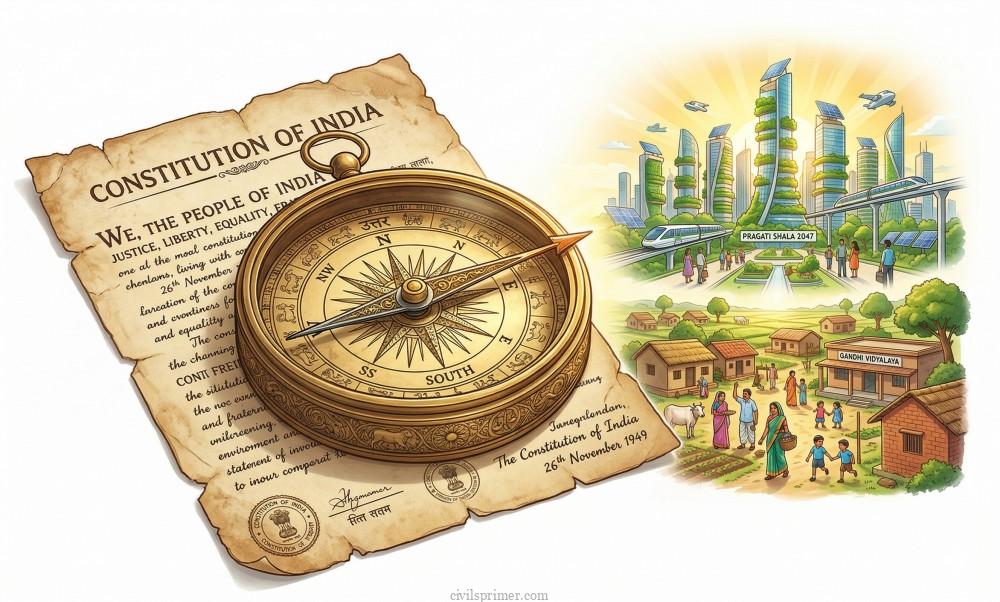
The Nature of the Directives (Articles 36 & 37) #
If Fundamental Rights (FRs) are the “brakes” that prevent the State from becoming a dictator, the DPSPs are the “accelerator” pushing the State to become a Welfare State.
Article 36 simply borrows the definition of the “State” from Article 12 (covering the central government, state governments, and local authorities). But the real magic lies in Article 37. It declares that the DPSPs are non-justiciable—meaning you cannot drag the government to court if they fail to provide you with a job or free healthcare.
Why make such grand promises if they cannot be legally enforced? In 1947, India simply did not have the financial resources to guarantee education, housing, and employment to everyone. Making them legally binding would have bankrupted the young republic. However, Article 37 emphatically states that these principles are “fundamental in the governance of the country“ and it shall be the duty of the State to apply them in making laws. Dr. B.R. Ambedkar explicitly warned future governments that while they might not be answerable to a court of law for ignoring DPSPs, they would certainly be answerable to the ultimate court—the court of public opinion during elections.
Classification of DPSPs #
To understand the DPSPs, we must look at the different ideological streams that influenced the freedom struggle. Though the Constitution does not formally classify them, scholars divide Articles 38 to 51 into three distinct categories based on their philosophy.
1. The Socialist Principles: The Quest for Equality – These principles reflect the ideology of democratic socialism. Their goal is to dismantle extreme wealth concentration and provide a decent standard of living for all.
- Article 38: The bedrock of the Welfare State. It directs the State to secure a social order promoting the welfare of the people by minimizing inequalities in income, status, facilities, and opportunities.
- Article 39: A massive umbrella of economic rights. It demands equal pay for equal work for men and women, protection of workers’ health, and ensures that the economic system does not lead to the concentration of wealth.
- Article 39A: Promotes equal justice and provides free legal aid to the poor.
- Article 41: The right to work, to education, and to public assistance in cases of unemployment, old age, sickness, and disablement.
- Demographic Reality Check: Today, this article is more critical than ever. India’s geriatric population (60+ years) is rising sharply and was already around 149 million in 2022. States in southern India are rapidly aging, leading to a “demographic divide”. Under Article 41, the State is under immense pressure to design robust social security and pension schemes to assist this vulnerable demographic. Additionally, to fulfill the “right to work”, the government is reportedly bringing the Viksit Bharat–Guarantee for Rozgar and Ajeevika Mission (Gramin) Bill, 2025, an ambitious step to upgrade rural employment beyond the 20-year-old MGNREGA framework.
- Article 42: Securing just and humane conditions of work and maternity relief.
- Article 43: Securing a living wage and a decent standard of life for all workers.
- Article 47: Raising the level of nutrition and the standard of living of people.
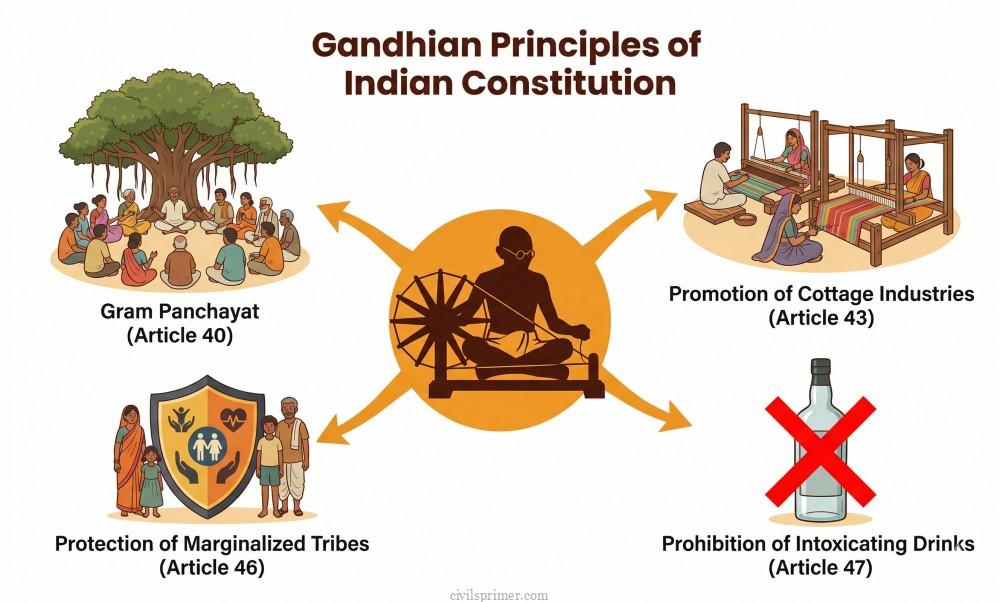
2. The Gandhian Principles: The Village Republic – Mahatma Gandhi believed that the true soul of India lived in its villages. He advocated for decentralization and a self-reliant village economy.
- Article 40: Organize Village Panchayats and endow them with powers to function as units of self-government. This dream was fully realized with the 73rd Constitutional Amendment Act.
- Article 43: Promote cottage industries on an individual or cooperative basis in rural areas.
- Article 43B: Promote voluntary formation, autonomous functioning, democratic control, and professional management of cooperative societies.
- Current Connect: Recognizing the power of this directive, the government launched the National Cooperative Policy in 2025, transforming grassroots economic structures and empowering rural artisans and farmers.
- Article 46: Promote the educational and economic interests of SCs, STs, and other weaker sections, and protect them from social injustice.
- Article 47: Prohibit the consumption of intoxicating drinks and drugs injurious to health.
- Article 48: Prohibit the slaughter of cows, calves, and other milch and draught cattle.
3. The Liberal-Intellectual Principles: Modernizing the Nation: These directives urge the State to adopt a modern, progressive, and scientific approach to governance.
- Article 44: Secure a Uniform Civil Code (UCC) for all citizens throughout the territory of India. This remains one of the most debated directives, seeking to replace personal religious laws with a common set of laws governing marriage, divorce, and inheritance to ensure gender justice and national integration.
- Article 45: Provide early childhood care and education for all children until they complete the age of six.
- Article 48: Organize agriculture and animal husbandry on modern and scientific lines.
- Article 48A: Protect and improve the environment and safeguard forests and wildlife.
- Current Connect: India is aggressively pursuing this constitutional mandate. As of 2025, India successfully achieved its Paris Agreement goal by ensuring that non-fossil fuel sources constitute over 50% of its installed electricity capacity, five years ahead of schedule. Concurrently, the Supreme Court has heavily relied on Article 48A in its “Green Governance” rulings, stepping in to halt deforestation in cases like the Aravalli Hills and protecting endangered species like the Great Indian Bustard.
- Article 49: Protect monuments, places, and objects of historic or national importance.
- Article 50: Separate the judiciary from the executive in the public services of the State.
- Article 51: Promote international peace and security, maintain just and honorable relations between nations, and foster respect for international law.
Fundamental Rights vs. Directive Principles #
As the newly formed Indian State began implementing the DPSPs—like abolishing the Zamindari system to distribute land equally (Article 39)—they hit a massive roadblock. Landlords went to the Supreme Court arguing that their Fundamental Right to Property (then Article 19(1)(f) and Article 31) was being violated.
What followed was a 30-year judicial and legislative tug-of-war to decide who was supreme: the individual’s Fundamental Rights (FRs) or the society’s Directive Principles (DPSPs)?
Round 1: Champakam Dorairajan Case (1951) The Supreme Court ruled that FRs are superior. It stated that DPSPs are like a subsidiary chapter and have to conform to Fundamental Rights.
Round 2: Golak Nath Case (1967) The Court took an even stricter stance, ruling that Parliament cannot abridge or dilute any Fundamental Right, even for the sake of implementing a Directive Principle.
Round 3: The 25th Amendment Act (1971) & Kesavananda Bharati Case (1973) Frustrated by judicial blocks to socialist reforms, Indira Gandhi’s government passed the 25th Constitutional Amendment. It inserted Article 31C, stating that if a law is made to implement the socialist directives in Article 39(b) and (c) (equitable distribution of resources), it cannot be struck down even if it violates the Fundamental Rights of Equality (Article 14) or Freedom (Article 19). In the historic Kesavananda Bharati Case (1973), the Supreme Court accepted this. It ruled that while Parliament can amend the Constitution, it cannot destroy its “Basic Structure”. However, it validated the superiority of Article 39(b) and (c) over Articles 14 and 19.
Round 4: The 42nd Amendment (1976) & Minerva Mills Case (1980) Intoxicated by this power, the government passed the 42nd Amendment during the Emergency, declaring that all DPSPs would now have priority over Articles 14 and 19. But the Supreme Court struck this down in the Minerva Mills Case (1980). The Court delivered a profound philosophical judgment: “The Indian Constitution is founded on the bedrock of the balance between Parts III (FRs) and IV (DPSPs). To give absolute primacy to one over the other is to disturb the harmony of the Constitution. This harmony and balance between fundamental rights and directive principles is an essential feature of the basic structure of the Constitution.”
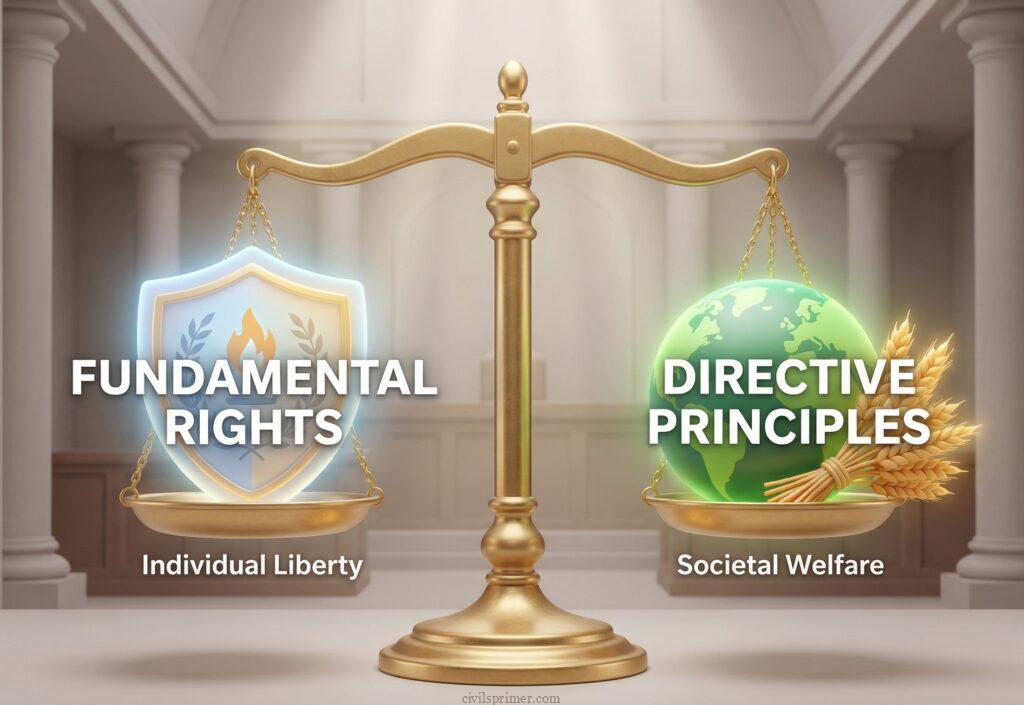
The Court beautifully described FRs and DPSPs as the “two wheels of a chariot”. You cannot establish an egalitarian society by crushing individual liberties, nor can you enjoy individual liberties in a society plagued by starvation and extreme inequality.
Conclusion: The Soul of the Nation #
Today, the relationship between FRs and DPSPs is not one of conflict, but of synergy. They are complementary. While Fundamental Rights set the boundaries of state action, the Directive Principles set the targets. From launching the MGNREGA to enacting the Right to Education (which was born from the womb of Article 45 and moved to Article 21A), the Indian state continues its long march toward the ideals set by the founding fathers. The Directive Principles remind us that the Constitution is not just a legal document; it is a manifesto for a social revolution.
UPSC Mains Previous Year Questions (PYQs) #
- 2025 → Women’s social capital complements in advancing empowerment and gender equity. Explain. (10 M) (Relates heavily to the directives under Article 39 advocating gender parity and equal economic opportunity)
- 2022 → Besides the welfare schemes, India needs deft management of inflation and unemployment to serve the poor and the underprivileged sections of society. Discuss. (15 M) (A direct test of understanding the socio-economic directives under Articles 38, 39, and 41)
- 2022 → Reforming the government delivery system through the Direct Benefit Transfer Scheme is a progressive step, but it has its limitations too. Comment. (10 M) (Assesses the practical implementation of the Welfare State philosophy mandated by DPSPs)
- 2021 → Discuss the desirability of greater representation of women in the higher judiciary to ensure diversity, equity, and inclusiveness. (10 M) (Relates to Article 39A on equal justice and overcoming social inequalities)
- 2015 → Discuss the possible factors that inhibit India from enacting for its citizens a Uniform Civil Code as provided for in the Directive Principles of State Policy. (12.5 M)
- 2015 → Does the right to clean environment entail legal regulations on burning crackers during Diwali? Discuss in the light of Article 21 of the Indian Constitution and Judgement(s) of the Apex Court in this regard. (12.5 M) (Directly links the Fundamental Right to Life with the environmental directive under Article 48A)
Latest Important Current Events #
- Jan, 2026: Top Court’s Green Governance → Highlights the Supreme Court’s proactive role in enforcing environmental protection, directly utilizing the mandate of Article 48A to balance conservation with infrastructure projects, though occasionally criticized for policy reversals.
- Jan, 2026: India’s Demographic Dividend is Turning into a Divide → A stark warning that the rapid aging of populations in Southern states requires urgent restructuring of social security nets, bringing the spotlight back to the State’s duty under Article 41 to provide public assistance in old age.
- Dec, 2025: Viksit Bharat–Guarantee for Rozgar and Ajeevika Mission (Gramin) Bill, 2025 → The Union Government’s proposal to replace the MGNREGA framework. This massive legislative shift aims to better operationalize the “Right to Work” envisioned under Article 41.
- Dec, 2025: The State of Social Justice 2025 → A comprehensive review of affirmative action and welfare delivery, assessing how far the State has succeeded in its Article 38 mandate to minimize inequalities in income, status, and opportunities across diverse demographic groups.
- Nov, 2025: Strengthening Legal Aid Mechanism in India → The Prime Minister emphasized the “ease of justice” via accessible and affordable legal services, reaffirming the government’s commitment to implementing Article 39A (Equal justice and free legal aid).
- Oct, 2025: Appointment of Chief Justice of India → Ongoing procedural and political debates regarding the collegium system and executive interference, reflecting the delicate constitutional balance required to uphold Article 50 (Separation of judiciary from the executive).
- Sep, 2025: Tracking India’s Climate Goals → India achieved a milestone where non-fossil fuel sources now constitute over 50% of its installed electricity capacity, successfully executing the environmental protection directive of Article 48A ahead of global targets.
- July, 2025: National Cooperative Policy – 2025 → The introduction of a comprehensive framework aimed at reviving and strengthening cooperative societies across the nation, fulfilling the specific Gandhian directive laid down in Article 43B.