
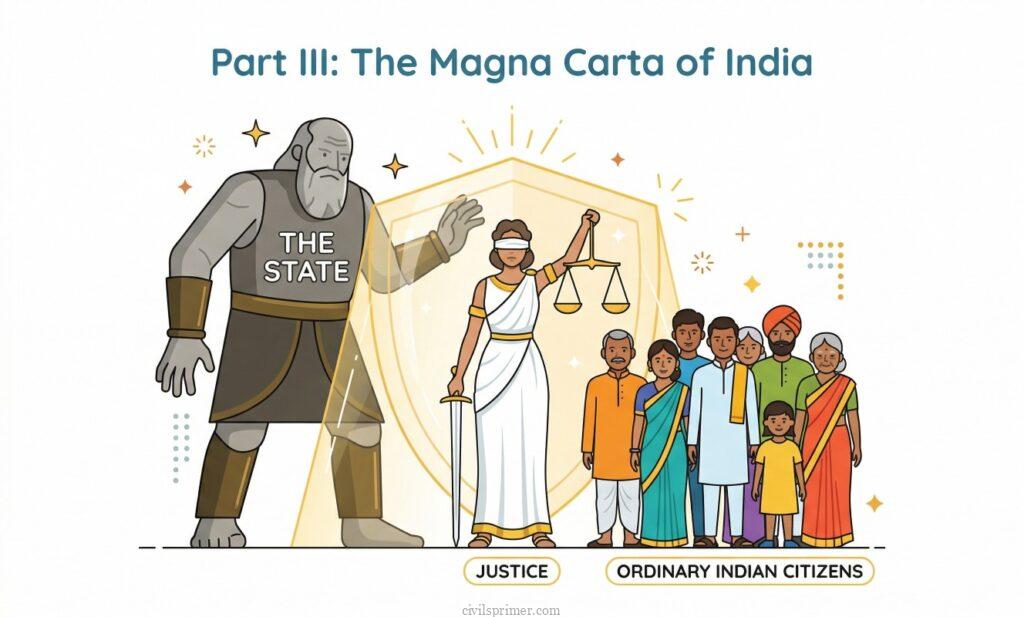
Imagine living in a land where you could be arrested without a warrant, where the state could dictate what religion you follow, and where speaking your mind could land you in prison. This was the reality for many during the colonial era. When the architects of the Indian Constitution sat down in 1947, they resolved to transform India from a land of subjects into a nation of empowered citizens. To do this, they forged a powerful shield—Part III of the Constitution (Articles 12 to 35), famously known as the Magna Carta of India.
These are your Fundamental Rights (FRs). They are called “Fundamental” because they are guaranteed by the Constitution itself and are justiciable, meaning you can knock on the doors of the Supreme Court if they are violated. Let us embark on a storytelling journey to understand how these rights operate, how they have evolved through recent judicial interpretations up to March 2026, and how they interact with India’s complex social demographics.
Defining the Battlefield (Articles 12 & 13) #
Before granting rights, the Constitution must define who you are protected against.
Article 12: Who is the “State”? If a private company fires you unfairly, your Fundamental Rights aren’t necessarily violated. FRs are primarily protections against the arbitrary actions of the “State”. Article 12 defines the State broadly: it includes the Central and State Governments, local authorities (like Panchayats), and even statutory or non-statutory bodies like LIC, ONGC, or universities acting as instruments of the State. Even a private body working as an instrument of the State falls under this definition.
Article 13: The Judicial Shield Think of Article 13 as a filter. It declares that any law that is inconsistent with or takes away Fundamental Rights shall be declared void. This article establishes the powerful doctrine of Judicial Review. If Parliament passes a law tomorrow banning people from criticizing the government, the Supreme Court can strike it down under Article 13. However, a constitutional amendment under Article 368 cannot be easily challenged unless it violates the “Basic Structure” of the Constitution (established in the famous Kesavananda Bharati case, 1973).
The Six Pillars of Freedom #
Originally, there were seven rights, but the Right to Property was removed in 1978 and made a mere legal right. Let us explore the remaining six.
1. Right to Equality (Articles 14–18) – In a country historically fractured by the rigid caste system and deep economic divides, equality was a revolutionary promise.
- Article 14: Promises Equality before the Law (no one is above the law) and Equal Protection of Laws (equals should be treated equally).
- Article 15: Prohibits the State from discriminating only on grounds of religion, race, caste, sex, or place of birth. However, it allows “protective discrimination”—special provisions for women, children, SCs, STs, and Socially/Educationally Backward Classes.
- Article 16: Guarantees equal opportunity in public employment.
- Article 17 & 18: Abolish the inhumane practice of untouchability and the conferring of aristocratic titles (like Maharaja or Sir).
Demographic & Current Context: India is currently facing a sharp debate over social justice. While affirmative action (reservation) aims to uplift historically marginalized groups, recent current affairs highlight the complexity. For instance, the debate around the “Creamy Layer Equivalence in OBC Quota” seeks to ensure that the benefits of reservation under Article 16 reach the most deprived, rather than being monopolized by a wealthy subset. Furthermore, discussions are ripe on whether India should breach the 50% reservation cap to accommodate diverse demographic realities, balancing affirmative action against the fundamental right of equal opportunity.
2. Right to Freedom (Articles 19–22) – This is the breathing space of democracy.
- Article 19: Guarantees six democratic freedoms to citizens: speech and expression, peaceful assembly, forming associations, movement, residence, and profession. But these are not absolute; the State can impose “reasonable restrictions” on grounds like public order, decency, and national security.
- Article 20 & 22: Protect you if you are accused of a crime. Article 20 ensures you cannot be forced to be a witness against yourself, while Article 22 protects against arbitrary arrest and outlines the rules for preventive detention.
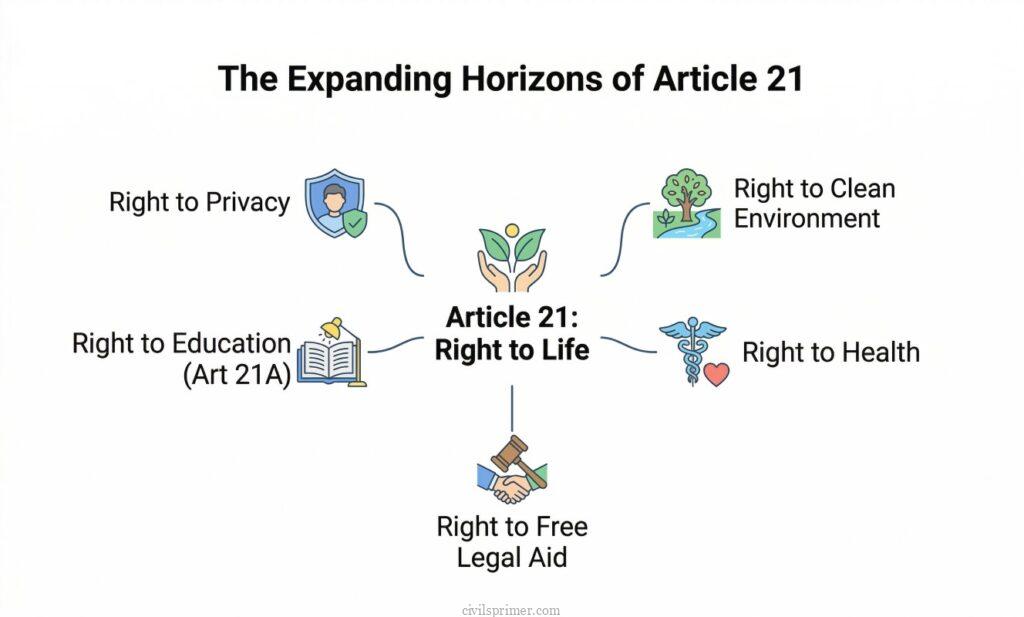
- Article 21: Protection of Life and Personal Liberty No person shall be deprived of his life or personal liberty except according to procedure established by law.
The Unstoppable Expansion of Article 21: Over the decades, the Supreme Court has transformed Article 21 into an umbrella of rights. It is no longer just about “breathing and surviving.” It now includes the right to privacy (Puttaswamy case), the right to free legal aid, the right to a clean environment (Subhash Kumar case), and the right to health,. Recently, demographic challenges like India’s aging population and the crisis of climate change have led courts to expand Article 21 further to imply a citizen’s right to be protected against the adverse effects of extreme heat and climate vulnerability.
Current Debate – Abuse of Free Speech Online: With over 800 million internet users in India, social media platforms have become the new public square. Recently, the Supreme Court heard cases concerning the abuse of Article 19(1)(a) through hate speech and digital defamation. In the Wazahat Khan (2025) and Hemant Malviya (2025) cases, the Court stressed that while digital speech is protected (as cemented in the landmark Shreya Singhal case that struck down Section 66A of the IT Act), it must come with self-regulation, warning that state regulation might become inevitable if the right to dignity is continually violated.
3. Right against Exploitation (Articles 23–24) – Before independence, landlords and colonial masters routinely subjected Indians to Begar (forced, unpaid labor).
- Article 23: Prohibits human trafficking and forced labor.
- Article 24: Prohibits the employment of children below 14 years in factories, mines, or hazardous jobs.
4. Right to Freedom of Religion (Articles 25–28) – India is a land of diverse faiths. Our secularism is not “negative” (where the state ignores religion completely like in France) but “positive”—all religions hold the same status and support from the state.
- Article 25 guarantees the freedom of conscience and the right to profess, practice, and propagate religion.
- Articles 26 to 28 allow religious denominations to manage their own affairs and prohibit compulsory religious instructions in fully state-funded educational institutions.
Note on Current Affairs: The recent political debates in July 2025 regarding the retention or removal of the words “Socialist” and “Secular” from the Preamble have brought Articles 25-28 into sharp focus, with the courts emphasizing that secularism remains an unamendable “Basic Feature” of the Constitution.
5. Cultural and Educational Rights (Articles 29–30) – In a democracy, the majority rules, but the minority must feel safe.
- Article 29: Protects the interests of minorities (and majority sections) by allowing any section of citizens to conserve their distinct language, script, or culture.
- Article 30: Grants religious and linguistic minorities the right to establish and administer educational institutions of their choice.
The Ultimate Weapon (Article 32) #
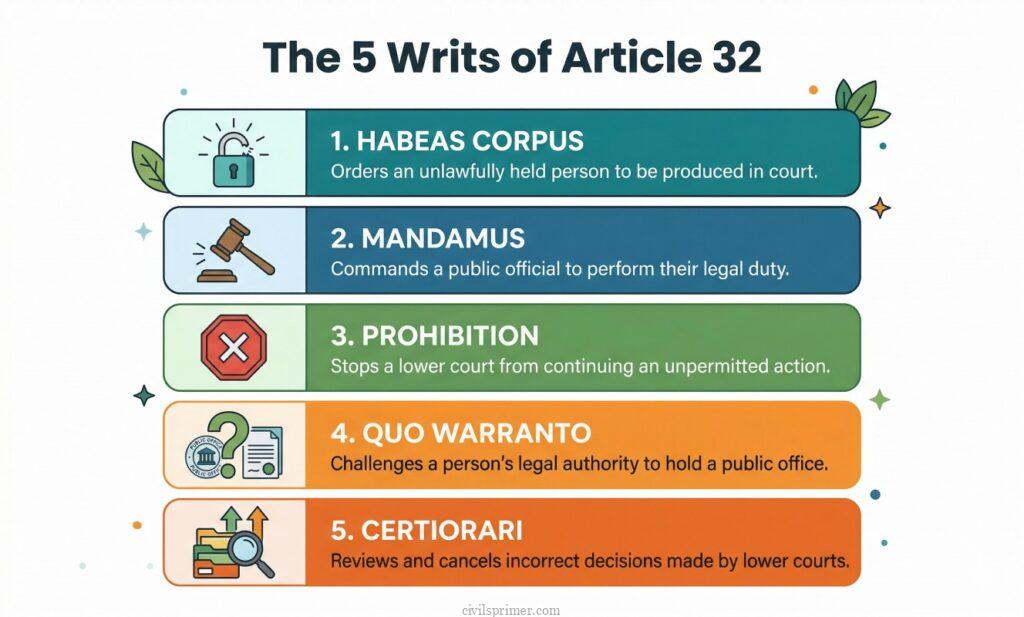
Dr. B.R. Ambedkar called Article 32 the “Heart and Soul of the Constitution”. Why? Because a right without a remedy is just an empty promise. Article 32 gives you the fundamental right to approach the Supreme Court directly if your rights are violated. The Court can issue five types of Writs (official orders) to enforce your rights:
- Habeas Corpus (“To have the body of”): Protects against illegal detention.
- Mandamus (“We command”): Orders a public official to perform their duty.
- Prohibition (“To forbid”): Issued by a higher court to a lower court preventing it from exceeding its jurisdiction.
- Certiorari (“To be informed”): Quashes the order of a lower court.
- Quo-Warranto (“By what authority”): Prevents the illegal usurpation of a public office by a person.
The Exceptions (Articles 33, 34, 35) #
Fundamental Rights are not absolute. To maintain discipline, Article 33 allows Parliament to restrict the rights of armed forces and police. Article 34 restricts rights while martial law (military rule) is in force in any area. Finally, Article 35 specifies that only Parliament (not state legislatures) can make laws to give effect to certain Fundamental Rights, ensuring uniformity across the country.
Conclusion: A Living Document #
The story of Fundamental Rights is not a history lesson; it is unfolding right now. From protecting the privacy of your digital data to ensuring you have a clean environment to breathe in, Articles 12 to 35 are continuously evolving. As a UPSC aspirant, you must not just memorize these articles; you must observe how they breathe life into our democracy every single day.
UPSC Mains Previous Year Questions #
- 2024: Right to privacy is intrinsic to life and personal liberty and is inherently protected under Article 21 of the Constitution. Explain. In this reference, discuss the law relating to DNA testing of a child in the womb to establish its paternity. (15 M)
- 2023: “The Constitution of India is a living instrument with capabilities of enormous dynamism. It is a constitution made for a progressive society.” Illustrate with special reference to the expanding horizons of the right to life and personal liberty. (15 M)
- 2017: Examine the scope of Fundamental Rights in the light of the latest judgement of the Supreme Court on Right to Privacy. (15 M)
- 2015: Does the right to clean environment entail legal regulation on burning crackers during Diwali? Discuss in the light of Article 21 of Indian Constitution and judgements of the apex in this regard. (12.5 M)
- 2014: What do understand by the concept “freedom of speech and expression”? Does it cover hate speech also? Why do the films in India stand on a slightly different plane from other forms of expression? Discuss. (12.5 M)
- 2013: Discuss Section 66A of IT Act, with reference to its alleged violation of Article 19 of the Constitution. (10 M)
Latest Important Current Events #
- Dec, 2025: Courts as Guardians, Not Regulators: Preserving Free Speech in India → Highlights the debate on Article 19(1)(a), reaffirming that courts must protect free speech without assuming the role of proactive censors over media and digital content.
- Dec, 2025: Right to Disconnect Bill, 2025: Re-defining Work–Life Boundaries → Discusses the expansion of Article 21 (Right to Life), pushing to protect employees’ mental health and personal liberty by granting them the right to ignore work communications after hours.
- Nov, 2025: Digital Personal Data Protection (DPDP) Rules, 2025 → A crucial step in operationalizing the Right to Privacy (Article 21) following the Puttaswamy judgment, detailing how citizens’ digital data can be lawfully processed and protected.
- Nov, 2025: Indian Constitution at 76: Why It Still Outpaces Western Models → An analytical overview celebrating how India’s Fundamental Rights successfully blend liberal individual liberties with a transformative agenda for social justice (like Articles 15 and 17).
- Sep, 2025: Personality Rights in India → Marks a new judicial interpretation expanding Article 21, protecting a citizen’s (often a celebrity’s) name, voice, and likeness from unauthorized commercial exploitation.
- Sep, 2025: Should India Raise Reservation Beyond 50%? → Re-ignites the constitutional debate balancing the Right to Equality (Article 14) and equal opportunity (Article 16) against affirmative action policies for marginalized demographics.
- Aug, 2025: Supreme Court Directive on Social Media Conduct Guidelines → The SC directed the Union government to frame guidelines balancing the freedom of speech (Art 19) with the right to dignity of individuals (Art 21) against cyberbullying.
- Aug, 2025: Creamy Layer Equivalence in OBC Quota → A policy debate linked directly to Article 16(4), ensuring that the benefits of public employment reservation reach the most deprived sections rather than affluent segments within the OBCs.
- Jul, 2025: Abuse Of Free Speech Online → The SC raised concerns over the misuse of Article 19(1)(a) through hate speech and fake news, observing that fundamental rights require self-discipline to prevent state-imposed censorship.,
- Jul, 2025: Socialist and Secular in India’s Preamble → Focuses on political and judicial debates surrounding the 42nd Amendment, directly impacting how the state interprets and protects the Right to Freedom of Religion (Articles 25-28).