
Imagine standing at the dawn of a new era in 1947. India had just awakened to life and freedom, but it was a fractured land—scarred by partition, burdened by extreme poverty, and divided by a dizzying array of castes, languages, and religions. The monumental task before the Constituent Assembly was not merely to write a rulebook, but to engineer a social revolution. They needed a document that could unite a subcontinent, eradicate centuries of inequality, and establish a resilient democracy. The result was the Constitution of India—the lengthiest written constitution in the world, and a “living instrument” capable of enormous dynamism.
Let us embark on a journey to understand the philosophy of this magnificent document, its core features, the judicial shield that protects it, and how it stands tall when compared to the rest of the world.
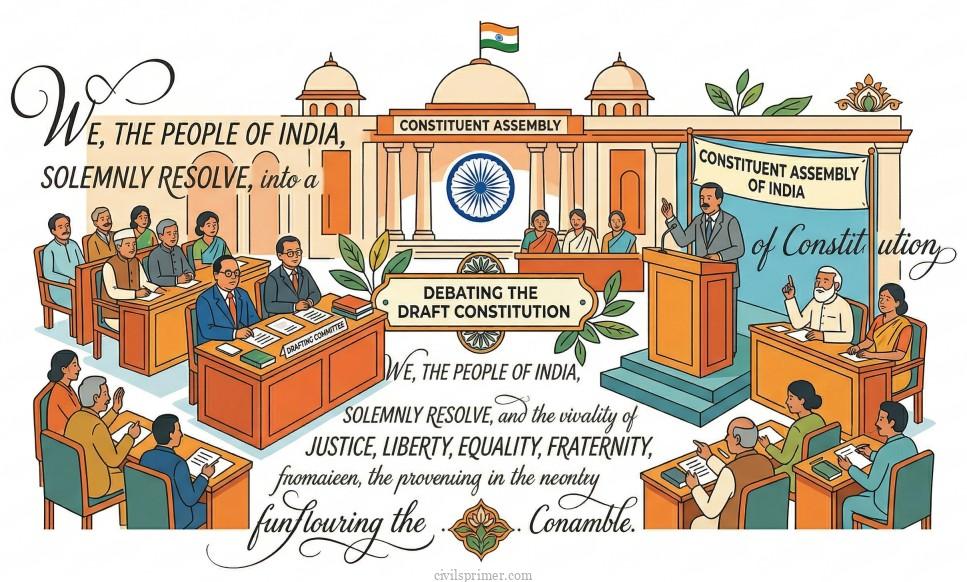
The Preamble – The Identity Card of the Constitution #
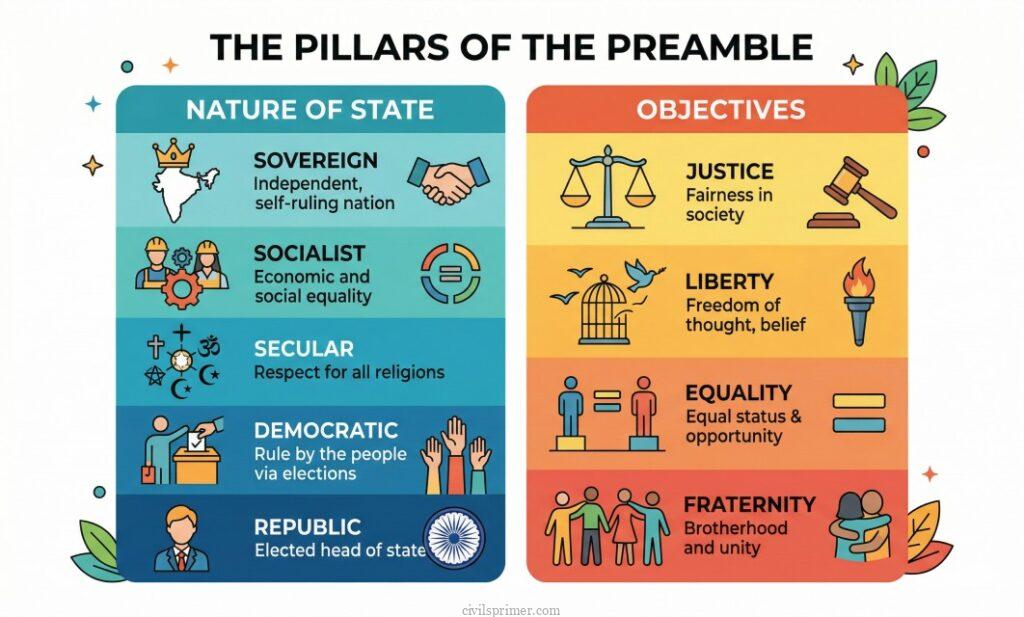
If the Constitution is a grand mansion, the Preamble is its beautifully crafted doorway. It is not merely an introduction; it is the philosophical key to the minds of the framers, outlining the nature of the Indian State and its ultimate objectives. Drafted based on the ‘Objectives Resolution’ moved by Jawaharlal Nehru in 1946, the Preamble declares India to be a Sovereign, Socialist, Secular, Democratic Republic.
Let us break down these powerful words, connecting them to the realities of modern India:
1. Sovereign, Democratic, Republic: India is internally supreme and externally free from any foreign dominion. We are a Democracy, meaning the government derives its authority from the will of the people, exercised through universal adult franchise. As a Republic, our head of state (the President) is elected, ensuring that political sovereignty vests in the people rather than a hereditary monarch.
2. Socialist and Secular (The 1976 Additions): Added by the 42nd Amendment during the Emergency, these terms made explicit what was already implicit in the Constitution.
- Socialist: Indian socialism is “democratic socialism”—a Mixed Economy where public and private sectors co-exist, aiming to end poverty, disease, and inequality. However, achieving this remains an ongoing battle. Today, India faces stark inequalities. Recent reports indicate that while the wealth of Indian billionaires surged significantly during the pandemic, the income of 84% of households declined in 2021. True socialism demands we bridge this widening gap.
- Secular: Unlike the Western model of strict separation between state and religion, Indian secularism is positive—the state gives equal respect and protection to all religions. In recent times, political debates have reignited around these terms, with some leaders questioning their Emergency-era insertion, while the Supreme Court has consistently upheld secularism as a basic feature.
3. Justice, Liberty, Equality, and Fraternity: These are the objectives the State must secure for its citizens.
- Justice (Social, Economic, and Political): This is where constitutional philosophy meets demographic reality. Social justice aims to uplift vulnerable sections. For instance, the elderly population (60+) in India was 149 million in 2022 and is projected to hit 347 million by 2050. The Constitution mandates the state to protect such vulnerable demographics. Similarly, economic justice targets the glaring female labor force participation rate, which stagnates at around 20% in India compared to a global average of 47%.
- Equality and Liberty: The Constitution abolishes untouchability and provides affirmative action to correct historical injustices, ensuring equality of status and opportunity.
- Fraternity: A sense of brotherhood that assures the dignity of the individual and the unity and integrity of the nation.
Salient Features #
The Indian Constitution is celebrated for its unique features, tailored specifically for the Indian context.
- Lengthiest Written Constitution: With 470 articles, 25 parts, and 12 schedules, it is a colossal document. It includes not just fundamental principles but detailed administrative provisions, drawing from the Government of India Act, 1935.
- Blend of Rigidity and Flexibility: It is neither entirely rigid (like the US Constitution) nor entirely flexible (like the British). Some provisions can be amended by a simple majority, others by a special majority, and some require ratification by half the states.
- Federal System with Unitary Bias: India is described as a “Union of States.” We have a federal structure (Centre and States, division of powers, Bicameralism), but strong unitary features (single citizenship, integrated judiciary, emergency provisions) that allow the Centre to take charge during crises.
- Parliamentary Form of Government: Inspired by the Westminster model, the executive (Council of Ministers) is drawn from and accountable to the legislature, ensuring close coordination rather than a strict separation of powers.
The Basic Structure Doctrine #
Every great story has a conflict. In the narrative of the Indian Constitution, the greatest conflict was between the Parliament’s desire to amend the Constitution to bring about socio-economic reforms (often clashing with the Right to Property) and the Judiciary’s duty to protect Fundamental Rights.
If the Parliament has the power to amend the Constitution (Article 368), can it rewrite the entire document? Can it destroy democracy itself?
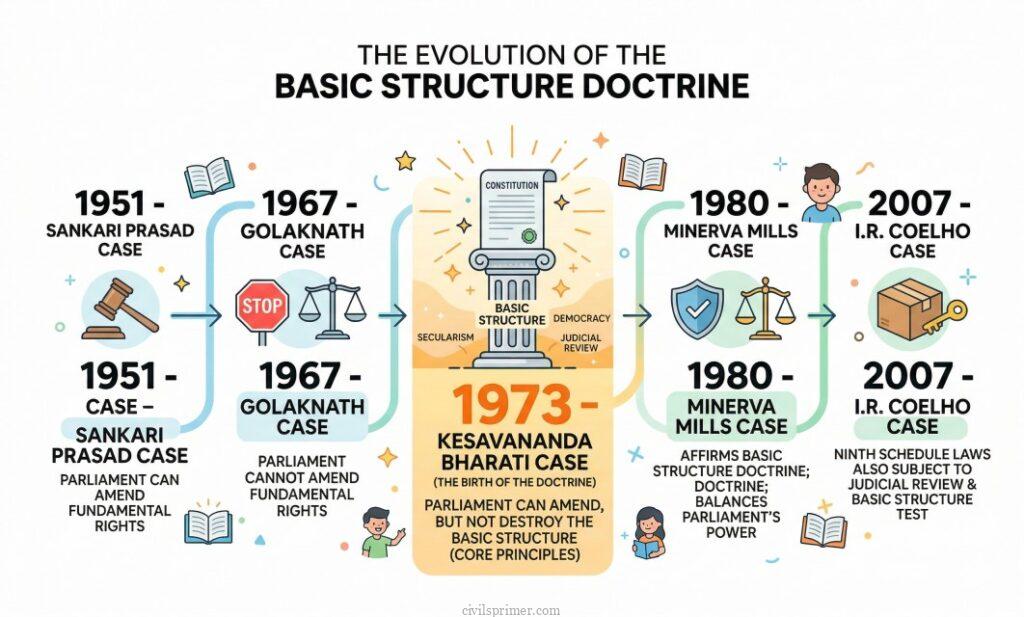
The climax of this battle arrived in 1973 with the historic Kesavananda Bharati v. State of Kerala case. A 13-judge bench of the Supreme Court delivered a masterstroke: The Basic Structure Doctrine. The Court ruled that while Parliament has vast powers to amend the Constitution, it cannot alter or destroy its “Basic Structure”.
What is the Basic Structure? The Constitution does not define it; it has evolved through judicial pronouncements. Over time, the Supreme Court has declared several features as “basic,” including:
- Supremacy of the Constitution.
- Sovereign, Democratic, and Republic nature of the Indian polity.
- Secular character of the Constitution.
- Separation of powers between the legislature, executive, and judiciary.
- Federal character of the Constitution.
- Judicial Review.
The Legacy of the Doctrine: This doctrine acted as a safety valve against authoritarianism. For example, in the Minerva Mills case (1980), the Court struck down provisions that tried to place constitutional amendments beyond judicial review. Later, in the I.R. Coelho case (2007), the Court held that any law placed in the Ninth Schedule after April 24, 1973 (the date of the Kesavananda verdict) is open to judicial review if it violates the basic structure.
Brief Global Comparisons – How India Outpaces the West #
When the Constitution was drafted, critics called it a “bag of borrowings.” Yet, a closer comparison reveals that India did not just copy; it innovated and adapted.
India vs. USA:
- Flexibility: The US Constitution is the shortest and most rigid, with only seven articles and 27 amendments in over two centuries. India’s Constitution is detailed, blending flexibility with rigidity to adapt to changing times.
- System of Government: The US follows a Presidential system with strict separation of powers and a powerful head of state not accountable to the legislature. India follows a Parliamentary system ensuring daily accountability of the executive to the legislature.
- Citizenship: The US has dual citizenship (federal and state). India, despite being a vast federation, enforces single citizenship to promote fraternal unity.
India vs. Britain:
- Nature of Constitution: Britain has an unwritten (uncodified) constitution relying heavily on conventions, making the Parliament completely sovereign. In India, the Constitution is written and supreme, and parliamentary laws are subject to judicial review by the Supreme Court.
India vs. France:
- Secularism: French secularism (Laïcité) demands a strict separation between religion and the state, pushing religion entirely into the private sphere. Indian secularism acknowledges the deep religious roots of its society, allowing the state to support and regulate religious institutions equally to ensure social welfare and harmony.
A Transformative Agenda: As recently highlighted in legal discourses, the Indian Constitution actually outpaces many Western models. Western constitutions primarily restrict state power to protect individual liberty. The Indian Constitution, however, goes further: it expands constitutional rights to shield citizens from societal oppression (like caste-based exclusion). While Western models took decades to incorporate anti-discrimination laws, India embedded them in its original text (Articles 14 to 17), blending liberal rights with a transformative agenda of social reform.
Conclusion: The Triumph of Constitutional Morality #
Dr. B.R. Ambedkar famously cautioned that “Democracy in India is only a top-dressing on an undemocratic soil”. To ensure the survival of the Constitution, he advocated for Constitutional Morality—a reverence for constitutional forms, pluralism, and fairness over mere legal compliance. The Indian Constitution has survived and thrived for over 75 years not just because of its brilliant legal drafting, but because the people, the Parliament, and the Judiciary have repeatedly upheld this morality. It remains a living document, a beacon of hope, and the ultimate guarantor of our shared destiny.
UPSC Mains PYQs #
- 2023: “The Constitution of India is a living instrument with capabilities of enormous dynamism. It is a constitution made for a progressive society.” Illustrate with special reference to the expanding horizons of the right to life and personal liberty. (15 M)
- 2021: Analyse the distinguishing features of the notion of the Right to Equality in the Constitutions of the USA and India. (15 M)
- 2019: What can France learn from the Indian Constitution’s approach to secularism? (10 M)
- 2019: India and the USA are two large democracies. Examine the basic tenets on which the two political systems are based. (15 M)
- 2016: Discuss each adjective attached to the word ‘Republic’ in the ‘Preamble’. Are they defendable in the present circumstances? (12.5 M)
- 2013: The Supreme Court of India keeps a check on the arbitrary power of the Parliament in amending the Constitution. Discuss critically. (10 M)
Latest Important Current Events #
- Nov, 2025: Indian Constitution at 76: Why It Still Outpaces Western Models → Highlights how the Indian Constitution combined liberal rights with a transformative agenda of social reform, embedding anti-discrimination protections in its original text unlike many rigid Western models.
- Nov, 2025: Constitution 131st Amendment Bill 2025 → Demonstrates the dynamic and flexible nature of the Indian Constitution, allowing the legislative framework to evolve with current political and social demands.
- Oct, 2025: Constitutional Morality → Expanding on Dr. B.R. Ambedkar’s vision, recent Supreme Court judgments have elevated constitutional morality as a foundational moral standard for governance, democracy, and rights adjudication.
- Sep, 2025: The 130th Amendment Bill: Accountability or Constitutional Overreach? → A critical debate questioning whether recent parliamentary amendments uphold executive accountability or violate the “Basic Structure Doctrine” through constitutional overreach.
- Sep, 2025: Should India Raise Reservation Beyond 50%? → Connects deeply to the constitutional philosophy of social and economic equality, testing the limits of affirmative action against the fundamental rights of equal opportunity.
- Aug, 2025: The 130th Constitution (Amendment) Bill, 2025 → Another legislative milestone reflecting the continuous use of Article 368 to amend provisions relating to Parliament and State legislatures.
- July, 2025: Socialist and Secular in India’s Preamble → Statements from political leaders reignited the debate on removing the words “Socialist” and “Secular” from the Preamble, originally added during the Emergency via the 42nd Amendment.
- July, 2025: Dangers of Regionalism → The Supreme Court warned that promoting regionalism for electoral gains threatens national unity and fraternity, emphasizing that it is as dangerous as communalism.