
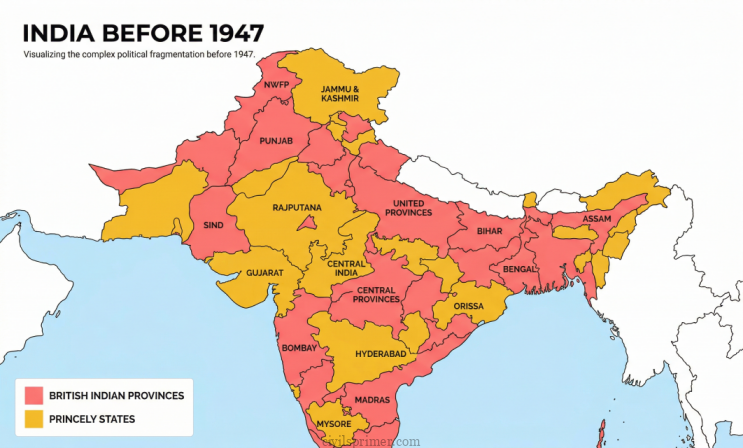
Imagine the year 1947. The British have finally left, but they haven’t left behind a single, unified country. Instead, they left a massive, bleeding geographic puzzle. On one side were the British Indian Provinces, and on the other were over 500 semi-independent Princely States. The challenge before the founding fathers, particularly Sardar Vallabhbhai Patel, was monumental: How do you stitch together a subcontinent divided by faith, languages, cultures, and thousands of miles of complex borders? The answer lay in the very first part of our new rulebook—the Constitution.
The Blueprint of the Nation (Articles 1 to 4) #
To build a house, you first need to define the plot of land. Part I of the Indian Constitution (Articles 1 to 4) does exactly this.
Article 1: The Name and the Nature The Constitution opens with a profound declaration: “India, that is Bharat, shall be a Union of States”. Dr. B.R. Ambedkar carefully chose the word ‘Union’ instead of ‘Federation’ for two critical reasons:
- The Indian federation is not the result of an agreement among independent states (unlike the United States of America).
- The states have no right to secede from the federation. The nation is whole and indestructible.
The “Territory of India” is a wider expression than the “Union of India.” While the ‘Union’ only includes the States, the ‘Territory’ includes the States, the Union Territories (UTs), and any territory the Government of India may acquire in the future.
Article 2: Welcoming the Newcomers Think of Article 2 as the front door of the country. It empowers the Parliament to admit new states into the Union or establish new states on terms and conditions it deems fit. This is the article used when territories that were not previously part of India are brought into the fold (e.g., the admission of Sikkim).
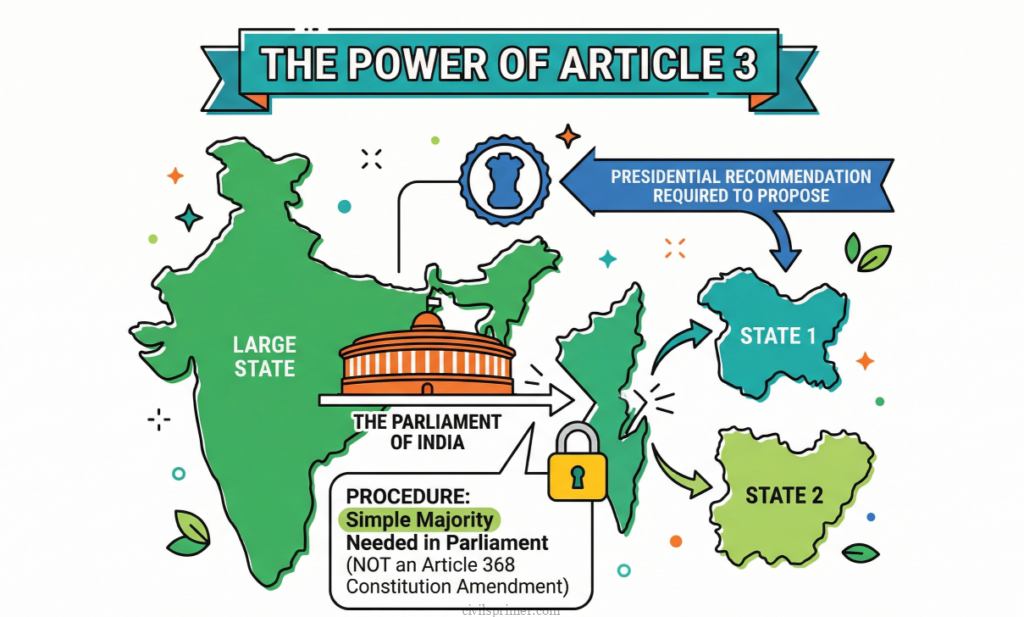
Article 3: The Magic Wand of Internal Reorganization While Article 2 is about the outside, Article 3 is about rearranging the furniture inside the house. It gives Parliament the phenomenal power to:
- Form a new State by separating territory from any State or uniting states/parts of states.
- Increase or diminish the area of any State.
- Alter the boundaries or the name of any State.
But there’s a catch! To prevent arbitrary political misuse, two conditions are laid down:
- A bill for this purpose can only be introduced in Parliament with the prior recommendation of the President.
- Before recommending, the President must refer the bill to the concerned state legislature to express its views within a specified time. Crucial Prelims Trap: The President (or Parliament) is not bound by the views of the state legislature and may accept or reject them. Hence, India is famously called an “indestructible union of destructible states”.
Article 4: The Fast Track If Parliament changes borders under Article 2 or 3, it requires amending the First Schedule (names of states) and Fourth Schedule (Rajya Sabha seats). Article 4 declares that such laws are not considered constitutional amendments under Article 368. This means Parliament can redraw the map of India using a simple majority and ordinary legislative process.
Note: Pay attention to the creative bypass of Article 3 rule by Central Government in case of removing statehood of J&K and abrogation of 370. (More details given at the end of the chapter below before conclusion)
The Language Conundrum and the SRC (1948 – 1956) #
Once the Princely States were integrated, the immediate demand was to redraw internal boundaries. During the freedom struggle, the Congress had promised that states would be organized based on local languages. But after the trauma of the 1947 Partition, the leadership panicked. Would linguistic states lead to further division?
The Committees of Delay:
- Dhar Commission (June 1948): Set up to assess the linguistic rationale. It flatly rejected language and recommended reorganization based on “administrative convenience”.
- JVP Committee (December 1948): Comprising Jawaharlal Nehru, Vallabhbhai Patel, and Pattabhi Sitaramayya, this committee also formally rejected language as the basis for statehood.
The Spark in the South: The people were not happy. In the Telugu-speaking areas of the Madras state, a massive agitation erupted. The turning point was the death of Potti Sriramulu, a veteran Congress leader, who went on a 56-day hunger strike demanding a separate state of Andhra. His death caused violent protests. Forced to concede, the government created the first linguistic state, Andhra Pradesh, in 1953.
The State Reorganisation Commission (SRC) – 1953: The creation of Andhra opened Pandora’s box. Everyone wanted their own linguistic state. The Centre appointed the Fazl Ali Commission (members: K.M. Panikkar and H.N. Kunzru).
- The Verdict: The SRC accepted language as the basis of reorganization but strictly rejected the theory of “one language, one state”. The unity of India was paramount.
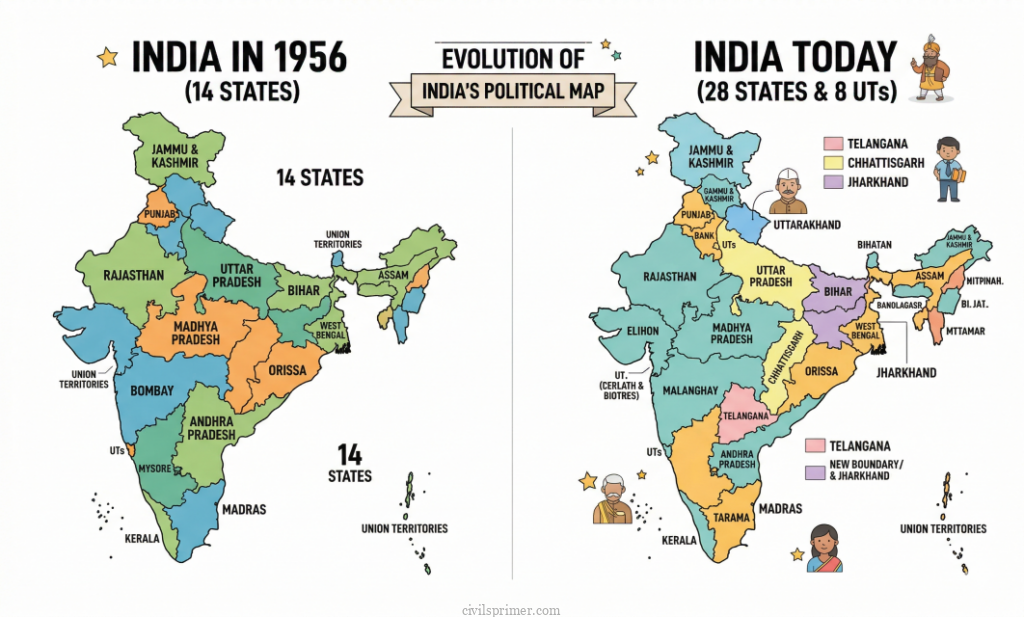
- The Result: The States Reorganisation Act was passed in 1956, abolishing the old colonial categories and creating 14 States and 6 Union Territories.
The Ongoing Evolution and Modern Demographics (1960 to Present) #
The map drawn in 1956 was not final. The political and social demands of a vibrant democracy kept reshaping it.
- 1960: Bombay was split into Maharashtra and Gujarat following massive agitations.
- 1966: The ‘Punjabi Suba’ movement led to the carving out of Punjab and Haryana.
- 1970s-80s: The sensitive Northeast was reorganized to grant statehood to Nagaland (1963), Meghalaya, Manipur, Tripura (1972), and later Arunachal Pradesh and Mizoram (1987).
- 2000s onwards: Language was no longer the sole criteria. Issues of regional imbalance and underdevelopment led to the creation of Chhattisgarh, Uttarakhand, and Jharkhand in 2000. In 2014, Telangana was born out of Andhra Pradesh.
The Modern Demographic Challenge: Why do demands for new states—like Vidarbha in Maharashtra, or statehood for the UT of Ladakh—still persist today?. The answer lies in governance, identity, and changing demographics. Today, India is facing a severe Demographic Divide. States in the North (like UP and Bihar) are in a population expansion phase, while States in the South (like Kerala and Tamil Nadu) are aging, with Total Fertility Rates (TFR) dropping below the replacement level of 2.1.
This demographic reality creates federal friction. The upcoming delimitation of Lok Sabha constituencies (post-2026) threatens to reduce the political representation of Southern states, effectively penalizing them for successfully controlling their population. As political power shifts, the demands for smaller states, administrative autonomy, and fair resource allocation will only intensify. The creation of smaller states is often debated as a tool to bring administration closer to the people and manage these demographic complexities better.
State Reorganization (Formation) Years #
| Name of State | Formation Year | Separated from Which State |
|---|---|---|
| Rajasthan | 1948–1950 | Formed by integration of multiple princely states (Rajputana) |
| Andhra State | 1953 | Madras State |
| Andhra Pradesh | 1956 | Andhra State + Telugu-speaking areas of Hyderabad State |
| Kerala | 1956 | Travancore-Cochin + Malabar district of Madras State |
| Karnataka (then Mysore State expanded) | 1956 | Kannada-speaking regions from Bombay, Hyderabad, Madras + Coorg |
| Madhya Pradesh (reorganised form) | 1956 | Madhya Bharat, Vindhya Pradesh, Bhopal + old Madhya Pradesh |
| Maharashtra | 1960 | Bombay State |
| Gujarat | 1960 | Bombay State |
| Nagaland | 1963 | Assam |
| Haryana | 1966 | Punjab |
| Himachal Pradesh (as full state) | 1971 | Upgraded from Union Territory; earlier areas mainly from Punjab hill regions |
| Meghalaya | 1972 | Assam |
| Manipur (as full state) | 1972 | Upgraded from Union Territory |
| Tripura (as full state) | 1972 | Upgraded from Union Territory |
| Sikkim | 1975 | Former protectorate/kingdom; joined India as a state |
| Mizoram | 1987 | Union Territory of Mizoram (earlier from Assam) |
| Arunachal Pradesh | 1987 | Union Territory of Arunachal Pradesh (earlier NEFA) |
| Goa | 1987 | Union Territory of Goa, Daman and Diu |
| Chhattisgarh | 2000 | Madhya Pradesh |
| Uttarakhand | 2000 | Uttar Pradesh |
| Jharkhand | 2000 | Bihar |
| Telangana | 2014 | Andhra Pradesh |
J&K reduced from State to Union Territory — what happened? #
In August 2019, the Union government effectively nullified Article 370 through Presidential Orders and reorganised the erstwhile State of Jammu & Kashmir into the Union Territories of Jammu & Kashmir and Ladakh through the Jammu and Kashmir Reorganisation Act, 2019. The most controversial aspect was procedural: since J&K was under President’s Rule and had no elected Assembly, Parliament effectively treated itself as the State Legislature for the purposes of consultation under Article 3, thereby bypassing the political obstacle of obtaining the views of an elected J&K Assembly. While the Supreme Court upheld the constitutional validity of the move in 2023, it also emphasised that statehood for J&K should be restored at the earliest.
At present, J&K has an elected government but remains a UT, while Ladakh continues as a UT without legislature and is witnessing a movement demanding statehood (by Activist Sonam Wangchuk) and 6th Schedule protections.
Conclusion #
From a fractured landmass of 500+ kingdoms to a robust union of 28 States and 8 UTs, the territorial evolution of India is a testament to the flexibility of Articles 1 to 4. Our Constitution makers brilliantly created a framework that allowed the internal map to bend to the democratic aspirations of the people, without ever allowing the external borders of the nation to break.
UPSC Mains Previous Year Questions (PYQs) #
- 2019: Discuss the nature of Jammu and Kashmir Legislative Assembly after the Jammu and Kashmir Reorganization Act, 2019. Briefly describe the powers and functions of the Assembly of the Union Territory of Jammu and Kashmir. (10 M)
- 2016: Creation of smaller states and the consequent administrative, economic and developmental implication. (Topic given in Mains syllabus context)
- 2016: To what extent is Article 370 of the Indian Constitution, bearing marginal note “temporary provision with respect to the State of Jammu and Kashmir”, temporary? Discuss the future prospects of this provision in the context of Indian polity. (12.5 M)
- 2014: Recent directives from Ministry of Petroleum and Natural Gas are perceived by the ‘Nagas’ as a threat to override the exceptional status enjoyed by the State. Discuss in light of Article 371A of the Indian Constitution. (10 M)
- 2013: Many State Governments further bifurcate geographical administrative areas like Districts and Talukas for better governance. In light of the above, can it also be justified that more number of smaller States would bring in effective governance at State level? Discuss.
Latest Important Current Events #
- Jan, 2026: India’s Demographic Dividend is Turning into a Divide → Highlights the severe demographic transition disparity between the North (high growth) and South (aging, TFR < 2.1), raising federal tensions regarding political representation and the upcoming delimitation of constituencies.
- Jan, 2026: 16th Census of India Announced → The Centre issued a notification for the first phase of Census 2027. It will be the first digital and caste-based census, crucial for redefining demographic data and subsequent socio-economic policies.
- Nov, 2025: Constitution 131st Amendment Bill 2025 → A controversial draft amendment seeking to bring the Union Territory of Chandigarh under Article 240, which would allow the President to directly frame regulations, altering its administrative structure.
- Oct, 2025: Assam-Nagaland Border Dispute → Ongoing territorial and administrative clashes along the state borders, highlighting that the historical complexities of the States Reorganisation Act and North-East mapping are still active challenges.
- Aug, 2025: Ladakh Statehood & Sixth Schedule → The Union Government introduced executive rules under Article 240 to frame regulations for the UT of Ladakh, responding to prolonged local unrest regarding its administrative autonomy.
- July, 2025: Ladakh Protests Escalation → Violent protests and a 15-day hunger strike by activist Sonam Wangchuk in Leh, demanding full statehood and inclusion in the Sixth Schedule to protect local identity and environment.