
The Great Sky Ocean: Earth’s Invisible Shield #
Imagine you are standing on the surface of the Moon. You look up, and the sky is pitch black, even though the sun is shining. There is no breeze, no sound, and no protection from the harsh cosmic rays. Now, teleport back to Earth. The sky is a brilliant blue, clouds drift lazily, and a gentle breeze cools your face. What makes the difference? It is a thin, delicate envelope of gases held in place by gravity—our Atmosphere.
It isn’t just empty space; it is a multi-layered ocean of air that protects life from the sun’s scorching heat by day and the freezing vacuum of space by night. It is an integral part of the earth’s mass, and remarkably, 99% of its total mass is squeezed within just 32 km from the earth’s surface.
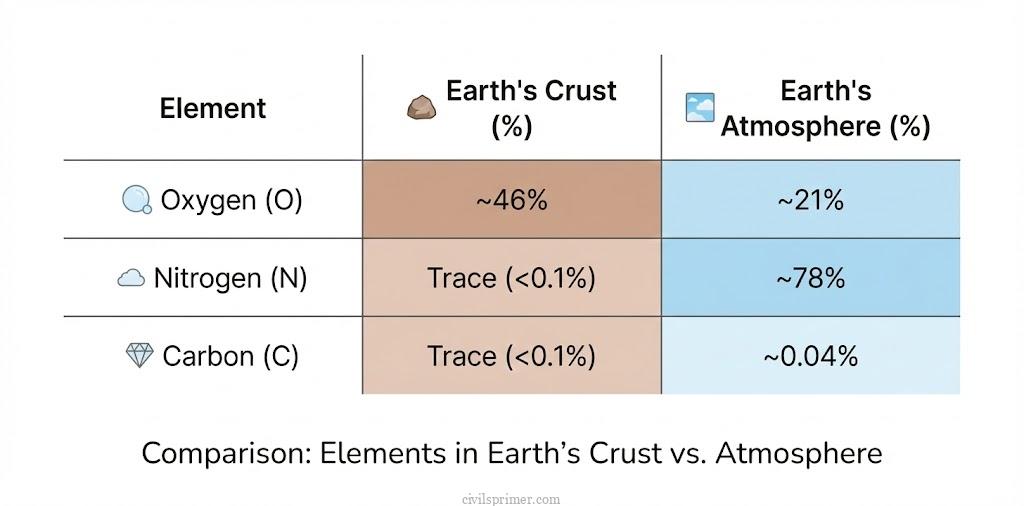
Note: % of Oxygen, Nitrogen and Carbon in Earth Crust Vs. Earth Atmosphere
Part 1: Composition of Atmosphere #
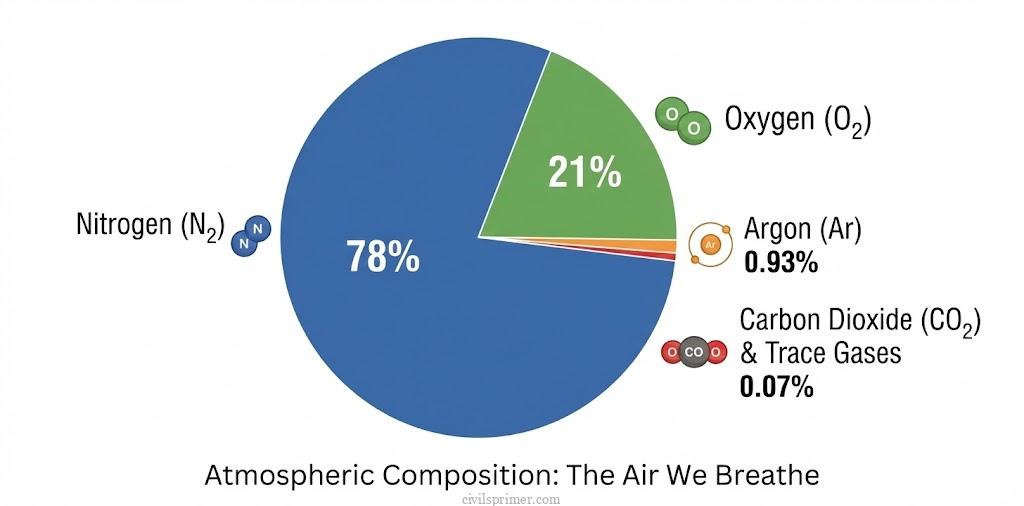
If we were to take a scoop of this “air soup” what would we find? It is not a single element but a mixture of gases, water vapour, and tiny dust particles.
1. Permanent Gases The Heavyweights:
- Nitrogen (78%): The silent giant. It acts as a diluent, preventing things from burning up too quickly.
- Oxygen (21%): The breath of life. Essential for respiration and burning fuel.
- Argon (0.93%): The lazy noble gas. Together, Nitrogen and Oxygen make up 99% of the clean, dry air.
2. Variable Gases -The Climate Controllers: Though they exist in tiny amounts, these gases control the temperature of our planet.
- Carbon Dioxide (CO₂ – 0.036%): Think of CO₂ as the Earth’s blanket. It is transparent to the incoming heat (insolation) from the Sun but opaque to the outgoing heat (terrestrial radiation) from the Earth. It traps heat, creating the Greenhouse Effect. However, like wearing a blanket in summer, too much CO₂ (from burning fossil fuels) causes Global Warming.
- Ozone (O₃): Found between 10 and 50 km up, this gas acts as a sunscreen. It absorbs harmful Ultra-Violet (UV) rays from the Sun, preventing them from frying the surface.
3. Water Vapour – The Shape-Shifter: This is the most variable gas. In the wet tropics, it can be 4% of the air; in dry deserts, less than 1%. It acts like a glasshouse, trapping heat. Crucially, without water vapour, there would be no clouds, no rain, and no snow. It decreases rapidly as you go higher up.
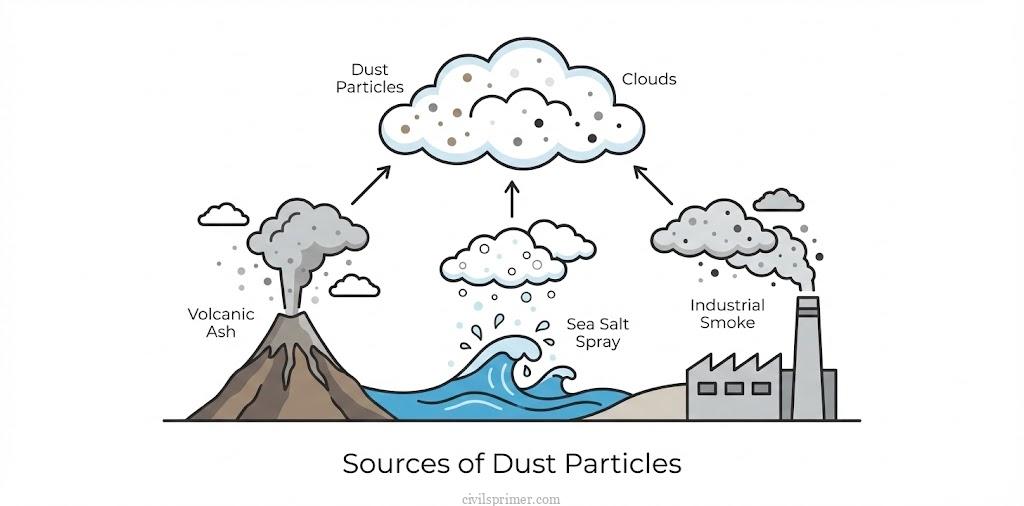
4. Dust Particles – The Solid Floating Army: The atmosphere carries sea salt, fine soil, smoke, and ash. These tiny particles have a special superpower: they are Hygroscopic Nuclei. Water vapour condenses around them to form cloud droplets. Without this “dust,” we wouldn’t have rain.
Part 2: Vertical Structure (The Layered Cake) #
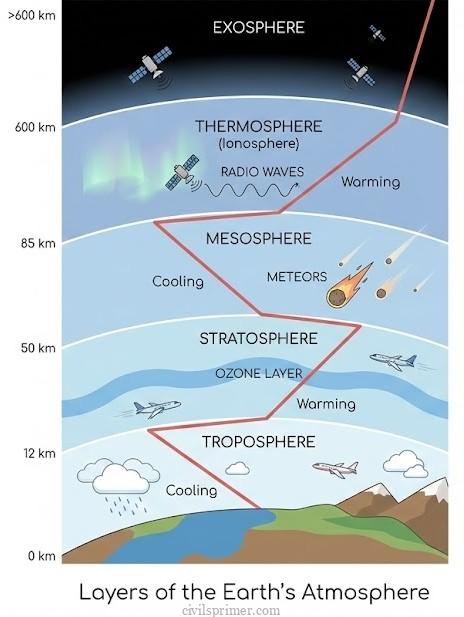
The atmosphere isn’t a uniform mix. It is layered like a cake, based on temperature and density. Let’s take a rocket ship from the ground up to the edge of space.
Layer 1: The Troposphere (The Weather Theatre)
This is the bottom layer where we live. It extends roughly 8 km at the poles and 18 km at the Equator. This is where the drama happens. Clouds, storms, rainfall, and jet streams all exist here. It contains almost all the dust and water vapour. As our rocket climbs, it gets colder. For every 165 meters we go up, the temperature drops by 1°C. This is the Normal Lapse Rate. We hit a ceiling called the Tropopause. Here, the temperature stops dropping.
Layer 2: The Stratosphere (The Calm Zone)
Extending up to 50 km, this layer is dry and free of clouds. Because it has no stormy weather, pilots love flying their jets here for a smooth ride. Because it has no stormy weather, pilots love flying their jets here for a smooth ride. This layer houses the Ozone Layer. Because Ozone absorbs UV rays, the temperature here actually increases as we go higher.
Layer 3: The Mesosphere (The Meteor Shield)
This layer extends up to 80 km. As we enter this layer, the temperature plunges again, reaching -100°C at the top (Mesopause). It is the coldest place in the atmosphere. When meteors from space try to hit Earth, friction in this layer burns them up, creating “shooting stars”.
Layer 4: The Thermosphere/Ionosphere (The Electric Layer)
From 80 km to 400 km and beyond. The sun’s radiation is so strong here that it breaks gas atoms into electrically charged particles called Ions. This sub-layer is the Ionosphere. These ions reflect Radio Waves back to Earth, making wireless communication possible . This is also where the beautiful Aurora Borealis (Northern Lights) dance. It gets extremely hot here, rising with height.
Layer 5: The Exosphere (The Final Frontier)
This is the outermost layer. The air is incredibly thin, merging into outer space. Light gases like Helium and Hydrogen float here, barely held by gravity, occasionally drifting off into space.
Part 3: Planetary Comparison – Neighborhood Watch #
How does our atmosphere compare to our neighbors? In the early days of the Solar System, Earth’s atmosphere was very different—mostly Hydrogen and Helium, which were stripped away by solar winds. Then, volcanoes spewed out gases (Degassing) to create a primitive atmosphere of Carbon Dioxide and methane, similar to Venus and Mars today.
- Venus & Mars: Their atmospheres are still 95-97% Carbon Dioxide. Because of this, Venus is a runaway greenhouse oven, while Mars is a frozen desert with a very thin atmosphere.
- Earth: Life (photosynthesis) changed everything. Plants consumed the CO₂ and released Oxygen, creating the unique “Life-supporting” blend we breathe today. This is why we are the “Goldilocks” planet—not too hot, not too cold.
Part 4: Space Missions – Eyes in the Sky #
To understand our atmosphere and its changes (like the Ozone hole or Climate Change), we use advanced technology.
- Sounding Rockets: These are used to probe the upper atmosphere (Mesosphere/Thermosphere) to measure temperature and winds.
- Satellites: Modern climatology relies on satellites.
- IRNSS (NavIC): The Indian Regional Navigation Satellite System monitors atmospheric phenomena to aid navigation.
- Juno Mission (NASA): While it orbits Jupiter, the Juno Mission helps scientists understand the origin of the solar system’s atmospheres. By studying Jupiter’s massive gas giant atmosphere, we get clues about how Earth’s primitive atmosphere might have evolved and differentiated.
- Project Stardust: Scientists even collect dust from comets (like in Project Stardust) to understand the “ingredients” of the early solar system that formed our atmosphere.
The Achievement: Through these studies, we discovered the Ozone hole over Antarctica (concentrated in the Stratosphere) and realized the danger of Chlorofluorocarbons (CFCs), leading to global treaties to heal our sky .
UPSC Mains Subjective Previous Years Questions #
- 2022: Troposphere is a very significant atmosphere layer that determines weather processes. How?
- 2017: How does the cryosphere affect global climate?
- 2013: What do you understand about the phenomenon of temperature inversion in meteorology? How does it affect the weather and the habitants of the place?
Answer Writing Minors #
Introduction and Conclusion for Mains Answers
Introduction (3-4 Lines): “The Earth’s atmosphere is a multi-layered gaseous envelope held by gravity, playing a pivotal role in sustaining life and regulating the planetary heat budget. Extending from the surface to the exosphere, its composition—primarily Nitrogen, Oxygen, and variable Greenhouse Gases—along with its thermal structure, drives the dynamic weather and climatic systems of the globe.”
Conclusion (3-4 Lines): “Conclusively, the atmosphere acts as a complex interface between the terrestrial sphere and solar radiation, governing phenomena from local weather events to global climate patterns. Understanding its delicate composition and vertical stratification is essential for addressing contemporary challenges like global warming, ozone depletion, and the erratic behavior of monsoonal systems.”
Related Latest Current Affairs #
- November 2025: Launch of Interstellar Mapping and Acceleration Probe (IMAP) NASA launched the IMAP mission to map the boundaries of the heliosphere (the magnetic bubble surrounding the solar system). It will study how solar particles are energized and interact with the interstellar medium, protecting planetary atmospheres from cosmic radiation,.
- November 2025: Discovery of Phosphine in Brown Dwarf Atmosphere Astronomers using the James Webb Space Telescope detected Phosphine (PH3) in the atmosphere of the brown dwarf Wolf 1130C. This draws a comparison to Jupiter and Saturn, where Phosphine forms naturally in deep, hot atmospheric layers, unlike on Earth where it is often biogenic,.
- November 2025: Global methane Status Report 2025 The UNEP released this report assessing the levels of methane (CH4) in Earth’s atmosphere. It highlights that methane emissions are still rising, driven by agriculture and fossil fuels, which significantly impacts the troposphere’s Greenhouse Effect and global warming potential,.
- October 2025: First Observation of Solar Impact on Lunar Exosphere (CHACE-2) ISRO’s CHACE-2 payload on the Chandrayaan-2 orbiter recorded the first direct evidence of the Sun’s Coronal Mass Ejection (CME) impacting the Moon’s exosphere (a tenuous atmosphere). It studied the distribution of neutral gases like Argon-40 in this outer atmospheric layer,.
- September 2025: Shutdown of NASA’s Orbiting Carbon Observatories (OCO) NASA announced the shutdown of OCO-2 and OCO-3, satellites dedicated to monitoring Earth’s atmospheric Carbon Dioxide (CO2) levels. These missions provided critical data on CO2 sources and sinks, essential for understanding the composition of the atmosphere,.
- July 2025: Launch of GOSAT-GW Satellite for Greenhouse Gases Japan (JAXA) launched the GOSAT-GW satellite to monitor global concentrations of Greenhouse Gases (CO2, CH4) and the water cycle. This mission aims to provide high-resolution observations of atmospheric composition to support climate policy,.
- June 2025: AmazonFACE Experiment on Atmospheric CO2 Scientists in Brazil launched the AmazonFACE experiment to simulate future atmospheric conditions. By artificially elevating CO2 concentrations in parts of the rainforest, the project studies how the biosphere interacts with the changing composition of the Earth’s atmosphere,.
- February 2025: Discovery of Hydroxymethanesulphonate (HMS) in Aerosols A study revealed the formation of Hydroxymethanesulphonate (HMS) in the atmosphere of cold urban areas like Fairbanks, Alaska. This discovery reshapes the understanding of aerosol chemistry and sulfur compounds in the troposphere under extreme cold conditions.
- December 2024: Arctic Tundra Emitting Greenhouse Gases The Arctic Report Card revealed that the Arctic Tundra is transitioning from a carbon sink to a source, emitting CO2 and methane (CH4) due to permafrost thaw. This feedback loop significantly alters the composition of the polar atmosphere.