
Imagine a symphony orchestra where 1.4 billion musicians are playing different instruments. India is exactly that—a civilizational state holding together an astonishing level of diversity. According to the 2011 Census, we have over 19,500 mother tongues and dialects, and a religious composition that includes Hindus (79.8%), Muslims (14.2%), Christians (2.3%), Sikhs (1.7%), Buddhists (0.7%), and Jains (0.4%).
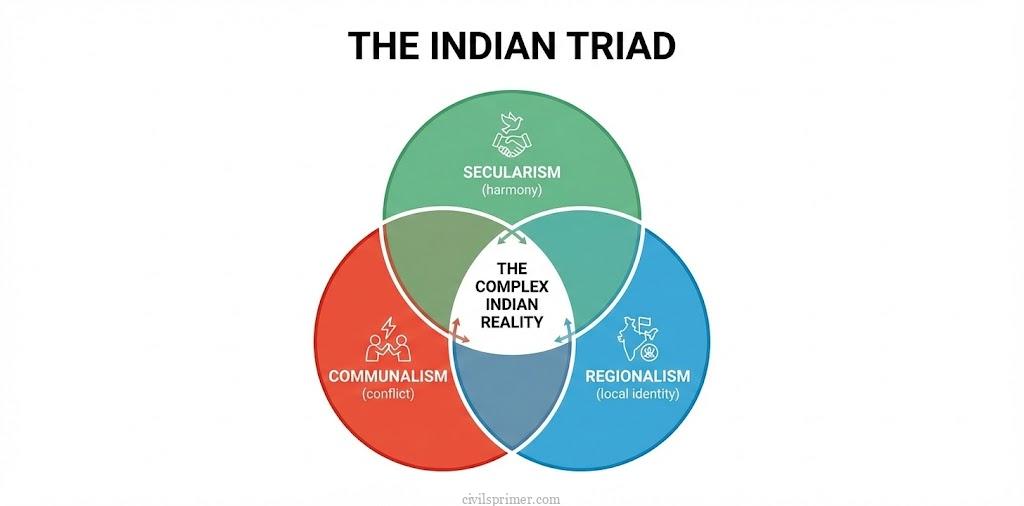
How does such a diverse nation survive without splitting apart? The answer lies in its ideological glue. For your UPSC preparation, you must understand three powerful ‘Isms’ that define India’s social and political landscape: Secularism (the glue that binds us), Communalism (the fire that threatens to burn the fabric), and Regionalism (the local pride that can either strengthen the nation or fracture it). Let us take a journey through these three fascinating concepts.
1. Secularism and ‘Principled Distance’ #
When India gained independence, it was bleeding from the wounds of religious partition. The Western world assumed we would either become a Hindu mirror-image of Pakistan or adopt the Western model of Secularism. We did neither. We created something unique.
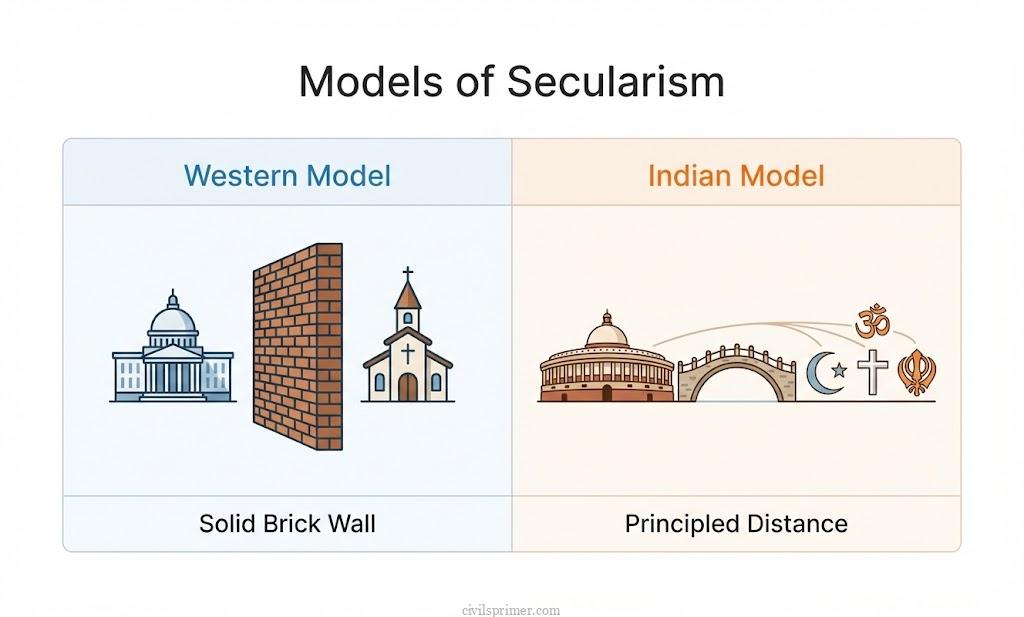
1. The Western Wall vs. The Indian Bridge
In the West, particularly in France (the concept of Laïcité) or the USA, secularism means a strict “wall of separation” between the state and religion. Religion is a strictly private affair, and the state cannot aid any religious institution.
Indian secularism, deeply influenced by Gandhian thought, is based on Sarva Dharma Samabhava (equal respect for all religions). Political theorist Rajeev Bhargava perfectly coined the term “Principled Distance” to describe our model. The Indian State does not build a wall; instead, it engages with or disengages from religion based on what promotes constitutional values like equality and liberty.
2. Why Does the State Intervene? – Because Indian society is deeply religious, the State must intervene to ensure social justice.
- Intervention for Justice: The State abolished untouchability (Article 17) and opened temples to all castes, intervening directly in Hindu practices to protect fundamental rights.
- Protection of Minorities: Under Article 30, religious and linguistic minorities have the right to establish their own educational institutions, ensuring their distinct cultures aren’t swallowed by the majority.
- Equidistant Support: The State provides security for the Amarnath Yatra and facilitates the Haj pilgrimage, treating communities equitably.
3. Current Debates: The UCC and The Hijab
Today, Indian secularism faces severe stress tests. The debate around the Uniform Civil Code (UCC – Article 44) pits the ideal of a common civic code (to ensure gender justice across all religions) against the fear of minority communities who see it as an imposition of majoritarian norms. Similarly, the 2022 Hijab Controversy in Karnataka highlighted the clash between a student’s right to express religious identity and the state’s mandate for a uniform, secular dress code in public spaces.
2. Understanding Communalism #
If Secularism is the glue, Communalism is the solvent trying to melt it away. A massive misconception among aspirants is confusing religiosity with communalism.
1. Religiosity vs. Communalism
Religiosity is your personal faith and spiritual devotion. Communalism, however, is a modern, aggressive political ideology. It operates on the false belief that because a group of people follow a particular religion, they have common political and economic interests that are fundamentally hostile to the interests of other religions.
2. The Three Stages of the Communal Fire: Historian Bipan Chandra explains that communalism doesn’t start with riots; it is a gradual poison that grows in three stages:
- Stage 1: Communal Consciousness: The simple belief that people of the same religion share common secular interests (e.g., the initial formation of the Muslim League).
- Stage 2: Liberal Communalism: Acknowledging that different religions have different political interests, though still maintaining some democratic values (e.g., the early Hindu Mahasabha).
- Stage 3: Extreme Communalism: The toxic stage where communities believe their interests are completely incompatible and hostile, advocating violence and elimination (e.g., the ideology that led to the 1947 Partition).
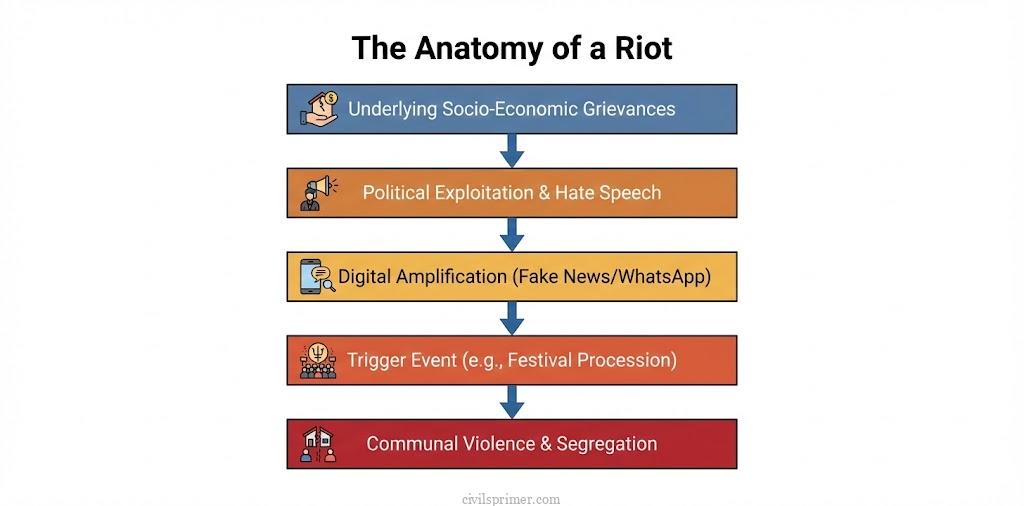
3. The Triggers and Modern Realities: Why does communalism survive today? As scholar Asghar Ali Engineer noted, religion is often just the instrument, while the root causes are secular: competition for jobs, political power, and resources.
- Political Vote Banks: Leaders exploit religious differences, using inflammatory rhetoric to polarize voters.
- Relative Deprivation: When a community feels economically or educationally left behind (as highlighted by the Sachar Committee regarding Muslims), it breeds resentment vulnerable to extremist exploitation.
- The Digital Spark: In the modern era, social media acts as an accelerant. During the 2020 Delhi Riots, WhatsApp groups and social media platforms were heavily used to spread disinformation, coordinate mobs, and amplify hate speech, turning virtual echo chambers into real-world violence.
- Current Data: The threat remains grave. A recent report documented 59 communal riots in India in 2024 alone, an 84% increase from the previous year, often triggered by religious processions.
3. Regionalism in India #
Now, let us move away from religion to geography. Regionalism is the strong feeling of loyalty and attachment to one’s specific region, often based on shared language, culture, or historical neglect.
1. Is Regionalism Anti-National? – Not necessarily. For your Mains exam, you must clearly distinguish between its forms:
- Positive Regionalism (Diversity): A healthy love for one’s local language and culture. Celebrating your regional festival doesn’t make you less Indian.
- Parochialism: A negative, inward-looking mindset that is hostile to “outsiders.” This gives birth to the dangerous “Sons of the Soil” doctrine.
- Separatism: The extreme form where a region demands complete secession from the Indian Union (e.g., the Khalistan movement in the 1980s).
2. The Twin Engines of Regional Movements – Regional movements almost always run on two tracks:
- Unequal Development (The Economic Engine): A deep feeling of relative deprivation. When a region feels neglected by the Centre in terms of infrastructure and jobs, resentment brews. For example, the creation of Telangana in 2014 was heavily driven by grievances that its resources and jobs were being diverted to coastal Andhra.
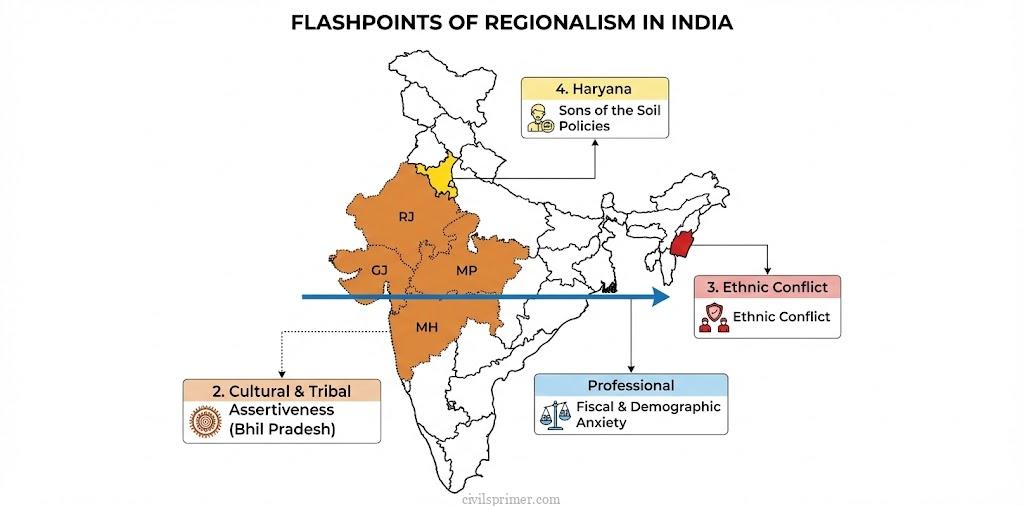
- Cultural Assertiveness (The Identity Engine): The desire to protect a distinct culture from being swallowed by the mainstream. The recent demand for a separate ‘Bhil Pradesh‘ across four western states is driven by a desire to protect distinct tribal identity coupled with a history of developmental neglect.
3. Current Affairs: The North-South Divide and Parochial Laws – Today, regionalism is taking on new, complex forms rooted in economic data and demographics.
- Fiscal Federalism & Delimitation: Southern states (like Karnataka and Tamil Nadu) have successfully controlled their populations and grown their economies. They now argue that they contribute vastly more tax revenue than they receive back, effectively subsidizing the poorer, more populous Northern states. They also fear that the upcoming political delimitation exercise will reduce their representation in Parliament because of their lower population growth. This has sparked a massive new wave of regional anxiety.
- The “Sons of the Soil” Laws: Driven by severe unemployment, states are turning to parochialism. For example, the Haryana Employment of Local Candidates Act 2020 attempted to reserve 75% of private-sector jobs for locals. While popular locally, such laws pose a severe threat to India’s unified economic market and the constitutional right to freedom of movement.
4. Ethnic Regionalism: The Tragedy of Manipur
Regional and ethnic identities can sometimes result in catastrophic violence when they clash over resources and affirmative action. The ongoing conflict in Manipur (2023-Present) between the Meitei and Kuki-Zo communities, which has resulted in over 250 deaths and mass displacement, is a grim reminder of how deeply rooted ethnic regionalism can fracture society.
Conclusion: The Task of the Administrator #
As a future civil servant, you will be thrust into the middle of these competing forces. How do you respond?
You must remember that regionalism and communalism are symptoms of deeper diseases: unequal economic growth, unemployment, and lack of justice. The solution is not merely deploying police during a riot. The solution involves Cooperative Federalism—ensuring balanced economic development across all districts (like the Aspirational Districts Programme). It involves enforcing the law impartially to build trust in the administration, ensuring that social media is monitored to stop the spark of fake news before it becomes a communal fire, and protecting the unique cultural units of India while fostering a larger national identity through initiatives like Ek Bharat Shreshtha Bharat.
Secularism in India is not a finished product; it is a daily practice. As long as the State maintains its “principled distance,” ensuring justice for the marginalized while respecting our vast diversity, the Indian symphony will continue to play.
UPSC Mains Previous Year Questions (PYQs) #
- What is regional disparity? How does it differ from diversity? How serious is the issue of regional disparity in India? (2024, 15 Marks)
- Discuss the impact of post-liberal economy on ethnic identity and communalism. (2023, 15 Marks)
- Are tolerance, assimilation, and pluralism the key elements in the making of an Indian form of secularism? Justify your answer. (2022, 15 Marks)
- Do you agree that regionalism in India appears to be a consequence of rising cultural assertiveness? Argue. (2020, 10 Marks)
- ‘Communalism arises either due to power struggle or relative deprivation.’ Argue by giving suitable illustrations. (2018, 15 Marks)
- Distinguish between religiousness/religiosity and communalism giving one example of how the former has got transformed into the latter in independent India. (2017, 15 Marks)
Related Latest Current Affairs #
- (October, 2025): Secularism and the Mysuru Dasara Case – The Supreme Court dismissed a petition challenging the invitation of a Muslim writer to inaugurate the state-run Mysuru Dasara festival. The Court reaffirmed India’s secular model, stating the State has no religion of its own and must treat all faiths with principled neutrality and equality.
- (October, 2025): SC Re-evaluates RTE Exemption for Minority Institutions – The Supreme Court questioned a 2014 judgment that granted minority schools a blanket exemption from the Right to Education (RTE) Act. The bench emphasised that minority rights under Article 30(1) must mutually co-exist with a child’s fundamental right to education under Article 21A, ensuring inclusive learning.
- (October, 2025): Resolution of the Thiruparankundram Hill Dispute – The Madras High Court resolved a complex religious dispute by confirming the official Hindu name of the hill and banning unproven animal sacrifices at a local Dargah. This ruling exemplified the constitutional balance between preserving shared archaeological heritage, maintaining public order, and upholding religious freedom.
- (October, 2025): Ladakh Statehood Protests – Violent protests erupted in Leh demanding full statehood and Sixth Schedule constitutional protection. This unrest highlights deep regional aspirations and the ongoing tension between centralised governance and the local demand for democratic empowerment, land protection, and tribal identity preservation.
- (October, 2025): SC Order on Waqf Act – The Supreme Court temporarily stayed specific provisions of the Waqf Amendment Act 2025, preventing government-designated executive officers from unilaterally adjudicating disputes over Waqf properties. This reflects the legal friction between implementing state governance reforms and protecting minority religious administrative rights.
- (September, 2025): Flare-up in Assam-Nagaland Border Dispute – Tensions escalated when armed miscreants torched nearly 100 houses in a minority-dominated village in the disputed Golaghat district. This incident underscores the volatile and violent impacts of deeply entrenched regional and ethnic boundary disputes in Northeast India.
- (August, 2025): Linguistic Secularism and Identity Politics in Maharashtra – Following instances of violence against non-Marathi speakers, political experts stressed the constitutional need to protect “linguistic secularism.” These events demonstrate how “sons of the soil” identity politics and language-based chauvinism can mimic religious communalism and threaten national integration.
- (July, 2025): Supreme Court Warning on the Dangers of Regionalism – The Supreme Court explicitly stated that promoting regionalism for electoral gain is as dangerous as communalism. This observation coincided with renewed debates on language and migration following attacks on migrant workers by regional outfits in cities like Bengaluru and Mumbai.