
The Hidden Kingdom When we think of the Earth’s wealth, we often look to the land—our lush forests, towering mountains, and deep mines. However, as an aspiring civil servant, you must cast your gaze beneath the waves. The ocean is not merely a massive body of saltwater; it is the ultimate repository of Earth’s biological and mineral wealth.
Imagine diving into the crystal-clear, sunlit waters of the Lakshadweep islands. You are immediately greeted by a kaleidoscope of colours—vibrant fish, anemones, and sprawling, intricate rock-like structures. You have just entered the domain of the Coral reef, often referred to as the “Tropical Rainforests of the Oceans” due to their incredibly high productivity and biodiversity. But this kingdom is currently under siege. Let us unravel the story of marine resources, the magical builders of the sea, the treasures buried in the dark abyss, and the looming crisis that threatens coastal millions.
The Master Builders and Their Magical Algae #
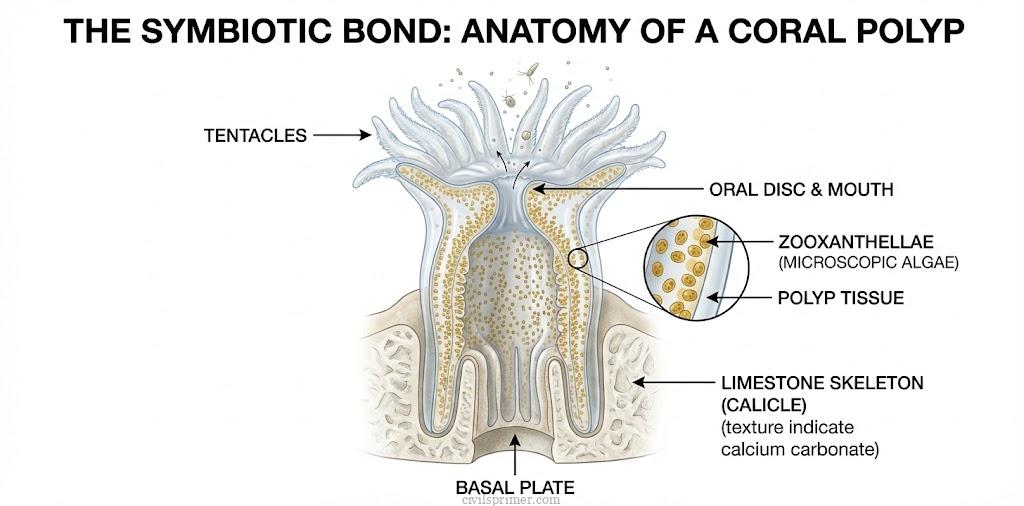
To understand a Coral reef, we must first understand its architect: the humble Coral polyp. Coral Polyps are tiny, soft-bodied marine organisms related to sea anemones and jellyfish, belonging to the Phylum Cnidaria. If you were to look closely at one, it resembles a tiny sack with a mouth surrounded by tentacles. But these creatures are nature’s greatest masons. They extract calcium salts from seawater to build hard, protective Limestone skeletons (calcium carbonate) around their bases.
When millions of these Polyps live together in colonies fastened to the rocky seafloor, and generations of them die and leave their skeletons behind, they create massive calcareous rocky masses known as Coral Reefs.
The Secret of their Survival: Zooxanthellae Corals have a brilliant survival strategy: a symbiotic relationship with a single-celled microscopic alga called Zooxanthellae (belonging to the Phylum Dinoflagellata).
- What the Algae does: Zooxanthellae live inside the Coral’s tissues. Through photosynthesis, they produce nutrient-rich carbon compounds and provide energy to the Coral, allowing these slow-growing Polyps to outcompete faster-growing algae. Crucially, the beautiful, vibrant colours of the corals do not come from the Coral tissue itself (which is clear), but entirely from these microscopic algae.
- What the Coral does: In return, the Coral polyp provides the algae with a protected, safe environment and a steady supply of carbon dioxide necessary for photosynthesis.
Conditions for Coral Growth #
Corals are the “Goldilocks” of the marine world; their environment must be just right. They are highly fragile and susceptible to rapid changes. For a Coral reef to form, several strict conditions must be met:
- Perpetually Warm Waters: Corals thrive only in tropical waters, generally between 30°N and 30°S latitudes. The water temperature must be stable, ideally around 20°C, with very narrow annual temperature ranges. UPSC Insight: This is exactly why you will rarely find Coral Reefs on the western coasts of tropical continents—the presence of cold ocean currents there chills the water, making it hostile for corals.
- Shallow Depth: Because the symbiotic zooxanthellae need sunlight for photosynthesis, corals cannot survive in the dark abyss. The ideal depth is 45 to 55 meters below the sea surface.
- Clear Salt Water: The water must be clear to let sunlight penetrate. Both freshwater (from river mouths) and highly saline water are fatal.
- Abundant Plankton & Low Pollution: They need an adequate supply of microscopic marine food (plankton). More importantly, even a minute increase in marine pollution or chemical contaminants (xenobiotics) can be catastrophic.
Types of Coral Reefs #
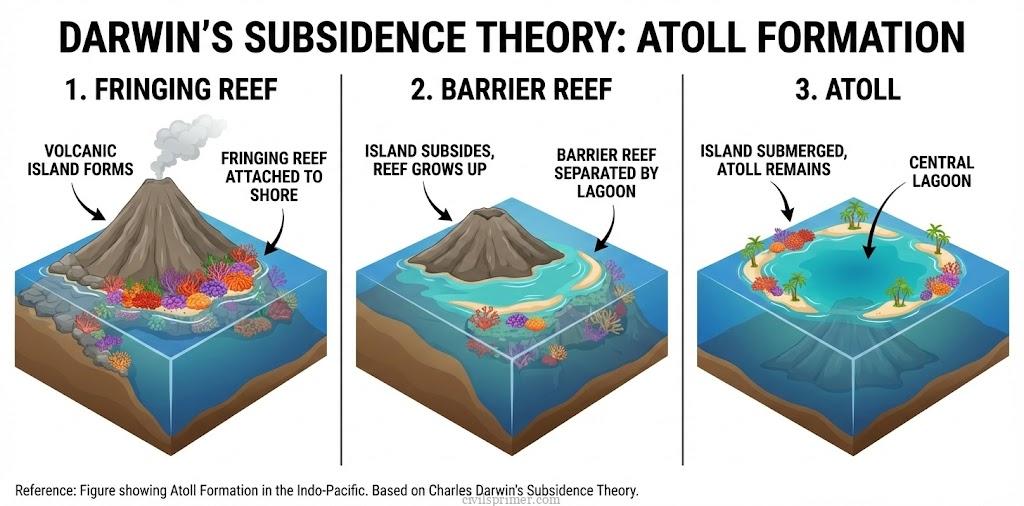
If you were to fly over the world’s tropical oceans, you would observe that these Coral architects build three distinct types of structures. The evolution of these reefs was famously explained by Charles Darwin’s Subsidence Theory.
- Fringing Reefs (The Shore Huggers): These are the most common type. They grow directly from the shore of a continent or island, forming a narrow belt (1-2 km wide). A very shallow, narrow Lagoon might separate them from the beach. They plunge steeply into the deep sea on their seaward side.
- Barrier Reefs (The Massive Walls): Over time, if the island begins to slowly subside (sink) into the ocean, the corals keep growing upwards towards the sunlight. The distance between the land and the reef increases, forming a Barrier Reef. These are extensive, linear reefs running parallel to the shore, separated by a wide, deep Lagoon.
- Global Landmark: The Great Barrier Reef off the northeast coast of Queensland, Australia, is the world’s largest reef system, stretching over 2,600 kilometres and comprising 2,900 individual reefs.
- Atolls (The Ocean Rings): If the central volcanic island completely subsides beneath the waves, all that is left is a roughly circular ring of Coral reef enclosing a central Lagoon, with no island in the middle. This is an Atoll.
Important Locations:
- In the World: The Pacific Ocean is the global capital of Coral Reefs. You will find massive atolls in Fiji, French Polynesia, Micronesia, and the Marshall Islands.
- In India: India is blessed with a rich diversity of reefs. The Lakshadweep Islands in the Arabian Sea are entirely a group of Coral atolls built on a submerged volcanic ridge (part of the Reunion Hotspot chain). We also have extensive fringing reefs in the Andaman and Nicobar Islands, the Gulf of Mannar, and the Gulf of Kachchh.
Marine Deposits and Minerals in Corals #
Let us temporarily leave the shallow, sunlit reefs and dive into the deep sea. The ocean floor is not a barren rock; it is blanketed by layers of unconsolidated sediments known as Ocean Deposits. These are broadly divided into two realms:
1. Terrigenous Deposits (The Land’s Gift): Found closer to the continents on the continental shelves and slopes, these are inorganic sediments derived from the weathering and erosion of rocks on land, brought to the ocean by rivers and winds. As you move from the coast towards the deep sea, the sequence of these deposits strictly follows the size of the particles:
Sand → Silt → Clay → Mud
2. Pelagic Deposits (The Deep Sea Carpet): Covering nearly 75% of the total deep-sea floor, pelagic deposits rule the abyss.
- Organic Oozes: These are liquid muds formed from the calcium and silica-rich remnants of microscopic marine plants and animals.
- Inorganic Red Clay: Composed primarily of silicon and aluminium dioxide of volcanic origin, Red Clay is the most widely spread pelagic deposit, covering more than half of the entire Pacific Ocean floor.
The Mineral Wealth: The ocean floor is a reservoir of future economic wealth.
- Continental Shelf Minerals: Near the shores, we find Marine Placer Deposits—heavy, valuable minerals eroded from land that accumulate due to their high density. Examples include cassiterite (tin ore), rutile, and ilmenite (titanium). The shelves are also the primary sites for massive offshore oil and natural gas reserves.
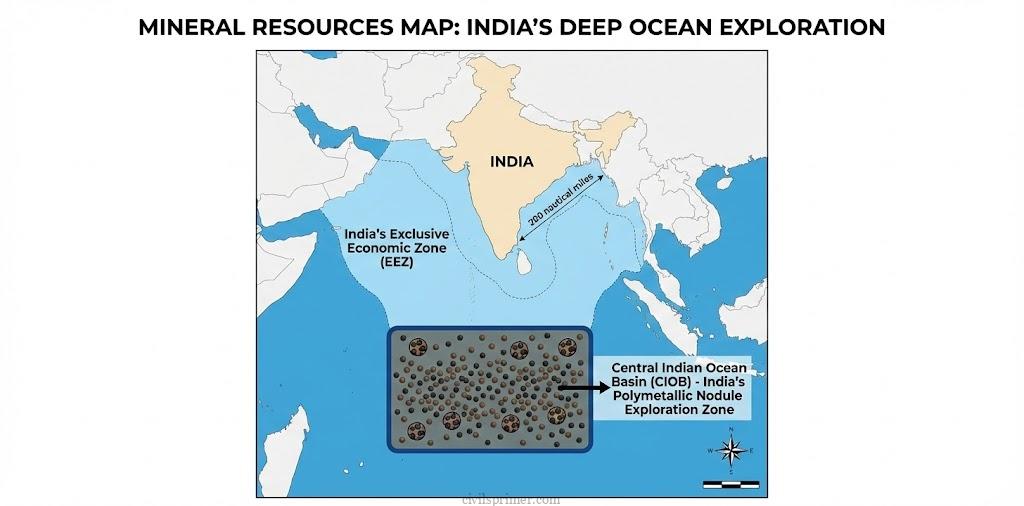
- Deep-Sea Minerals (Polymetallic Nodules): Deep on the abyssal plains lie potato-shaped lumps called Manganese Nodules (or polymetallic nodules). These are incredibly valuable, containing manganese (~30%), nickel, copper, and cobalt. Indian Context: India holds an extremely strategic position here. The International Seabed Authority has granted India exclusive rights to explore and mine these polymetallic nodules from a massive area in the Central Indian Ocean Basin (CIOB). Furthermore, massive accumulations of natural gas hydrates have been discovered by ONGC in the Bay of Bengal.
Coral Bleaching and the Climate Crisis #
Returning to our Coral Reefs, a silent tragedy is unfolding. The “Rainforests of the Sea” are turning into underwater graveyards. This phenomenon is called Coral Bleaching.
The Mechanism of Death: Remember the symbiotic Zooxanthellae that give corals their food and colour? When Coral Polyps are exposed to severe environmental stress, they panic. In a stress response, the corals expel their life-giving zooxanthellae, or the algae lose their photosynthetic pigments. Without the algae, the Coral loses 50-80% of its pigments, revealing its stark white Limestone skeleton—hence the term “bleaching”. Without their primary food source, if the stress is prolonged, the Coral starves and eventually dies.
The Ecological Triggers (Causes of Bleaching):
- Rising Ocean Temperatures (Global Warming): This is the deadliest culprit. Corals live near their upper thermal limits. A temperature increase of just 1-2°C for a few weeks can trigger mass bleaching.
- Ocean Acidification: As the atmosphere fills with excess CO2 from fossil fuels, the oceans absorb it, making the water more acidic (lowering the pH). This acidity dissolves the calcium carbonate, severely reducing the corals’ ability to build their skeletons.
- Pollution and Runoff: Chemical contaminants (xenobiotics) like herbicides, oil spills, and heavy metals poison the Polyps.
- Epizootics (Diseases & Predators): Outbreaks of predators, such as the Acanthaster planci (crown-of-thorns starfish), literally eat the Coral Polyps alive.
Current Affairs & Demographics (The Socio-Economic Shock): The impact of this destruction goes far beyond marine biology; it is a demographic and economic crisis.
- The Global Biodiversity Outlook 5 (GBO-5, 2020) issued a dire warning: more than 60 percent of the world’s Coral Reefs are currently under severe threat.
- In 2016, catastrophic marine heatwaves across northern Australia caused unprecedented, severe mass bleaching of the Great Barrier Reef.
For India, the stakes are existential. India has a massive coastline of over 7,500 km. Millions of citizens in coastal states depend directly on the marine ecosystem for their livelihoods. Coral Reefs act as vital nurseries for commercial fish populations. When reefs die, fish populations collapse, threatening the food security of millions and derailing the government’s ambitious “Blue Revolution” (focused on aquaculture and marine economy expansion).
Furthermore, Coral Reefs act as massive, natural breakwaters (buffers). They absorb the devastating kinetic energy of ocean waves, tropical cyclones, and tsunamis, protecting coastal villages from flooding and erosion. According to the National Centre for Coastal Research (NCCR), 33.6% of the Indian coastline is already highly vulnerable to erosion. As global warming simultaneously raises sea levels and destroys the protective Coral Reefs, coastal demographics are left entirely defenseless against the encroaching sea.
Conclusion: The Ticking Clock #
As a future administrator, you must view marine resources not just as subjects in a textbook, but as the fragile foundation of human survival. From the tiny polyp building atolls in Lakshadweep to the polymetallic nodules resting in the deep Indian Ocean basin, our marine wealth is immense but highly vulnerable. Tackling anthropogenic climate change and reducing marine pollution are no longer environmental luxuries; they are urgent economic and demographic imperatives to save the rainforests of the deep.
Mains PYQs #
- (2022) GS Paper 1: What are the forces that influence ocean currents? Describe their role in the fishing industry of the world. (15 Marks)
- (2019) GS Paper 1: Assess the impact of global warming on the Coral life system with examples. (10 Marks)
- (2015) GS Paper 1: Critically evaluate the various resources of the oceans which can be harnessed to meet the resource crisis in the world. (10 Marks)
Related Latest Current Affairs #
- (November, 2025): Mass Coral Mortality at Ningaloo Reef – Australia’s UNESCO-listed Ningaloo Reef experienced the death of nearly 70% of its corals due to the region’s most intense and prolonged marine heatwave on record. This event highlights the severe threat of global sea temperature rise and prolonged Coral bleaching to major fringing reef ecosystems.
- (October, 2025): Coral Microatolls Reveal Accelerated Sea-Level Rise – A scientific study using Coral microatolls in the Maldives and Lakshadweep demonstrated that sea-level rise in the central Indian Ocean has been accelerating since the late 1950s. The research showed that periods of interrupted Coral growth coincided with marine stress events like El Niño and negative Indian Ocean Dipole anomalies.
- (October, 2025): India Secures Contract to Explore Polymetallic Sulphides – India signed a 15-year contract with the International Seabed Authority (ISA) to explore Polymetallic Sulphides (PMS) in the Carlsberg Ridge of the Indian Ocean. These valuable ocean deposits, rich in copper, zinc, and gold, form near hydrothermal vents where hot mineral-rich fluids mix with cold seawater.
- (October, 2025): Southeast Asia’s First Coral Larvae Cryobank – The Philippines launched a pioneering scientific facility to freeze and preserve Coral larvae at ultra-low temperatures (–196°C). Serving as a “genetic seed vault,” this project aims to safeguard Coral biodiversity against climate change and support future reef restoration efforts.
- (September, 2025): Discovery of New Deep-Sea Coral Species – Scientists identified a new deep-sea Coral species, Iridogorgia chewbacca, in the tropical western Pacific Ocean. Named after the Star Wars character due to its hairy, curly, and shiny branches, this discovery highlights the ongoing exploration of unique benthic habitats and deep-ocean biodiversity.
- (August, 2025): Revival of Coral Reefs in the Gulf of Mannar – Two decades of scientific restoration by the Tamil Nadu Forest Department successfully rehabilitated degraded reefs across 21 islands in the Gulf of Mannar. By deploying artificial substrates and transplanting fast-growing Coral species like Acropora, the initiative significantly improved Coral survival rates and local fish density.