
Imagine a household that earns ₹100 but spends ₹150 every month. It borrows to cover the difference. Suddenly, the lenders stop lending, and the household realizes it has only enough savings to buy groceries for two more weeks. This was India in 1991. We faced a massive Balance of Payments (BoP) Crisis. Our Foreign Exchange reserves dropped to just $1.2 billion (barely enough for 2 weeks of imports). We were on the verge of defaulting on our loans.
Causes:
- High Fiscal Deficit: The government was spending much more than it earned.
- Gulf Crisis: Oil prices shot up, increasing our import bill.
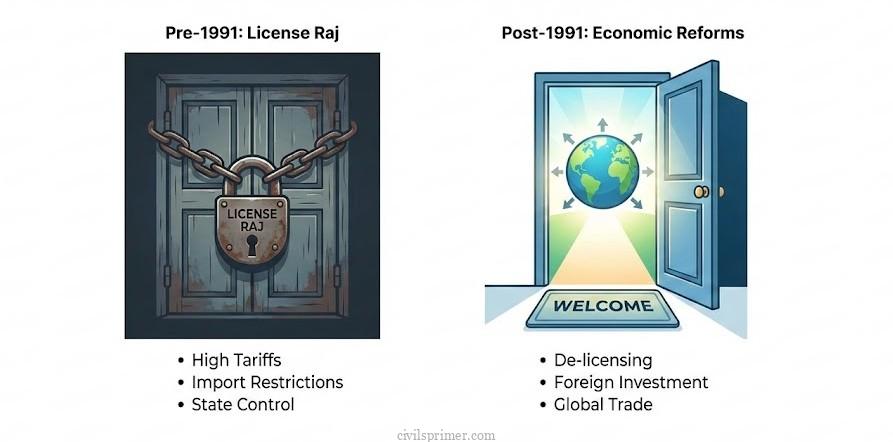
- Closed Economy: The “License Raj” strangled private businesses with red tape.
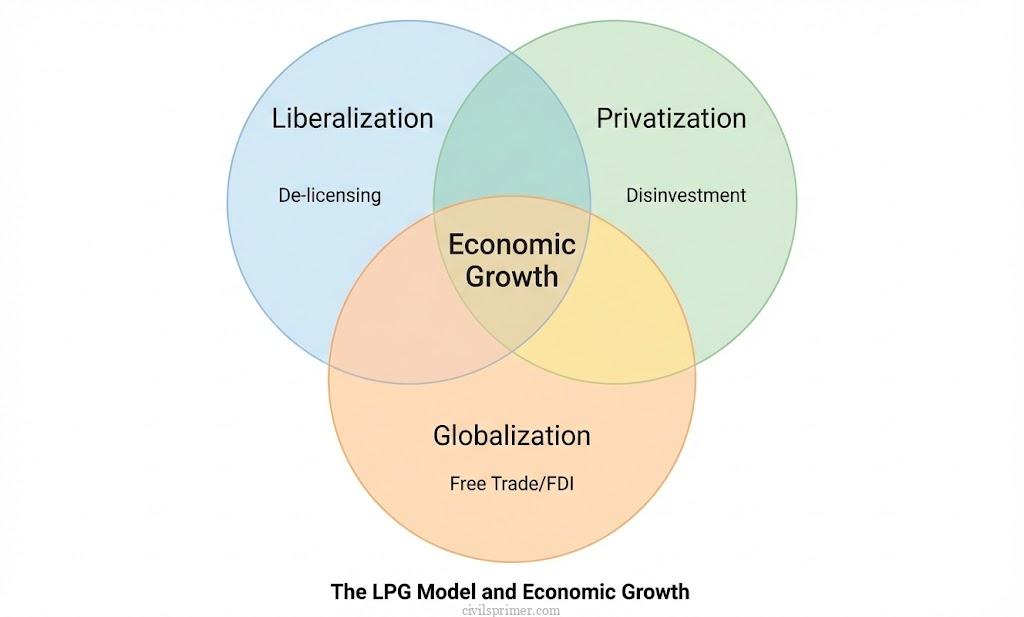
India approached the International Monetary Fund (IMF) and the World Bank for a $7 billion loan. The IMF agreed, but with a condition: India had to open up its economy and fix its structural problems. This crisis forced the government to launch the New Economic Policy (NEP) of 1991, famously known as the LPG Reforms (Liberalization, Privatization, Globalization).
LPG (Liberalization, Privatization, Globalization) #
The National Economic Policy had two main parts:
- Stabilization Measures (Short-term): Controlling inflation and fixing the BoP crisis.
- Structural Reforms (Long-term): Changing the fundamental structure of the economy via LPG.
A. Liberalization: Removing the Shackles – Removing government control and restrictions on economic activities. Following are the Key Reforms:
- Abolishing License Raj: Earlier, you needed government permission to start a Factory or produce more goods. This was scrapped for almost all industries (except 18 sensitive ones initially, now only a few like atomic energy and railway transport remain),.
- Financial Sector: The RBI’s role shifted from a “Regulator” to a “Facilitator.” Private banks were allowed to open.
- Tax Reforms: Taxes were lowered to encourage people to pay them honestly (reducing tax evasion).
B. Privatization: Reducing the State’s Burden – Shedding the ownership or management of government-owned enterprises.
- Why? Public Sector Undertakings (PSUs) were suffering losses and becoming a burden on the taxpayer. The government realized it “has no business being in business”.
- Method: Selling shares of PSUs to the public and private players (Disinvestment).
C. Globalization: Connecting with the World – Integrating the Indian economy with the world economy. Following are the Key Reforms:
- Rupee Devaluation: In 1991, the government deliberately lowered the value of the Rupee to make exports cheaper and attract foreign currency.
- Opening Markets: Import duties (tariffs) were slashed. Foreign Direct Investment (FDI) was welcomed.
Impact of Economic Reforms: The Report Card #
After three decades, let’s assess the performance.
Where were they successful?
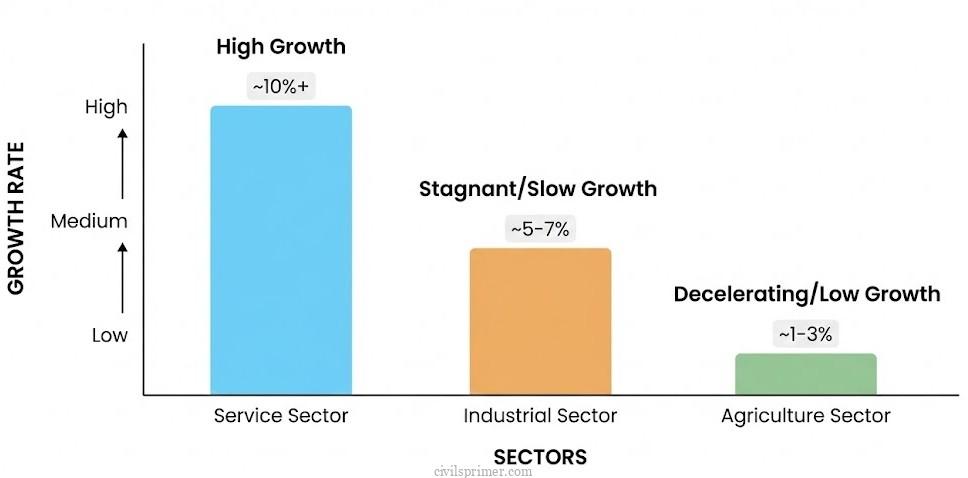
- GDP Growth: India transitioned from the slow “Hindu Rate of Growth” (around 3.5%) to become one of the fastest-growing major economies.
- Foreign Reserves: From a meager $1.2 billion in 1991, reserves crossed $600 billion recently,.
- Global Player: India became a hub for IT, software, and pharmaceuticals (the “Pharmacy of the World”).
Where did they faced challenges and failures?
- Jobless Growth: While GDP grew, employment did not grow at the same pace. The manufacturing sector stagnated at around 16-17% of GDP.
- Agriculture Neglect: Reforms largely focused on industry and services. Public investment in agriculture actually declined.
- Inequality: The gap between the rich and poor widened. While we have billionaires, we still have the largest number of poor people globally.
Disinvestment and Strategic Sale #
Disinvestment vs. Strategic Sale: Imagine you own a car.
- Minority Stake Sale: You sell 10% ownership to a friend but you keep the steering wheel (management control). This is standard Disinvestment.
- Strategic Sale (Privatization): You sell 51% or more to a friend and give them the steering wheel (management control). This is Strategic Sale.
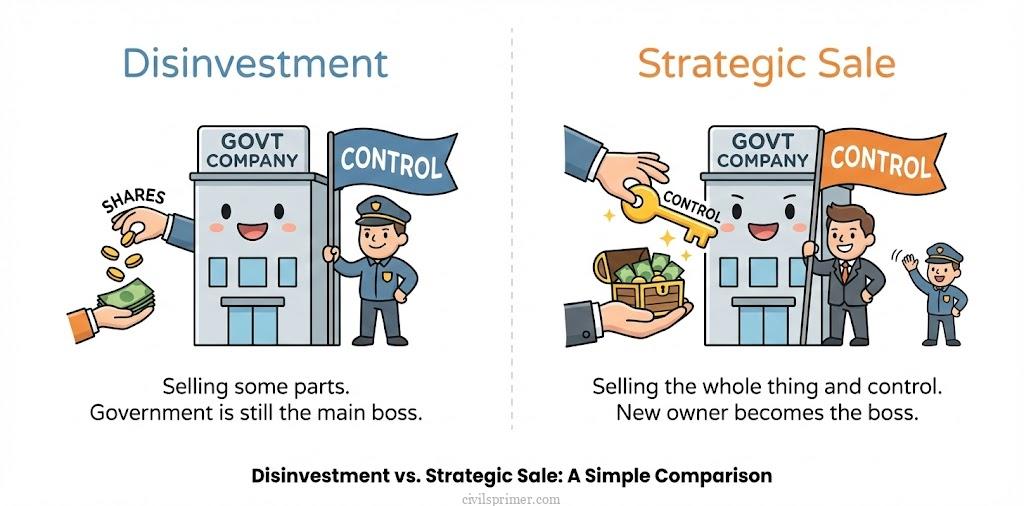
Policy Shift: Initially, the government only sold small stakes. Recently, the policy shifted to Strategic Disinvestment (e.g., selling Air India to Tata). The government has categorized sectors into Strategic (where limited PSUs will remain) and Non-Strategic (where all PSUs will be privatized or closed).
National Land Monetization Corporation (NLMC): A new body set up to monetize (sell or lease) surplus land and building assets of government agencies to generate revenue for new infrastructure.
Labour and Land Reforms: The Unfinished Agenda #
Economists call these “Factor Market Reforms” (Factors of production = Land, Labour, Capital). These are the toughest reforms to implement.
A. Labour Reforms:
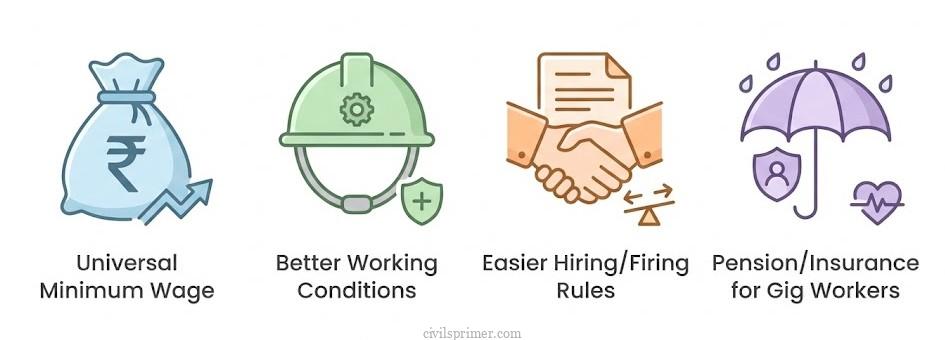
- The Issue: India had over 40 central labour laws, making compliance a nightmare for companies. This discouraged them from hiring more workers (creating the “Missing Middle” problem).
- The Reform (2019-2020): The government consolidated 29 central labor laws into 4 Labour Codes:
- Code on Wages.
- Code on Industrial Relations.
- Code on Social Security.
- Code on Occupational Safety, Health, and Working Conditions.
- Goal: To simplify rules, allow fixed-term employment, and expand social security to the unorganized/gig sector.
B. Land Reforms:
- The Issue: Land records in India are messy. Ownership is often unclear (presumptive titles), leading to endless litigation.
- Reforms:
- SVAMITVA Scheme: Using drones to map rural land and provide property cards.
- Land Leasing Laws: NITI Aayog proposed a Model Land Leasing Act to legalize land leasing, protecting the rights of the owner while giving security to the tenant farmer.
- DILRMP: The Digital India Land Records Modernization Programme aims to computerize all land records.
Recent Economic Reforms (Post-2014) #
The reform process didn’t stop in 1991. The “Second Generation” reforms are ongoing.
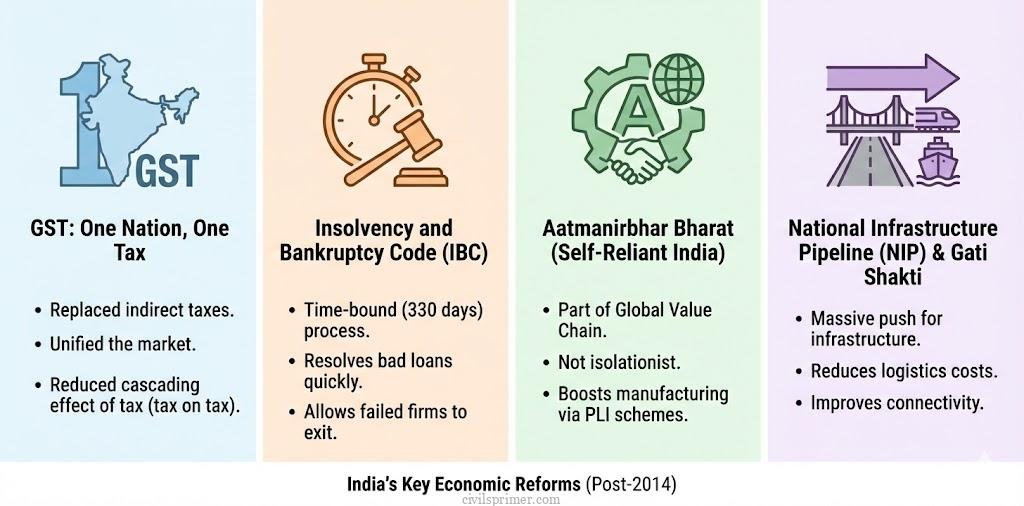
- GST (Goods and Services Tax): One Nation, One Tax. It replaced a web of indirect taxes, unified the market, and reduced the cascading effect of tax (tax on tax).
- Insolvency and Bankruptcy Code (IBC): Earlier, it took years to close a failed company. IBC provided a time-bound (330 days) process to resolve bad loans and allow firms to exit.
- Aatmanirbhar Bharat (Self-Reliant India): Launched during COVID-19. It focuses on making India a part of the Global Value Chain rather than being isolationist. Key tool: Production Linked Incentive (PLI) schemes to boost manufacturing.
- National Infrastructure Pipeline (NIP) & Gati Shakti: Massive push for infrastructure to reduce logistics costs and improve connectivity.
Mains PYQs #
Economic Reforms, Liberalization, Privatization & Globalization
- 2016: How globalisation has globalization led to the reduction of employment in the formal sector of the Indian economy? Is increased informalisation detrimental to the development of the country?
- 2014: Foreign Direct Investment (FDI) in the defence sector is now set to be liberalized. What influence is this expected to have on Indian defence and economy in the short and long run?
- 2013: Examine the impact of liberalization on companies owned by Indians. Are they competing with the MNCs satisfactorily?
Labour Reforms & Employment
- 2017: Account for failure of the manufacturing sector in achieving the goal of labour intensive exports. Suggest measures for more labour-intensive rather than capital intensive exports.
Land Reforms
- 2021: How did land reforms in some parts of the country help to improve the socio-economic conditions of marginal and small farmers?
- 2016: Discuss the role of land reforms in agricultural development. Identify the factors that were responsible for the success of land reforms in India.
- 2013: Establish the relationship between land reform, agriculture productivity and elimination of poverty in the Indian Economy. Discussion the difficulty in designing and implementation of the agriculture friendly land reforms in India.
Answer Writing Minors #
- Introduction: “The economic crisis of 1991 acted as a watershed moment for the Indian economy, necessitating a shift from a closed, state-dominated model to an open, market-oriented one via the LPG reforms. Today, as India aims for a $5 Trillion economy, the focus has shifted from ‘first-generation’ reforms to ‘structural’ reforms in land, labour, and logistics.”
- Conclusion: “While the 1991 reforms unleashed India’s growth potential, the benefits have not been equitable, leading to a ‘Jobless Growth’ phenomenon. The way forward lies in completing the unfinished agenda of factor market reforms (Land and Labour) and focusing on Inclusive Growth to ensure the fruits of development reach the ‘last mile’.”
Related Latest Current Affairs #
- November 2025: Draft National Labour & Employment Policy (Shram Shakti Niti 2025) The Ministry of Labour & Employment released this draft policy to shift from a regulator to an “employment facilitator” role. It aims to modernize India’s labour ecosystem by integrating social security databases (EPFO, e-Shram), promoting gig worker protection, and creating a unified “Labour Stack” for data-driven governance.
- November 2025: Implementation of Four Labour Codes The government announced the consolidation of 29 outdated labour laws into four simplified codes: Wages, Industrial Relations, Social Security, and Occupational Safety. This historic reform aims to universalize minimum wages, allow fixed-term employment, and simplify compliance to boost investment and formalization.
- October 2025: GST 2.0 – Rate Rationalisation and Reform The GST Council approved a “Next-Gen” reform simplifying the tax structure into two main slabs (5% and 18%) and a luxury slab. This “GST 2.0” aims to reduce litigation and compliance costs, furthering the indirect tax reforms initiated in 2017 to create a unified national market.
- August 2025: India–China Reform Deficit Analysis Recent analyses highlighted a “reform deficit” where India struggles with low private investment and stagnant manufacturing compared to China. The discourse focuses on the need for “next-generation” factor market reforms (land, labour) to move beyond the consumption-led growth model established post-1991.
- August 2025: Employment Linked Incentive (ELI) Scheme Approved by the Cabinet, this scheme serves as a direct intervention to address “Jobless Growth,” a critique of the post-liberalization era. It incentives firms to create net new jobs, aiming to formalize the workforce and boost labour-intensive manufacturing.
- July 2025: Relaxing SEZ Rules for High-Tech Manufacturing The government relaxed key provisions of the SEZ Rules, 2006, to encourage semiconductor and electronics manufacturing. This continues the liberalization of export-oriented units to integrate India into high-value global value chains (GVCs).
- February 2025: RBI Study on ‘Quality of Public Expenditure’ (Post-1991 Analysis) The RBI released a study tracking the efficiency of government spending since the 1991 reforms. It noted that fiscal discipline (FRBM Act) and increased capital expenditure have significantly improved India’s growth and social indicators over the last three decades.
- February 2025: Zamindari Abolition and Land Reforms Review Discussions on the abolition of the Zamindari system resurfaced, highlighting the legal and political challenges of India’s earliest economic reforms. The focus remains on the unfinished agenda of equitable land distribution and the need for modern land titling reforms.