
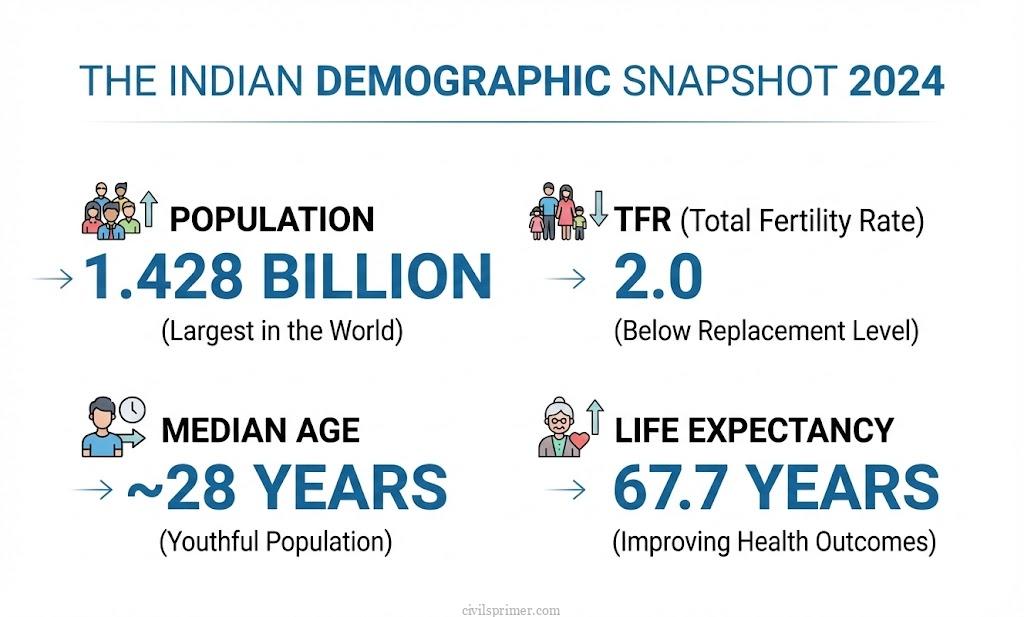
For decades, the narrative surrounding India’s population was one of “explosion” and doom. However, the story has fundamentally changed. In 2023, India officially overtook China to become the world’s most populous nation, with over 1.428 billion people. Yet, this is no longer a story of out-of-control breeding.
According to the National Family Health Survey (NFHS-5, 2019-21), India’s Total Fertility Rate (TFR)—the average number of children a woman has over her lifetime—has dropped to 2.0. This is below the “replacement level” of 2.1, meaning the Indian population is finally stabilizing. If our TFR is falling, why is our population still growing? The answer is “Population Momentum”. Because we had high birth rates in the past, a massive proportion of our population is currently in the reproductive age group.
For the UPSC exam, you must stop viewing population merely as a “numbers problem” and start viewing it as a complex socio-economic matrix involving age structures, gender, migration, and Human Capital.
1. Demographic Transition and the ‘Divide’ #
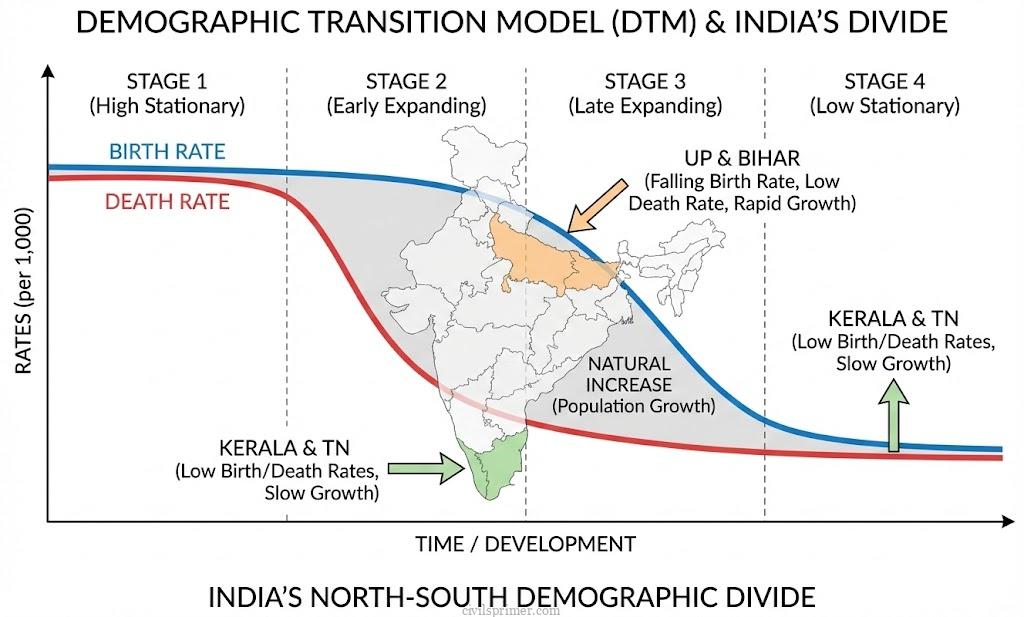
To understand a country’s population journey, sociologists use the Theory of Demographic Transition. This theory explains how societies move from high birth/death rates (agrarian societies) to low birth/death rates (industrialized societies).
India as a whole is currently in the late third stage of this transition (falling birth rates, low death rates, slowing growth). However, India is not a monolith. We suffer from a severe ‘Demographic Divide’ between the North and the South:
- The Southern Vanguard (Stage 4): States like Kerala and Tamil Nadu have already undergone their demographic transition. They have highly educated female populations, TFRs well below replacement level (around 1.8), and a rapidly aging society.
- The Northern Bulge (Stage 3): The “BIMARU” states (Bihar, Madhya Pradesh, Rajasthan, Uttar Pradesh) still have higher TFRs (e.g., Bihar is at 2.98) and a massive youth bulge.
This divide means the Indian State must formulate two sets of policies simultaneously: building schools and creating jobs for the North, while building geriatric care and managing an aging workforce in the South.
2. The Demographic Dividend – A Closing Window #
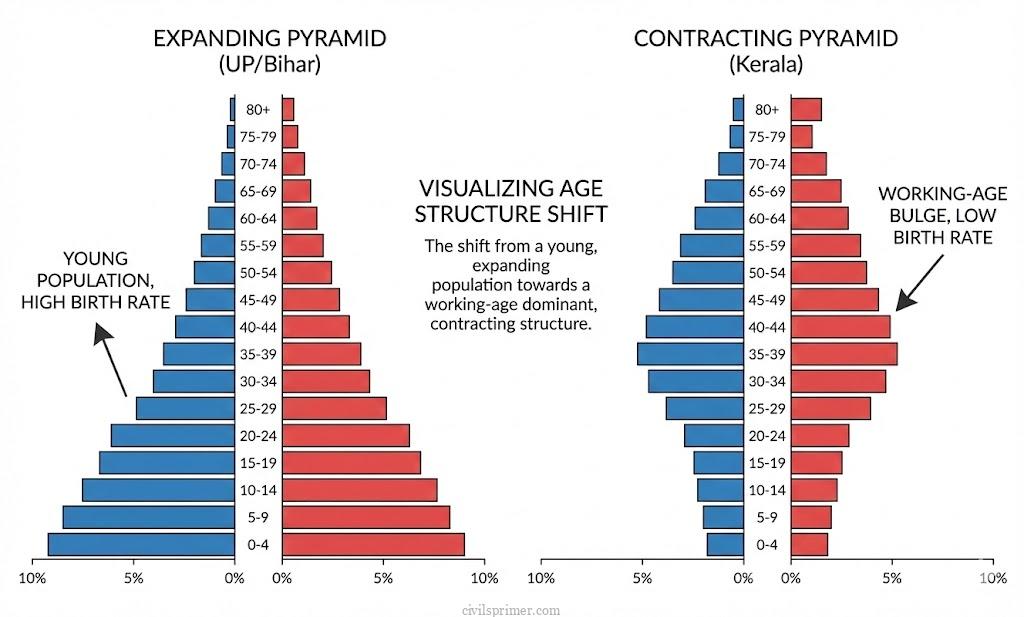
Because of our falling birth rates, the share of our young, dependent population is decreasing, while the share of our working-age population (15-59 years) is expanding. This creates the Demographic Dividend—a window where the economy can soar because there are more hands to work and fewer mouths to feed, leading to higher savings and investment. India has the longest demographic window in the world, available roughly from 2005-06 to 2055-56. But is this youth bulge a dividend or a looming disaster?
The Threat of a Demographic Disaster:
- Jobless Growth: India is one of the fastest-growing economies, but this growth is heavily skewed towards the highly skilled IT and service sectors, leaving millions of moderately educated youths unemployed or trapped in the informal sector.
- Poor Human Capital: A workforce cannot be productive if it is unhealthy. A staggering 57% of Indian women aged 15-49 are anemic, meaning millions of youths are born with compromised physical and cognitive abilities.
- The Skill Mismatch: There is a severe disconnect between what schools teach and what the industry needs.
To turn this bulge into a true dividend, India needs massive investments in the “Three Pillars of Human Capital”: Health (e.g., Poshan Abhiyan), Education, and Vocational Skilling (e.g., PM Kaushal Vikas Yojana).
3. Population Aging – The Silver Tsunami #
While we obsess over the youth, a silent revolution is occurring at the other end of the age spectrum. India is aging rapidly due to increased life expectancy (now around 67.7 years) and falling fertility. Currently, the elderly (60+ years) constitute about 10.5% of the population, but this will nearly double to 20% by 2050.
The Unique Challenges of Indian Aging:
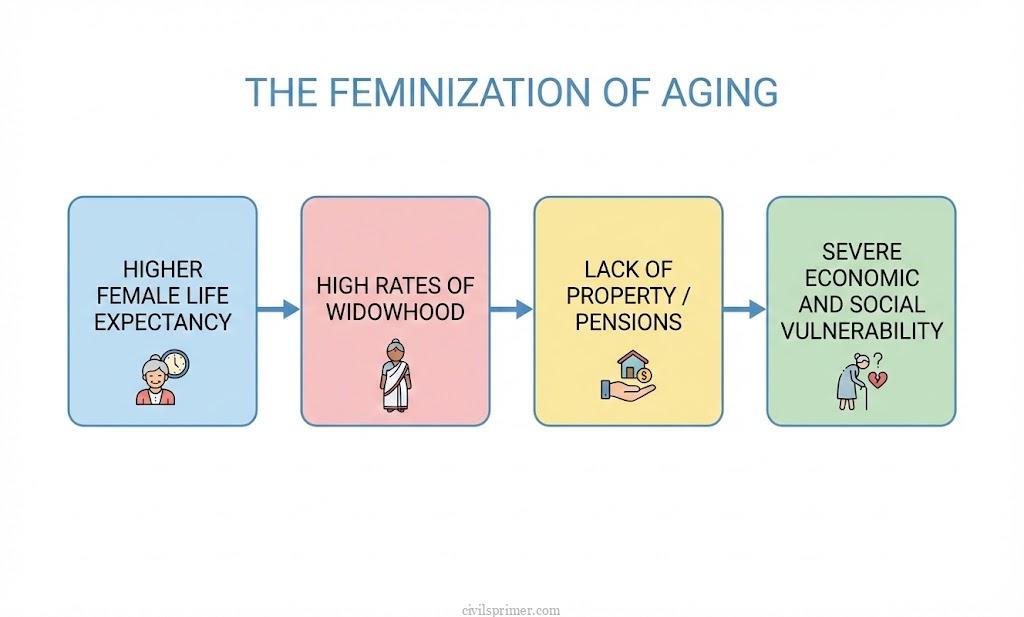
- The Feminization of Aging: Women biologically outlive men. Consequently, a vast majority of the “oldest old” (80+ years) are widows. They face a triple burden: old age, gender discrimination, and economic dependency due to lack of property rights.
- Erosion of the Joint Family: Historically, the joint family was the social security net for the elderly. With urbanization, youth migration, and the rise of nuclear families (now 50% of households), millions of elderly are facing the “Empty Nest Syndrome”.
- The Care Crisis: A striking example is Kerala, where high international migration has left thousands of elderly parents living alone, surviving on remittances but suffering profound emotional loneliness and a lack of physical care.
To address this, the government has launched the Rashtriya Vayoshri Yojana (providing physical aids to BPL senior citizens) and the SAGE Initiative (promoting start-ups in elderly care products). However, establishing a comprehensive “Silver Economy” and universal pension system is the need of the hour.
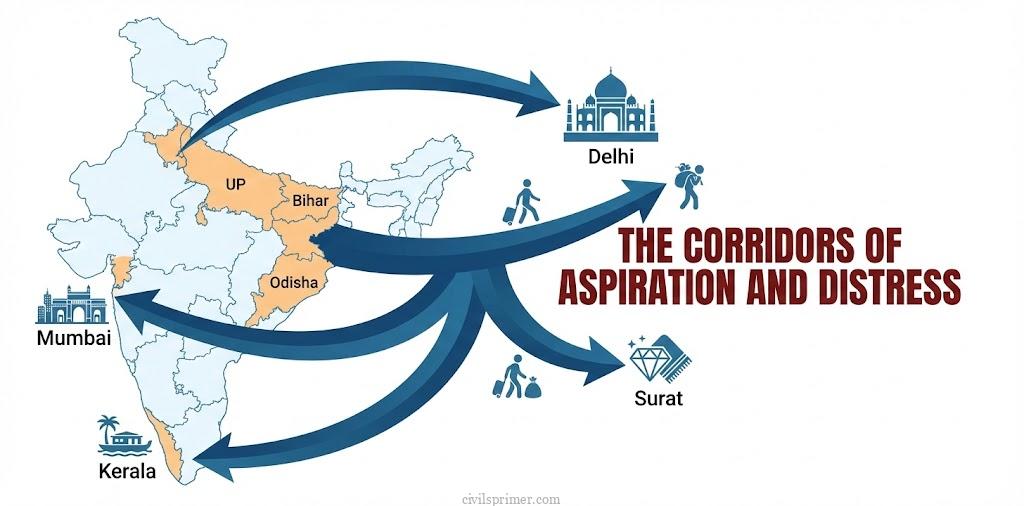
4. The Migration Matrix – People on the Move #
“Migration is the physical manifestation of economic inequality and aspiration.” – The 2011 Census recorded over 450 million internal migrants in India. The Constitution, under Article 19(1)(d) and (e), guarantees the freedom to move and settle anywhere in India, making this a fundamental driver of our economy. Following are the broad migration types:
1. Internal Migration: Distress vs. Aspiration
- Rural-to-Urban Push: Agrarian distress, crop failures, and a lack of rural jobs act as massive “Push” factors, creating distress migration. For example, landless labourers from the drought-prone Bundelkhand region frequently migrate to Delhi or Surat to work in hazardous construction jobs.
- The Gendered Reality: While men mostly migrate for employment, the Census reveals that a staggering 86.8% of female migration in India is driven by marriage (patrilocal exogamy). However, an increasing number of young women are now migrating to cities for education and IT sector jobs, transforming their personal freedom and family dynamics.
- The Urban Crisis: Cities like Mumbai and Surat thrive on cheap migrant labor. Yet, migrants are systematically excluded from urban benefits, living in slums without basic sanitation or voting rights. Initiatives like One Nation One Ration Card and Ayushman Bharat are crucial steps toward making welfare “portable” for these floating populations.
2. International Migration: Brain Drain vs. Remittance Economy Globally, India has the largest diaspora. This results in the “Brain Drain” (skilled IT and healthcare workers moving to the US, UK, Canada). However, this also results in a massive “Brain Gain” and economic boom. In 2023, India received a staggering $125 billion in remittances, primarily from the blue-collar workforce in the Gulf Cooperation Council (GCC) countries.
6. Gender, Coercion, and Population Policy #
You cannot separate demography from gender. Economist Amartya Sen coined the term “Missing Women” to describe the millions of Indian females who are demographically absent due to sex-selective abortions, infanticide, and chronic health neglect.
Despite our overall sex ratio improving to 1020 females per 1000 males, the Sex Ratio at Birth (SRB) remains heavily skewed at 929 females per 1000 males (NFHS-5). This proves that while women live longer, the deep-rooted patriarchal desire for a male heir (“son meta-preference”) still dictates who gets to be born.
The Debate on the ‘Two-Child Policy’: Recently, states like Assam and Uttar Pradesh have mooted punitive Two-Child Policies, denying government jobs or welfare to families with more than two children. Sociologists strongly argue against this:
1. It is redundant: India is already experiencing a natural decline in fertility (TFR 2.0).
2. It harms women: In a patriarchal society, strict birth limits lead to an increase in forced sex-selective abortions because families will ensure their “allowed” two children are male.
3. The True Contraceptive is Development: The National Population Policy (NPP) 2000 correctly shifted focus from “coercive targeting” to women’s empowerment. The data is clear: higher female literacy directly correlates with delayed marriage and lower fertility.
Conclusion: From Numbers to Human Capital #
India’s demographic journey is at a historic crossroads. The era of the “population explosion” is effectively over, replaced by the nuanced challenges of an aging South, a youth-heavy North, rapid urbanization, and massive internal migration.
For a civil servant, the goal is no longer to merely “control” the population. The goal is to transform this 1.428 billion-strong crowd into healthy, educated, and skilled Human Capital. Only by investing in our youth, ensuring equitable urban spaces for migrants, and protecting our vulnerable elderly can India truly cash in its demographic dividend before the window closes in 2055.
Mains PYQs #
- What is the concept of a ‘demographic winter’? Is the world moving towards such a situation? Elaborate. (2024, 10 Marks)
- Why do large cities tend to attract more migrants than smaller towns? Discuss in the light of conditions in developing countries. (2024, 10 Marks)
- Discuss the main objectives of Population Education and point out the measures to achieve them in India in detail. (2021, 15 Marks)
- “Empowering women is the key to controlling population growth.” Discuss. (2019, 10 Marks)
- Critically examine whether growing population is the cause of poverty or poverty is the main cause of population increase in India. (2015, 12.5 Marks)
- Discuss the changes in the trends of labour migration within and outside India in the last four decades. (2015, 12.5 Marks)
Related Latest Current Affairs #
| (December, 2025): The Changing Patterns of India’s Student Migration – Over 18.82 lakh Indian students are now studying abroad, increasingly favouring cost-effective destinations like Germany. This trend highlights a gap in domestic employability and is causing a significant outflow of education remittances, straining household savings. |
| (November, 2025): National Migration Survey 2026 Announced – The Ministry of Statistics and Programme Implementation (MoSPI) announced a year-long survey starting July 2026 to map internal mobility. It will capture rural-urban trends, seasonal migration, and socio-economic profiles to inform policies on urban planning and social protection. |
| (October, 2025): SRS Statistical Report 2023 Highlights Fertility Decline – The latest Sample Registration System data revealed India’s Total Fertility Rate (TFR) dropped to 1.9. Notably, rural TFR touched the replacement rate of 2.1 for the first time, reflecting a major demographic transition driven by rising female education and changing aspirations. |
| (August, 2025): India’s Demographic Dividend as a Time Bomb – Experts warned that India’s demographic window, open until 2045, risks becoming a liability due to rising automation and low youth employability. Urgent skilling reforms and curriculum updates are needed to convert this youth bulge into productive economic capital. |
| (August, 2025): Protecting India’s Geriatric Population from Heat Burden – With India’s elderly population projected to nearly double by 2050, their vulnerability to climate stress is escalating. Studies showed a 55% rise in heat-related deaths among the elderly, prompting urgent calls for elder-specific heat action plans and better healthcare infrastructure. |
| (August, 2025): India’s Democracy and the Migrant Citizen Crisis – The deletion of millions of circular migrants from electoral rolls in Bihar underscored systemic migrant disenfranchisement. India’s sedentary electoral framework struggles to accommodate internal migrants, depriving them of political representation and voting rights. |
| (July, 2025): BHARAT Study for Healthy Ageing in India – IISc Bengaluru launched the BHARAT study to develop India-specific biomarkers for healthy ageing. As India experiences a rapid demographic transition towards an ageing society, this initiative aims to bridge diagnostic gaps and ensure functional longevity for the elderly. |
| (June, 2025): State of the World Population 2025 Report – The UNFPA report noted India’s population reached 1.46 billion with a massive working-age cohort. However, it highlighted a hidden demographic issue: an unmet reproductive agency where millions face unintended pregnancies or unfulfilled desires for children due to socio-economic barriers. |