
Picture the Indian woman. On one hand, she is revered as a deity (devi, shakti) in cultural texts, leads multinational corporations, and has occupied the highest political offices in the country. On the other hand, she is part of a demographic where the Child Sex Ratio (0-6 years) plummeted to an alarming 919 girls per 1,000 boys (Census 2011), and a staggering 57% of women aged 15-49 suffer from anemia (NFHS-5).
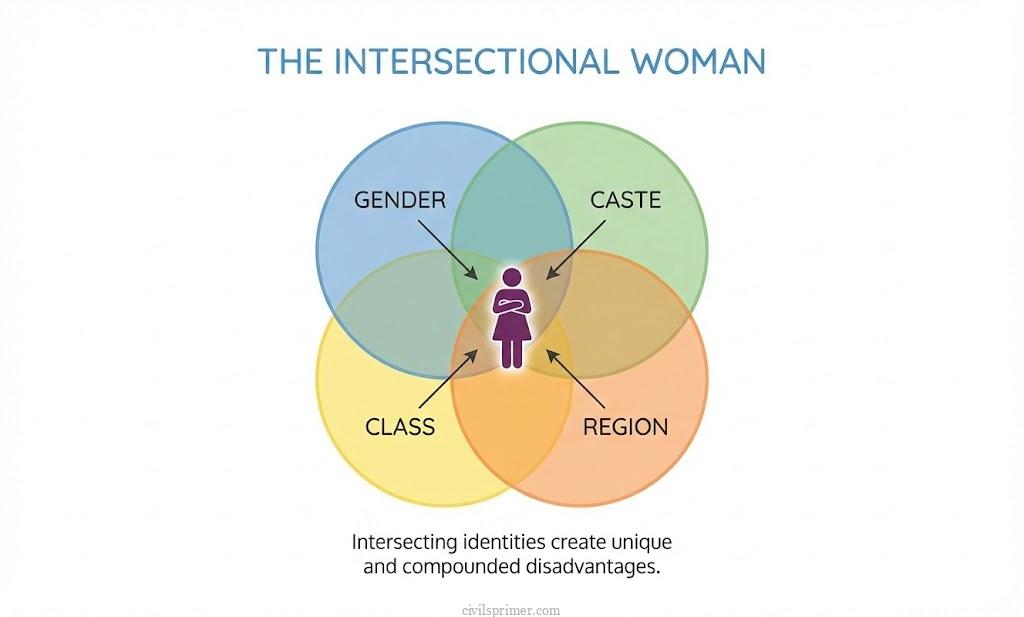
This is the great Indian paradox. To understand the role of women in Indian society for the UPSC exam, you must first discard the idea of a “single” type of Indian woman. Instead, wear the lens of Intersectionality. A Dalit woman migrating to a city for domestic work faces a unique, compounded cocktail of discrimination based on gender, caste, class, and migrant status that is fundamentally different from the struggles of an urban, middle-class, upper-caste woman.
1. The Invisible Chains – Understanding Gender Inequality #
Why does gender inequality persist despite economic growth? The answer lies in Patriarchy—a systemic social structure where men hold primary power in the family, economy, and politics. Patriarchy isn’t just about individual men; it operates through “Structural Violence”. Structural violence refers to the harm caused by invisible, normalized social systems that prevent women from meeting their basic needs, such as the denial of equal healthcare or property rights.
2. The Economic Battlefield: Work, Wages, and the “Second Shift” #
Let us look at the economy. India is an emerging global superpower, yet its Female Labour Force Participation (FLFP) stands at around just 41.7% (PLFS 2023-24). Why are Indian women missing from the workforce?
1. The Burden of Unpaid Care Work: Indian women spend nearly 10 times more time on domestic duties than men. This unpaid care work (cleaning, cooking, elder care) contributes an estimated 3.1% to India’s GDP (compared to 0.4% by men), but it goes completely unrecognized. Sociologists call this the “Dual Burden” or “Second Shift,” leaving women with “time poverty” that restricts their ability to pursue paid employment.
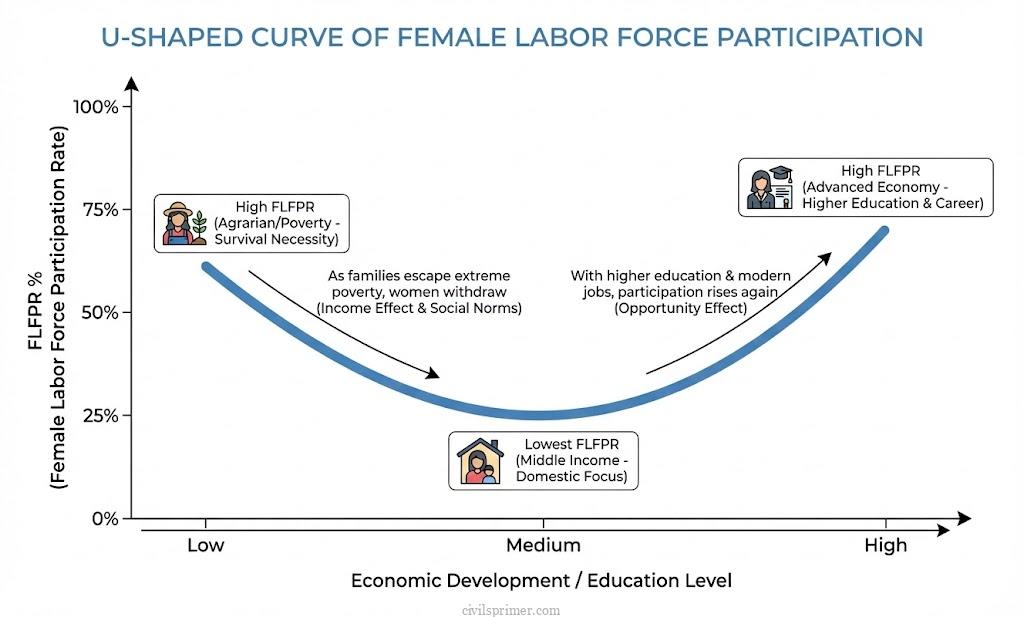
2. The U-Shaped Curve of Employment: Economist Claudia Goldin (Nobel Laureate) observed a “U-shaped” relationship between economic development and FLFP in India. As a poor rural family’s income slightly rises, women are often withdrawn from agricultural labor to focus on domestic duties as a marker of “social status” (the bottom of the ‘U’). It is only when women achieve higher education and urbanization that they re-enter the workforce in white-collar jobs.
3. Feminization of Informal Labor and Agriculture: A staggering 90% of working women are trapped in the informal sector without social security. Furthermore, as men migrate to cities, we see the “Feminization of Agriculture.” Women constitute over 70% of the agricultural workforce but hold a mere 13% of operational landholdings, denying them the status and credit access of a “farmer”.
4. The Glass Ceiling and Sticky Floor: In the formal sector, women face the “Glass Ceiling” (invisible barriers preventing their rise to leadership) and the “Sticky Floor” (forces keeping them trapped in low-paying, low-mobility jobs).
3. The Crucible of Violence and Changing Norms #
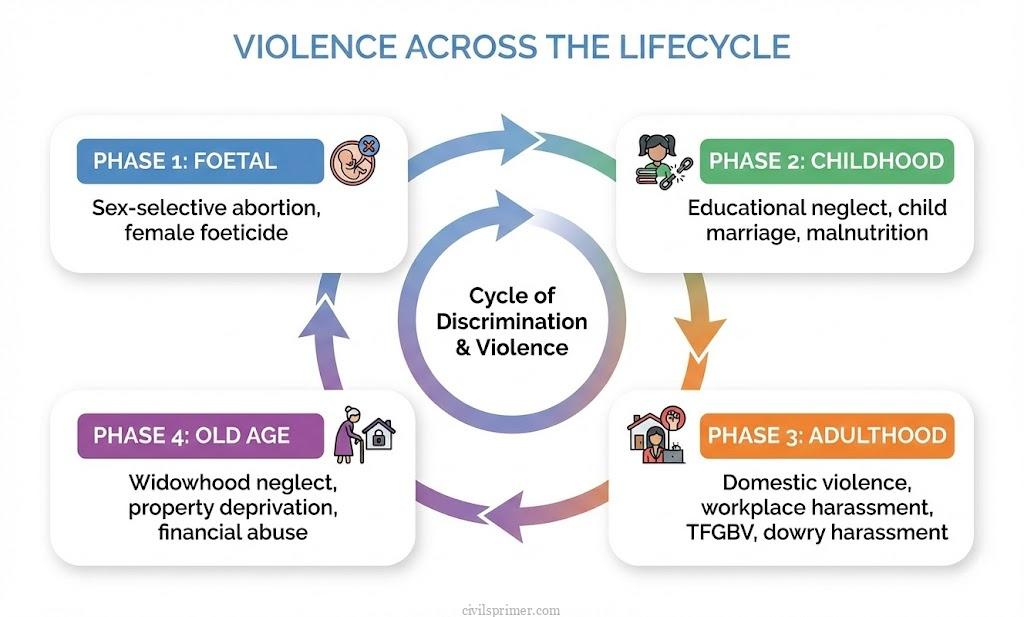
Inequality also manifests as physical and psychological violence across a woman’s lifecycle.
- Pre-Birth to Infancy: The “Son Meta-Preference” (a deep-rooted cultural bias for male children) drives sex-selective abortions. This creates the “Missing Women” phenomenon, reflected in India’s skewed Sex Ratio at Birth (SRB), which stands at 929 females per 1000 males (NFHS-5).
- Adulthood and Marriage: Domestic violence remains the most reported crime against women. Furthermore, debates around the criminalization of Marital Rape highlight the ongoing struggle for bodily autonomy within the institution of marriage.
- The New Frontier – Digital Violence: As India digitizes (with over 900 million internet users), women face Tech-Facilitated Gender-Based Violence (TFGBV) like cyberstalking and deepfakes. This is exacerbated by a stark Digital Divide: only 31% of Indian women own a mobile phone compared to 61% of men.
4. The Uprising – Women’s Organizations and Agency #
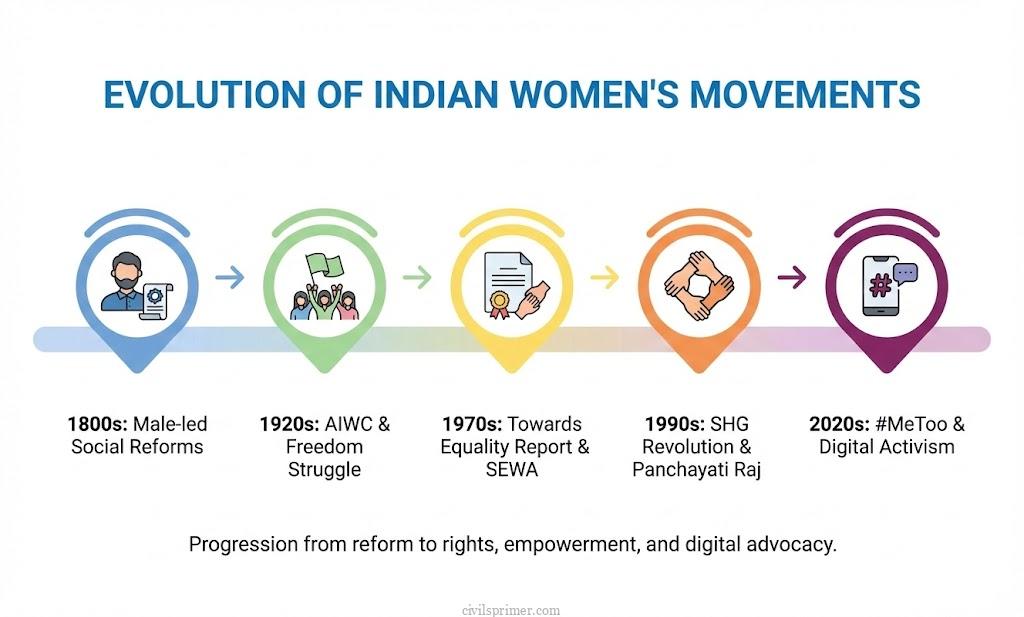
Women have never been mere passive victims; they have been active agents of change. The evolution of women’s organizations in India is a story of shifting power dynamics.
Phase 1: The Reformist Era (19th – Early 20th Century) Initially, the movement was “Androcentric” (led by men). Reformers like Raja Ram Mohan Roy (Brahmo Samaj) and Jyotirao Phule fought against Sati and championed female education. Later, during the National Movement, women established their own platforms, such as the All India Women’s Conference (AIWC) in 1927, integrating the demand for women’s suffrage with the fight for Indian independence.
Phase 2: The Radical 70s and 80s – “The Personal is Political” Post-independence, the movement evolved. The landmark ‘Towards Equality’ Report (1974) shocked the nation by revealing declining sex ratios and massive economic marginalization, sparking a new wave of autonomous women’s groups. Women realized that issues confined to the “private” home (like domestic violence or unequal chores) were actually “public” political issues rooted in patriarchal power.
- Trade Unions: Ela Bhatt founded the Self-Employed Women’s Association (SEWA), a revolutionary trade union that organized millions of invisible women in the informal sector, providing them with cooperative banking and bargaining power.
- Environmental Activism: The Chipko Movement saw rural women physically hugging trees to prevent deforestation, birthing the concept of “Ecofeminism”—the idea that the exploitation of nature and women are deeply linked.
Phase 3: The Era of NGOs and SHGs (1990s – Present) Today, the movement operates heavily through Self-Help Groups (SHGs). SHGs are not just micro-finance institutions; they are hubs of social capital. When rural women pool their savings, they also pool their voices, collectively fighting local issues like alcoholism, dowry, and poor school infrastructure.
Critique: The modern women’s movement is sometimes criticized for an “Urban/Middle-Class Bias,” occasionally failing to center the voices of Dalit, Adivasi, or minority women whose struggles are vastly different.
5. The Catalysts of Change – Legal & Social Reforms #
To dismantle patriarchy, the Indian State has stepped in as an agent of social reform. Let’s look at the legal and programmatic interventions driving this change.
- Political Empowerment: The Silent Revolution – The 73rd and 74th Constitutional Amendments (1992) mandated a 33% reservation for women in Panchayati Raj Institutions (PRIs). Today, women hold 46% of elected seats locally. Studies by economists like Esther Duflo show that female Sarpanches prioritize investments in critical public goods like drinking water, sanitation, and health. The next frontier: The Nari Shakti Vandan Adhiniyam, 2023 (106th Amendment), which aims to reserve one-third of seats in the Lok Sabha and State Assemblies, shattering the political glass ceiling at the national level.
- Legal Milestones for Justice
- Hindu Succession (Amendment) Act, 2005: Granted daughters equal coparcenary (inheritance) rights in ancestral property, attacking the economic roots of patriarchy.
- POSH Act, 2013: Built on the Supreme Court’s Vishaka Guidelines, it mandated Internal Complaints Committees (ICCs) to protect women from sexual harassment at the workplace.
- Maternity Benefit (Amendment) Act, 2017: Increased paid maternity leave to 26 weeks, though it has inadvertently made some private employers hesitant to hire women due to the financial burden.
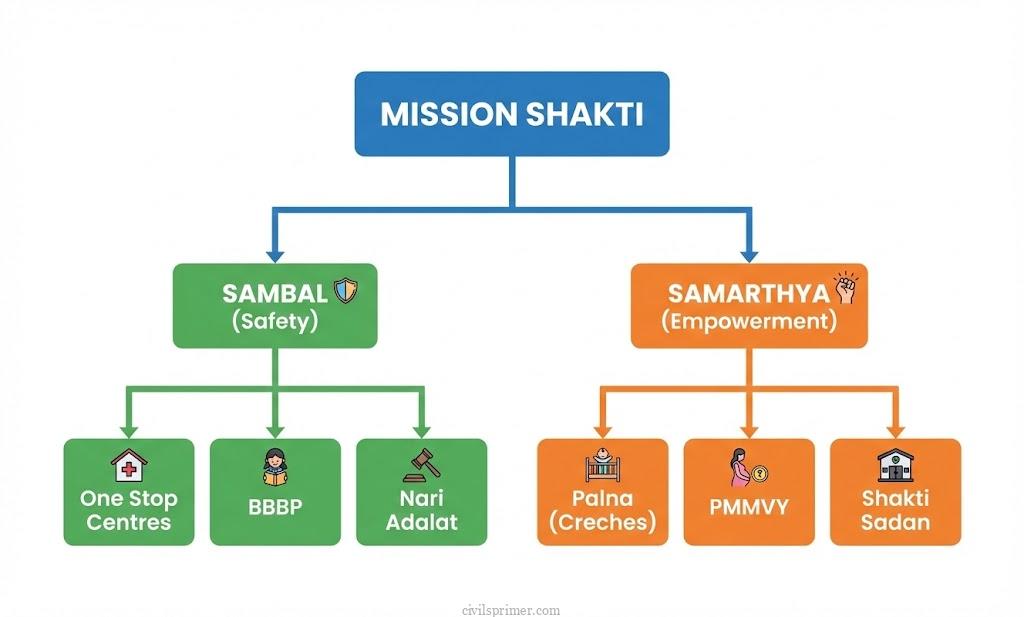
- Mission Shakti: The Umbrella of Empowerment – The government recently consolidated its efforts under Mission Shakti, a comprehensive framework for women’s safety and empowerment, divided into two distinct verticals:
- Sambal (Safety & Security): Includes One Stop Centres (providing medical, legal, and psychological aid to victims of violence under one roof), Women Helplines, and the Beti Bachao Beti Padhao (BBBP) scheme aimed at correcting the sex ratio. It also introduced Nari Adalats for alternative dispute resolution at the village level.
- Samarthya (Empowerment): Focuses on economic and social support. It includes Shakti Sadan (relief for trafficked/distressed women), Palna (quality creche facilities to ease the care burden on working mothers), and the Pradhan Mantri Matru Vandana Yojana (PMMVY) (maternity wage-loss compensation).
Conclusion: The Path Forward #
Fulfillment of the “new woman” in India is a work in progress. Achieving true gender equality requires moving from De Jure (in law) equality to De Facto (in reality) equity.
The path forward requires a multi-pronged approach:
1. Valuing the Care Economy: We must formalize and subsidize the care economy (like the Palna scheme) to free women from the “dual burden.”
2. Engaging Men: Patriarchy harms men too by enforcing toxic masculinity. Movements like ‘Mardon Wali Baat’ (engaging boys to redefine masculinity) are crucial because women’s empowerment cannot happen in an echo chamber.
3. Bridging the Digital Divide: Equipping rural women with smartphones and digital literacy is non-negotiable for their participation in the modern gig economy and e-commerce.
When we empower a woman, we don’t just uplift an individual; we stabilize population growth, enhance childhood nutrition, and add trillions to the GDP. As the economic survey rightly hints, India’s demographic dividend will remain a demographic disaster if half its population is left on the sidelines.
UPSC Mains Previous Year Questions (PYQs) #
- Distinguish between gender equality, gender equity and women’s empowerment. Why is it important to take gender concerns into account in programme design and implementation? (2024, 10 Marks)
- Explain why suicide among young women is increasing in Indian society. (2023, 10 Marks)
- Examine the role of the Gig Economy in the process of empowerment of women in India. (2021, 10 Marks)
- ‘Women’s movement in India has not addressed the issues of women of lower social strata.’ Substantiate your view. (2018, 15 Marks)
- Discuss the various economic and socio-cultural forces that are driving the increasing feminization of agriculture in India. (2014, 10 Marks)
Related Latest Current Affairs #
| (October, 2025): Launch of Women’s Economic Empowerment (WEE) Index – Uttar Pradesh launched India’s first district-level WEE Index to track the impact of government schemes on women’s economic participation. It shifts focus from mere participation numbers to identifying and addressing structural barriers in employment, education, and access to credit. |
| (October, 2025): GeM and UN Women MoU for ‘Womaniya’ Initiative – The Government e-Marketplace (GeM) and UN Women partnered to integrate informal women entrepreneurs and Self-Help Groups (SHGs) into India’s public procurement ecosystem. The initiative provides training and tackles challenges in market access to promote gender-responsive procurement. |
| (September, 2025): Educate Girls NGO Wins 2025 Ramon Magsaysay Award – ‘Educate Girls’ became the first Indian organisation to win this prestigious award, recognised for its community-driven approach. By mobilising local volunteers, the NGO has successfully enrolled and retained over 2 million rural, out-of-school girls in classrooms. |
| (September, 2025): 20 Years of the Protection of Women from Domestic Violence Act (PWDVA) – Marking two decades, reports highlighted the Act’s success in providing civil remedies like protection orders and changing cultural attitudes towards abuse. However, significant challenges remain, including a low 18% conviction rate and restrictive judicial interpretations. |
| (September, 2025): Release of “The Gender Snapshot 2025” Report – Co-published by UN Women, this report assessed global gender equality across SDGs, noting that 376 million women remain in extreme poverty. It emphasized the urgent need to address the gender digital divide, violence against women, and political underrepresentation. |
| (August, 2025): NCW Launches ‘SHAKTI Scholars’ Fellowship – The National Commission for Women (NCW) introduced a grant-based research fellowship for young scholars. It aims to encourage evidence-based, policy-oriented research on themes like women’s safety, economic empowerment, and legal rights to support gender-responsive governance. |
| (August, 2025): Tech-Led Women’s Welfare and Safety Platforms Highlighted – The Ministry of Women and Child Development showcased its integration of technology to empower women, utilizing the Mission Shakti Dashboard, the SHe-Box portal for workplace harassment complaints, and paperless DBT for maternity benefits to ensure transparent, last-mile delivery. |
| (July, 2025): India Ranks 131st in Global Gender Gap Report 2025 – The WEF report highlighted India’s drop to the 131st position out of 148 countries. While educational attainment improved, the country continues to struggle with severe disparities in economic participation, workforce inclusion, and a decline in political empowerment for women. |
| (July, 2025): The Female Labour Force Participation (FLFP) Paradox – Data from the PLFS 2023-24 revealed a stark paradox where high female literacy (84.9% in urban areas) does not translate to high labour participation (only 28%). This gap is driven by traditional patriarchal norms, heavy caregiving burdens, and a lack of flexible workplace models. |