
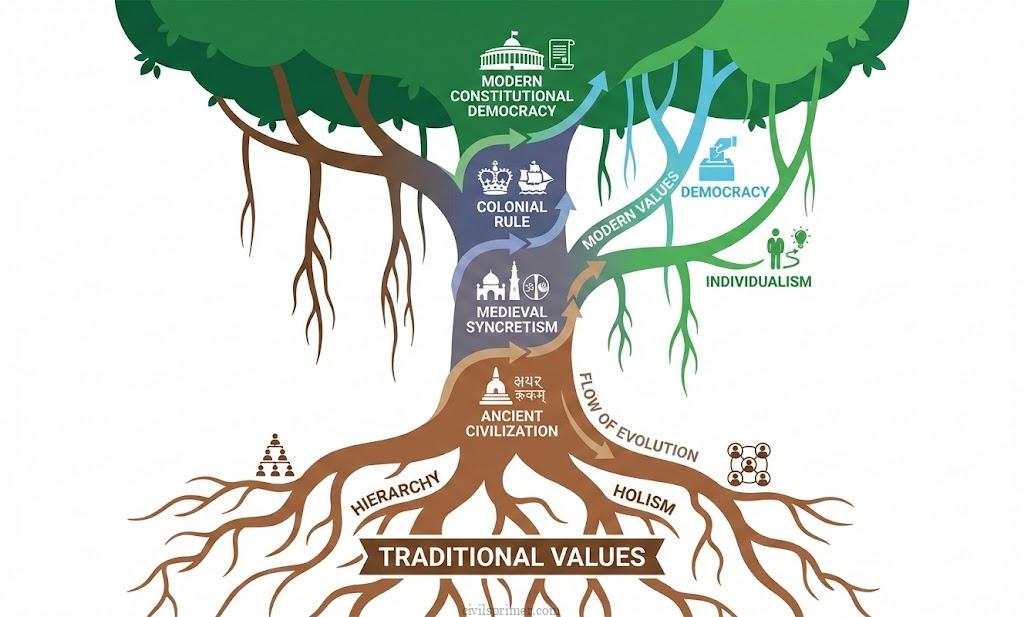
Imagine Indian society not merely as a country defined by borders, but as a “Civilizational State”—a living entity that has breathed, evolved, and absorbed influences for over 5,000 years. Unlike many other nations that are defined by a single language or religion, India is defined by its unique ability to manage the dynamic interplay between Continuity (keeping the old alive) and Change (adapting to the new). To understand India for UPSC exam, we must view it as a palimpsest—a manuscript where new layers are written over the old, but the old traces never truly disappear.
The Living Tapestry: A Journey Through Indian Society #
1. The Social Ladder – Caste and Hierarchy #
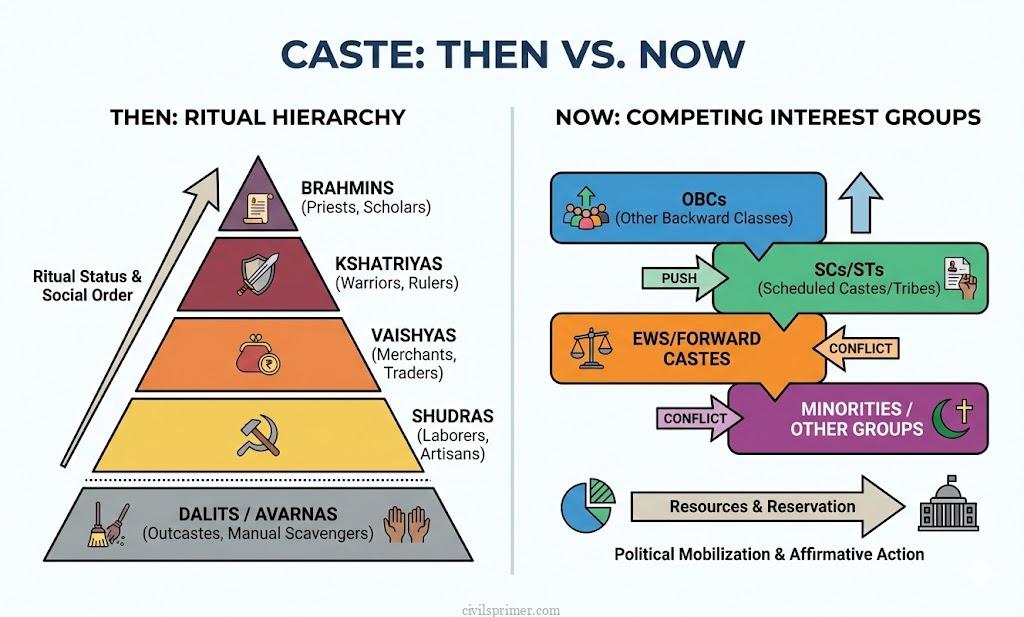
The first major pillar of our story is Hierarchy. In traditional Indian society, individuals were not viewed as independent atoms but as members of a group. This brings us to the Caste System.
1. The Two Faces of Caste: Varna vs. Jati – For Prelims, you must distinguish the theory from reality:
- Varna: This is the theoretical, four-fold division found in ancient texts (Brahmin, Kshatriya, Vaishya, Shudra). It is a broad framework.
- Jati: This is the lived reality. There are thousands of Jatis (occupational groups). They are endogamous (you marry within them) and govern daily life, social status, and interaction.
2. The Evolution: Is Caste Dying? – A common mistake aspirants make is thinking modernization killed caste. Sociologists argue that caste hasn’t died; it has transformed.
- Ritual to Political: Traditionally, caste was a “vertical hierarchy” based on purity and pollution. Today, it has stretched “horizontally.” Castes now function as political pressure groups and vote banks.
- The Paradox of Urbanization: In cities, the ritual barriers (who you can eat with) have weakened due to anonymity. You don’t ask the caste of the person sitting next to you on the Metro.
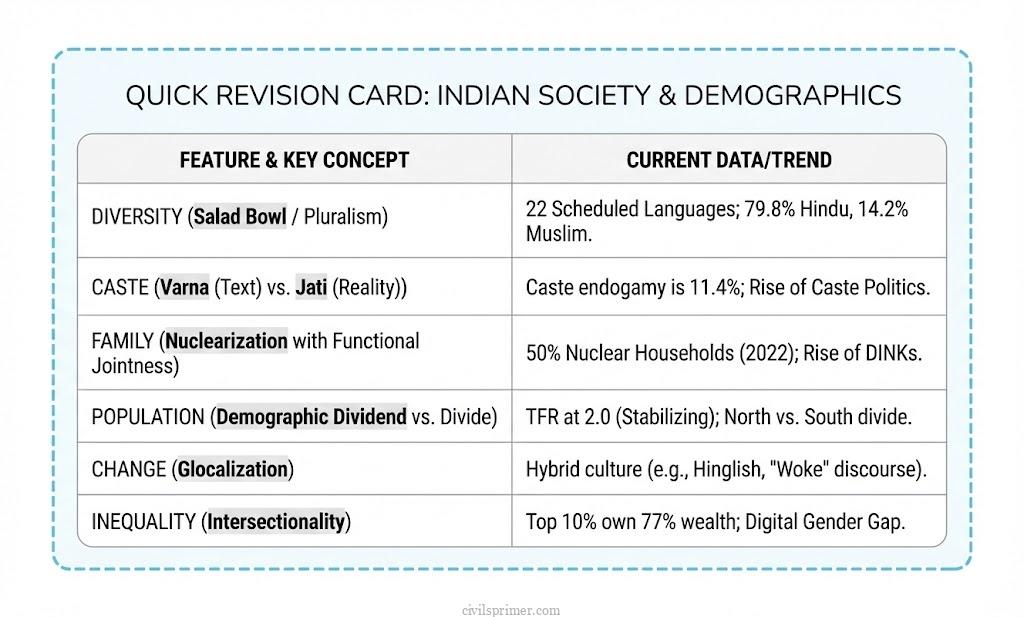
- The Persistence: However, caste endogamy remains stubborn. Even today, inter-caste marriages are only about 11.4% (NFHS-5, 2021).
- Dark Reality: The NCRB 2022 data reported 57,582 cases of caste-based crimes, showing that discrimination persists alongside modern laws.
2: The Hearth – Family and Kinship #
The second pillar is the Family, traditionally the unit of production and social security.
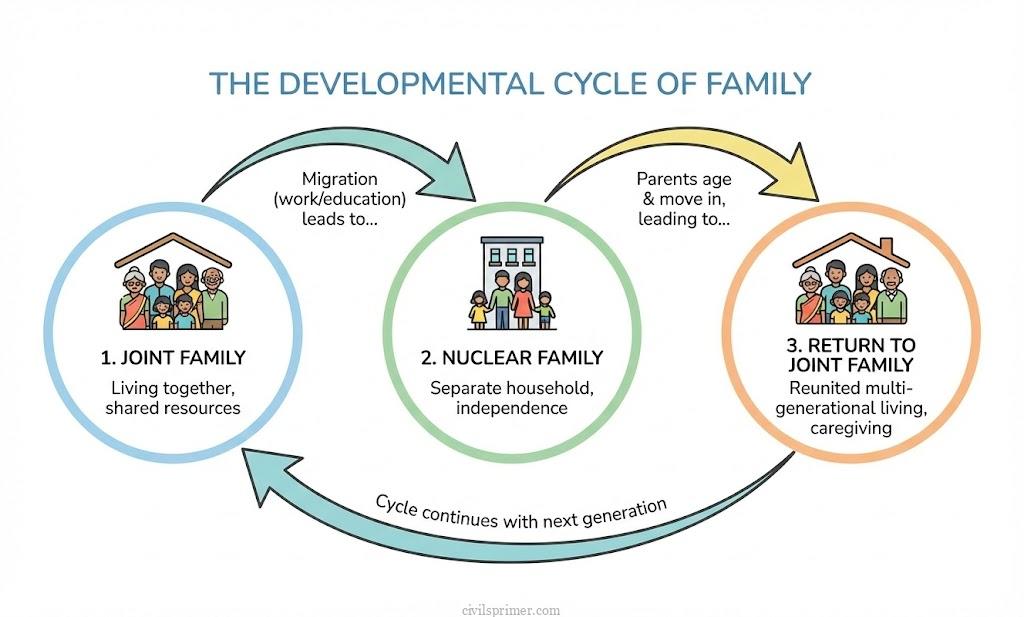
1. The Great Transition: Joint to Nuclear – The traditional ideal was the Joint Family—multi-generational, sharing a kitchen, property, and roof.
- The Myth of Disintegration: We often hear joint families are vanishing. While the structure is changing (Census 2011 says only ~20% of households are strictly joint), the spirit remains.
- Functional Jointness: Even if a son migrates to Bengaluru for an IT job (creating a nuclear household), he sends money home, attends rituals, and makes decisions with the larger family. The family is structurally nuclear but functionally joint.
2. New Social Norms & Demographics – Current affairs have introduced new characters to this story:
- DINK Families: “Dual Income, No Kids” families are growing at 30% per annum in urban hubs, driven by career aspirations and high costs of living.
- Live-in Relationships: Once taboo, these are gaining legal and social recognition in metros, driven by individualism and a desire to test compatibility.
- Educational Hypogamy: A fascinating new trend where women are marrying men with lower education levels than themselves (rising from 5% in the 70s to 20% in 2018) because female education has outpaced the availability of equally educated grooms.
3: The Cultural Fabric – Unity in Diversity #
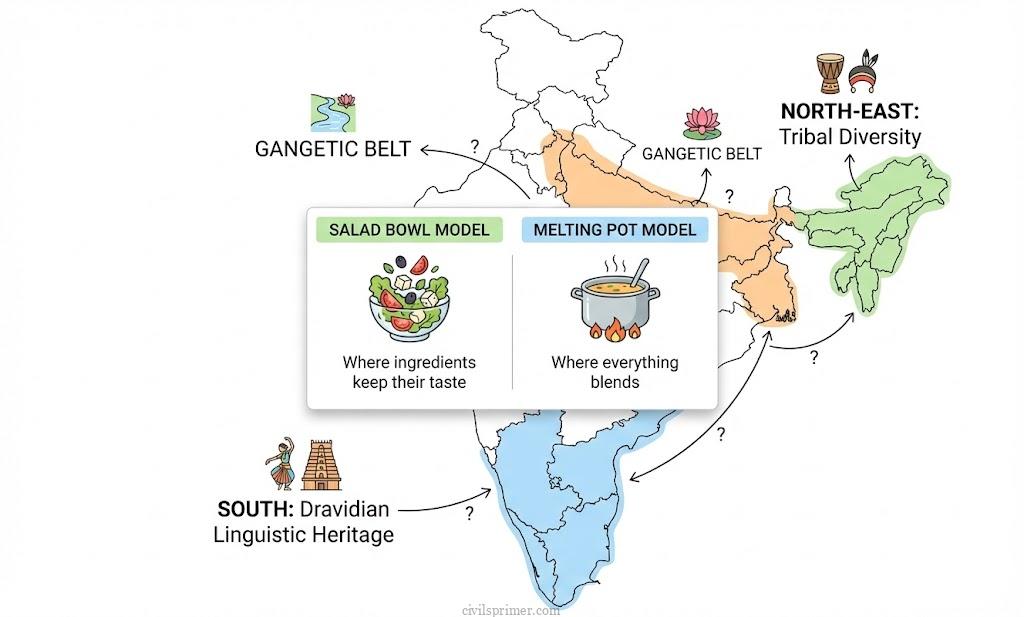
The most famous tagline of Indian society is “Unity in Diversity.” But for Mains, you must analyze how this works. It is not just about tolerance; it is about Pluralism.
1. Linguistic Pluralism – India does not have a single national language.
- Data: We have over 19,500 dialects/languages (Census 2011), with 22 scheduled in the Constitution.
- The Glue: The reorganization of states in 1956 based on language was feared to break India, but it actually strengthened unity by giving cultural recognition to regions.
- Current Issue: The push for the “Three Language Formula” in the New Education Policy (NEP) 2020 aims to balance local identity (mother tongue) with national integration.
2. Religious Diversity – India is the birthplace of four major religions (Hinduism, Buddhism, Jainism, Sikhism) and a sanctuary for others (Islam, Christianity, Zoroastrianism).
- Secularism: Indian Secularism is distinct from the Western model. In the West, it is a “Wall of Separation” (State and Religion do not touch). In India, it is “Principled Distance.” The State treats all equally but can intervene to reform (e.g., banning Triple Talaq or Untouchability).
3. Regionalism – Regionalism is often seen negatively, but it has two faces:
- Positive: Celebrating local culture (e.g., Mithila art crossing borders).
- Negative: “Sons of the Soil” movements (e.g., Haryana’s local reservation law) which threaten the idea of a single economic market.
4: The Winds of Change – Evolution of Social Norms #
How does this ancient society change? Sociologist M.N. Srinivas gave us the vocabulary for this.
1. Sanskritisation – This is a process where lower castes imitate the rituals and lifestyles of upper (Twice-born) castes to gain social status. It is a change in position, not a change in the structure of society.
2. Westernisation & Modernisation – Colonialism brought Westernisation (changes in technology, dress, law). This led to Modernisation—the adoption of rationality and scientific temper.
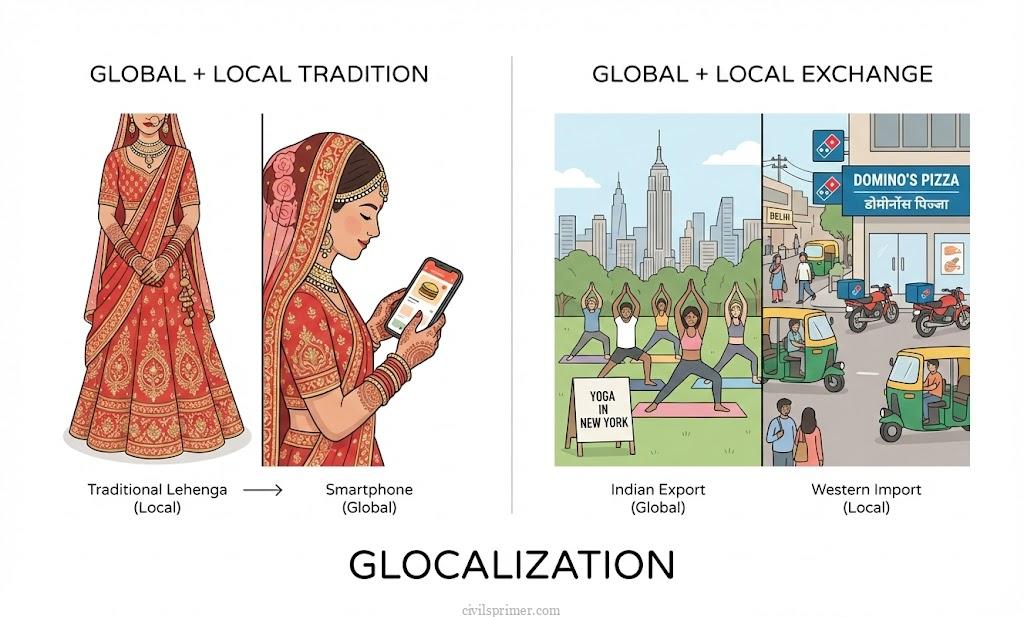
- Current Context: Today, we see “Glocalization” (Global + Local). McDonald’s selling McAloo Tikki is not just business; it’s cultural hybridity. We adapt global trends to fit Indian tastes.
3. The “Woke” Phenomenon – A new addition to your syllabus is the impact of global social justice movements. Concepts like “privilege,” “gender fluidity,” and “cancel culture” are entering urban Indian discourse via social media, creating a generational divide or “Culture Wars” in Indian cities.
5: The Numbers Game – Demographics & Current Affairs #
For your answers to stand out, you must back concepts with data.
1. Population: The Dividend and the Divide
- The Milestone: In 2023, India overtook China to become the world’s most populous nation (1.428 billion).
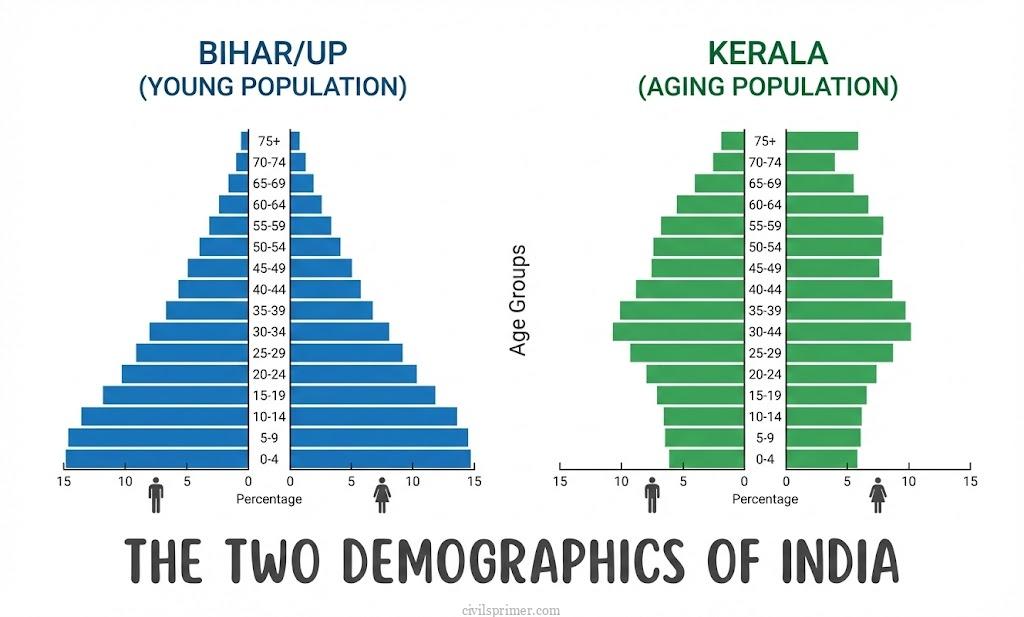
- The Stabilization: Contrary to the fear of explosion, India’s Total Fertility Rate (TFR) has dropped to 2.0 (NFHS-5), which is below the replacement level of 2.1.
- The Demographic Divide: This is a crucial Mains topic.
- South India (Kerala, TN): Aging population, TFR well below replacement. They need geriatric care.
- North India (Bihar, UP): Young population, high TFR. They need jobs and education to reap the “Demographic Dividend”.
2. Urbanization – India is urbanizing, but slowly (approx. 31% in 2011, projected to double by 2050).
- Social Consequence: Cities are becoming sites of exclusion. Slums (like in Mumbai) represent the failure of inclusive urban planning. However, cities also offer anonymity that dilutes caste barriers.
3. The Digital Gender Gap – While we celebrate “Digital India,” society reflects a divide. 31% of women own mobile phones compared to 61% of men. This “Digital Divide” restricts women’s autonomy in the modern era.
Conclusion: The Road Ahead #
Indian society is in a state of flux. We are witnessing the “Feminization of Agriculture” as men migrate for work, the rise of Gig Economy impacting traditional labor, and a struggle between Constitutional morality and Traditional morality (e.g., debates on marital rape or Sabarimala case).
For a civil servant, understanding these salient features is not just about clearing an exam; it is about understanding the people you will serve. The challenge lies in ensuring that as India modernizes, it retains the inclusivity of its civilizational ethos while shedding the discriminatory hierarchies of its past.
Mains PYQs #
- 2024 -> Intercaste marriages between castes which have socio-economic parity have increased, to some extent, but this is less true of interreligious marriages. Discuss.
- 2023 -> Do you think marriage as a sacrament is losing its value in modern India?
- 2023 -> Child cuddling is now being replaced by mobile phones. Discuss its impact on the socialization of children.
- 2023 -> Why is caste identity in India both fluid and static?
- 2022 -> Given the diversities among tribal communities in India, in which specific context should they be considered as a single category?
- 2022 -> Analyze the salience of ‘sect’ in Indian society vis-a-vis caste, region, and religion.
- 2021 -> How does Indian society maintain continuity in traditional social values? Enumerate the changes taking place in it.
- 2021 -> Why is India considered as a sub-continent? Elaborate your answer.
- 2020 -> Has caste lost its relevance in understanding the multi-cultural Indian society? Elaborate your answers with illustrations.
- 2018 -> “Caste system is assuming new identities and associational forms. Hence, caste system cannot be eradicated in India.” Comment.
- 2017 -> In the context of diversity of India, can it be said that the regions form cultural units rather than the States? Give reasons with examples for your viewpoint.
- 2014 -> The life cycle of a joint family depends on economic factors rather than social values. Discuss.
Related Latest Current Affairs #
| (October, 2025): Empowerment of the Ollo Tribe – The Assam Rifles launched a skill-based empowerment programme for the Ollo (Lazu Naga) tribe in Arunachal Pradesh. This initiative highlights the balance between integrating marginalised communities into the modern economy and preserving their unique, clan-based traditional structures and cultural practices like the Voorang festival. |
| (September, 2025): Protests over the Traditional Manki-Munda System – Ho tribals in Jharkhand’s Kolhan region protested against alleged state interference in their customary Manki-Munda self-governance system. This highlights the enduring presence of ancient, decentralised administrative structures and the challenges of integrating them with modern state governance. |
| (September, 2025): Kurmi Community Demands ST Status and Sarna Recognition – The agrarian Kurmi community held protests demanding Scheduled Tribe (ST) status and the official codification of their nature-worshipping “Sarna” religion. This reflects the complex dynamics of caste, regional tribal identities, and religious pluralism in India. |
| (September, 2025): Legal Scrutiny of Arya Samaj Marriages – The Allahabad High Court ordered an investigation into fake Arya Samaj societies conducting illegal marriages. This touches upon the evolution of social norms and the legal complexities surrounding inter-caste and inter-faith unions within India’s highly diverse and pluralistic society. |
| (August, 2025): Persistent Challenge of Honour Killings – Recent reports and editorials brought the issue of honour killings back into focus. This grim reality underscores how rigid traditional caste hierarchies and patriarchal structures continue to violently resist the evolution of progressive social norms regarding individual choice and marriage. |
| (July, 2025): Legal Debate on Polyandry in the Hatti Tribe – A woman from the Hatti tribe in Himachal Pradesh married two brothers under the traditional polyandrous custom of ‘Jodidara’. This incident revived public and legal debates regarding the clash between modern legal frameworks (like the Hindu Marriage Act) and ancient, protected tribal customs. |
| (May, 2025): Legal and Ethical Discourse on Santara (Sallekhana) – The reported death of a three-year-old girl in Indore, after allegedly being administered the Jain vow of Santhara, brought this ancient ritual of voluntary fasting unto death into public focus. It highlights the ongoing tension between traditional religious practices and modern constitutional rights. |
| (May, 2025): Social Media and the Evolution of Social Norms – Discussions and reports highlighted how modern lifestyles and social media algorithms are rewiring brains and defining self-worth among Indians. This marks a significant evolution in social norms, showcasing the shift from traditional community-based validation to westernised, digital metrics of success. |