
The Celestial Fire: Earth’s Energy and the Solar Future #
Imagine our Earth not just as a rock floating in space, but as a giant, complex machine. Like any machine, it needs fuel to run. It doesn’t run on petrol or batteries; it runs on a relentless stream of energy beaming down from a star 150 million kilometers away—the Sun. This energy, known as Solar Radiation, is the heartbeat of our planet. It drives the winds, fuels the rains, grows our food, and even dictates the rise and fall of civilizations. However, the Earth is a picky eater. It doesn’t just swallow all the energy it gets. It reflects some, absorbs some, and sends some back, maintaining a delicate balance that keeps us from freezing or burning.
Part 1: Insolation – The Arrival #
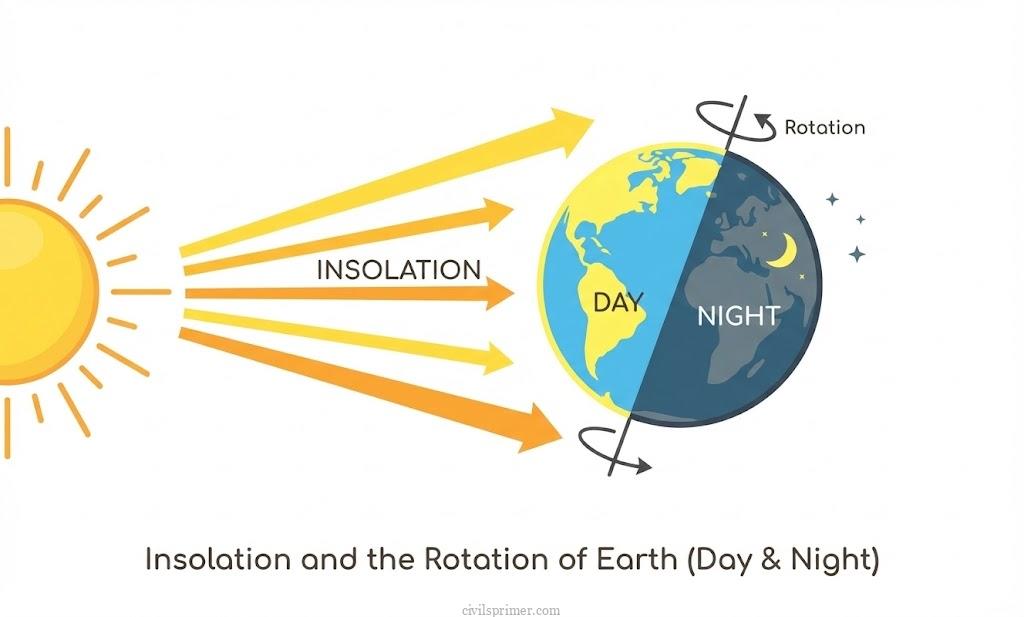
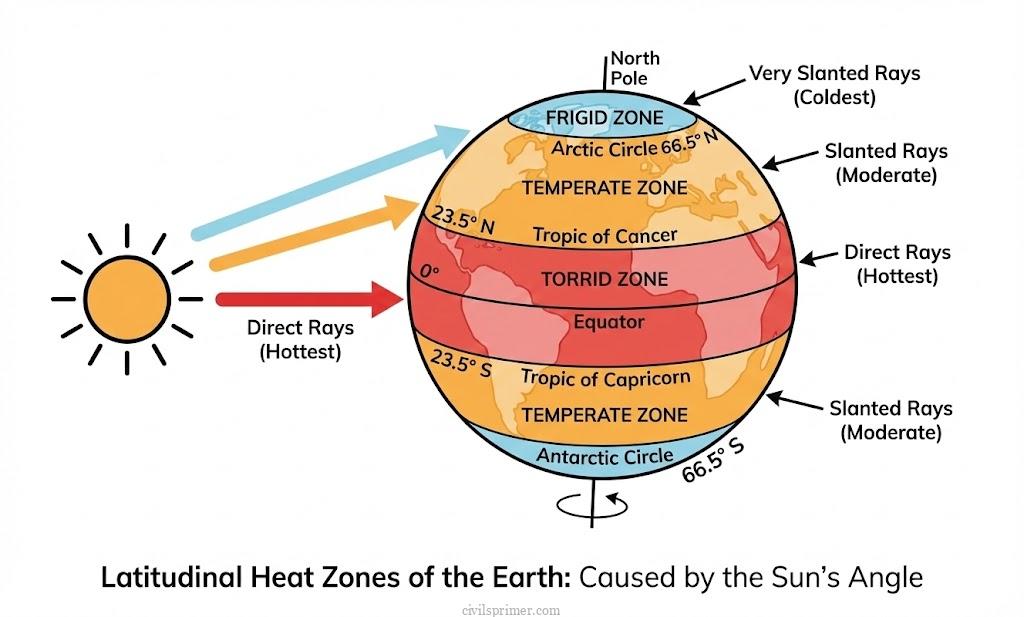
The Incoming Guest: The energy arriving from the sun is technically called Insolation (Incoming Solar Radiation). It arrives in the form of short waves. But here is the twist: this energy is not distributed equally. The Earth is a sphere (a Geoid), so the sun’s rays hit the Equator directly but strike the poles at a slant.
The Factors of Inequality: Just as a flashlight beam gets dimmer if you shine it at an angle, the solar energy received by the Earth varies.
- Tilt: Our Earth doesn’t stand up straight; it tilts on its axis. This tilt causes seasons.
- Latitude: The Equator gets the “main course” of energy, while the poles get the “leftovers.”
- Atmosphere: As the sun’s rays pass through the atmosphere, clouds, dust, and water vapour scatter and absorb some of it before it even hits the ground.
Part 2: The Heat Budget – The Great Balancing Act #
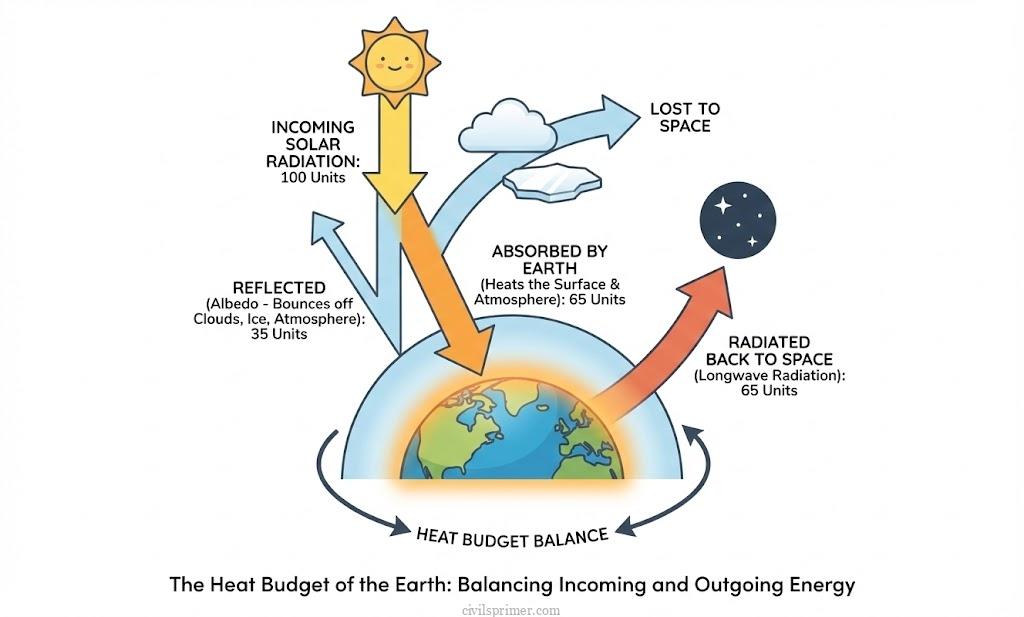
The Cosmic Ledger: Imagine you earn ₹100. If you spend ₹100, your savings balance remains stable. The Earth works the same way. It receives 100% solar energy. To keep its temperature stable, it must send 100% of that energy back into space. This accounting is called the Heat Budget.
The Calculation:
- The Refund (Albedo): Roughly 35 units of energy are reflected back to space immediately by clouds, ice caps, and dust. This reflected light is called Albedo. Planets like Venus or Mercury have different albedos compared to Earth.
- The Absorption: The remaining 65 units are absorbed by the atmosphere and the Earth’s surface.
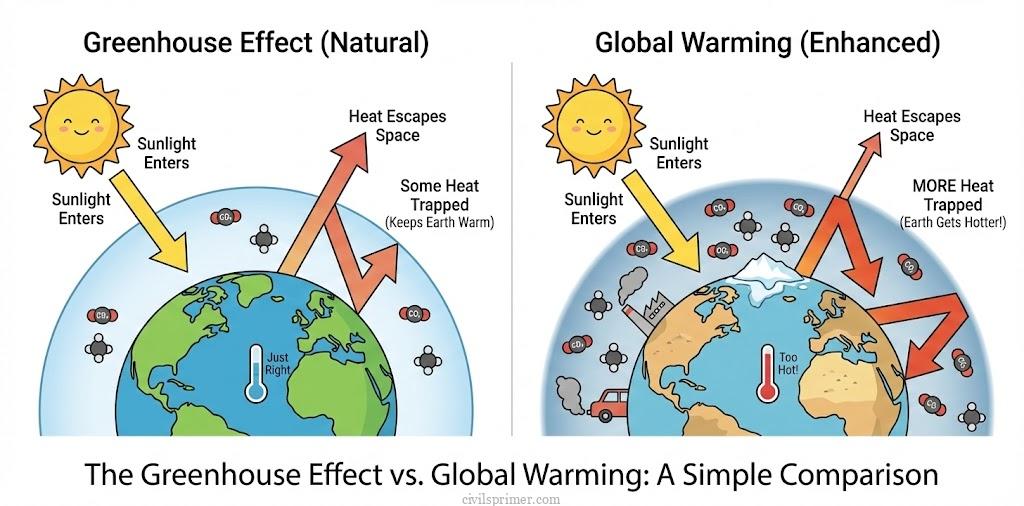
- The Return Journey (Terrestrial Radiation): The Earth absorbs shortwave solar energy but radiates it back as Longwave Terrestrial Radiation. The atmosphere is transparent to incoming shortwaves (letting them in) but opaque to outgoing longwaves (trapping them). This trapping of heat is the Greenhouse Effect.
The Crisis: Ideally, Income = Expenditure. But recently, human activities have added “blankets” of Carbon Dioxide (CO₂) and methane to the atmosphere. These gases trap too much outgoing terrestrial radiation. The ledger is unbalanced. The Earth is retaining more heat than it releases, leading to Global Warming.
Part 3: Temperature Distribution – The Unequal World #
Because insolation varies, temperature varies. This creates a dynamic map of hot and cold zones.
The Controllers of Temperature:
- Latitude: As we move from the Equator to the poles, temperature decreases.
- Altitude: The higher you go, the cooler it gets (Lapse Rate).
- Distance from the Sea: The sea heats up and cools down slowly. Places near the sea (like Mumbai) have moderate climates, while places far inland (like Delhi) have extreme climates (Continentality).
- Ocean Currents: Warm currents raise the temperature of coastal areas, while cold currents lower it.
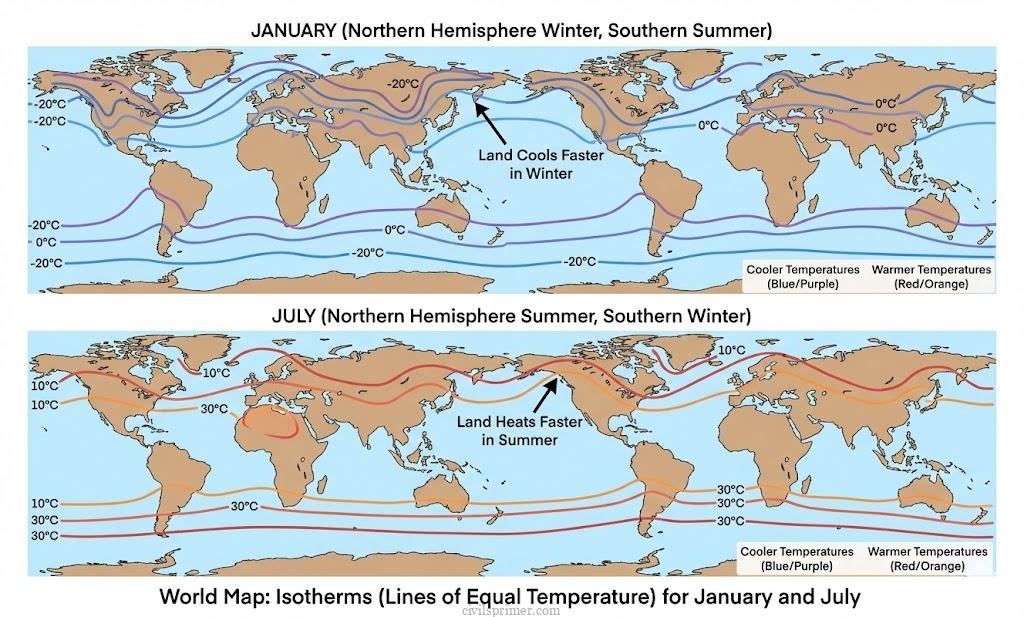
Isotherms: Geographers draw lines on maps connecting places having the same temperature. These are called Isotherms. In the northern hemisphere, where there is a lot of land, these lines wiggle and bend. In the southern hemisphere, dominated by oceans, they are straighter.
Part 4: The Changing Sun and the Modern Crisis #
The Solar Mystery: While we often blame only CO₂ for climate change, the Sun itself is dynamic. Scientists study Solar Activity (like sunspots) to see if the sun is getting hotter.
Scientific Findings: Recent studies have found that changes in solar activity contributed no more than 10% to global warming in the 20th century. This confirms that the current heating is largely human-made, not sun-made.
Changing Patterns and Impacts: The disruption of the heat balance has led to severe consequences:
- Heat Domes : High-pressure systems trap hot air over a region like a lid on a pot, causing extreme heatwaves.
- cryosphere Melting : The “Ambition on Melting Ice” (AMI) initiatives highlight how rising temperatures are melting glaciers and sea ice, threatening mountain water resources and raising sea levels.
- Urban Heat Island : Cities, with their concrete and lack of vegetation, are becoming significantly hotter than rural areas.
Chapter 5: Solar Energy in India – Harnessing the Fire #
The Indian Advantage: India is a tropical country. This is a geographic blessing. We receive enormous amounts of direct sunlight for most of the year. This makes solar energy a Non-conventional and Renewable resource that can power our future,.
Production and Potential:
- Photovoltaic Technology: We use this technology to convert sunlight directly into electricity.
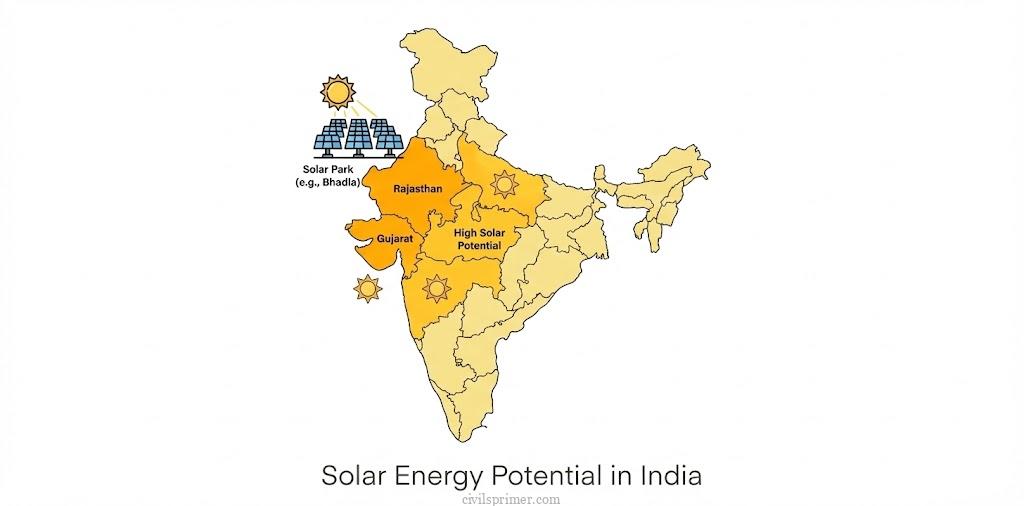
- Regional Potential: States like Rajasthan and Gujarat have huge potential for solar energy due to high insolation and vast available land,. However, some areas have not yet fully developed this potential.
- Rural Impact: Solar energy is becoming popular in rural and remote areas. It reduces dependence on firewood and dung cakes, which in turn helps conserve forests and produces manure for agriculture.
Targets and Initiatives: India is moving aggressively towards a solar future to balance its energy basket.
- National Solar Mission: A major initiative to promote solar power.
- International Solar Alliance (ISA): India plays a leading role in this global alliance to harness solar energy.
- PM-KUSUM: A scheme to help farmers generate solar power.
- One Sun One World One Grid (OSOWOG): A visionary project to connect solar energy across borders.
Challenges and Way Forward: While the potential is high, challenges like energy storage and cost remain. Advancements in battery storage and supportive government policies are crucial to making solar power the primary energy source.
UPSC Mains Subjective Previous Years Questions #
- 2020 → India has immense potential for solar energy though there are regional variations in its developments. Elaborate.
Answer Writing Minors #
Introduction (3-4 Lines): “Solar radiation acts as the primary engine for the Earth’s heat budget, driving atmospheric circulation and climatic patterns. The distribution of this insolation is not uniform, governed by factors such as latitude, altitude, and the Earth’s rotation, which in turn dictates the global temperature distribution and the viability of renewable energy resources like solar power.”
Conclusion (3-4 Lines): “Conclusively, maintaining the delicate balance of the Earth’s heat budget is critical for climatic stability. As anthropogenic factors increasingly disrupt this equilibrium leading to global warming, shifting towards non-conventional energy sources like solar power—especially in tropical nations like India—becomes imperative for sustainable development and environmental conservation.”
Related Latest Current Affairs #
- November 2025: Launch of Interstellar Mapping and Acceleration Probe (IMAP) Dimension: Recent Space Mission to Study Solar Radiation NASA launched the IMAP mission to map the boundaries of the heliosphere and study how solar particles are energized. Equipped with 10 instruments, it operates from the Sun-Earth L1 point to provide real-time space weather data and improve understanding of the solar wind’s interaction with the solar system, which shields Earth from cosmic radiation.
- October 2025: India Hosts 8th International Solar Alliance (ISA) Assembly Dimension: Solar Energy Production and Targets in India India hosted the 8th ISA Assembly in New Delhi, aiming to mobilize $1 trillion in solar investments by 2030. The assembly focused on delivering clean energy access and scaling solar capacity globally, reinforcing India’s commitment to its own target of 500 GW non-fossil fuel capacity by 2030.
- October 2025: Launch of Sentinel-6B Ocean Monitoring Satellite Dimension: Temperature Distribution and Heat Budget A joint mission (NASA, NOAA, ESA) launched Sentinel-6B to measure global sea-surface height and ocean dynamics. This data is critical for monitoring thermal expansion (a key component of the Earth’s heat budget) and understanding how ocean currents redistribute solar heat across the globe.
- August 2025: India Achieves 50% Non-Fossil Fuel Power Capacity Dimension: India’s Solar Potential and Targets India achieved its target of 50% installed electricity capacity from non-fossil sources (Solar, Wind, Hydro, Nuclear) five years ahead of the 2030 schedule. Solar power leads the renewable sector with over 127 GW capacity, driven by high insolation potential and schemes like PM Surya Ghar.
- July 2025: Breakthrough in Silicon-Perovskite Tandem Solar Cells Dimension: Solar Energy Production Potential Indian scientists at IIT Bombay achieved a record 29.8% efficiency with Silicon-Perovskite Tandem Solar Cells. This technology stacks materials to absorb different parts of the solar spectrum (insolation), significantly boosting energy conversion compared to conventional silicon panels and enhancing India’s solar potential.
- June 2025: Study on Solar Climate Intervention Techniques (Geoengineering) Dimension: Changing Pattern of Solar Radiation (Albedo Modification) A new study proposed Stratospheric Aerosol Injection (SAI) to reflect incoming solar radiation (increasing Earth’s Albedo) to cool the planet. This intervention aims to alter the Earth’s heat budget to counteract global warming without necessarily reducing greenhouse gases.
- June 2025: UN ESCAP Report on Urban Heat Islands and Cooling Dimension: Social/Environmental Impacts of Temperature Distribution The report highlighted the “Urban Heat Island” effect where cities like Delhi and Karachi face 2–7°C extra heat due to concrete trapping solar radiation. This uneven temperature distribution creates a “cooling inequality,” disproportionately affecting the poor and outdoor workers, necessitating sustainable cooling solutions.
- May 2025: Digitization of Kodaikanal Solar Observatory (KoSO) Data Dimension: Study of Solar Radiation History Scientists reconstructed over 100 years of the Sun’s polar magnetic history using archival data from KoSO (established 1899). This study of the solar cycle is crucial for predicting solar storms and understanding long-term variations in solar radiation that impact Earth’s climate.
- February 2025: WMO Global Climate Forecast 2025–2029 Dimension: Factors Responsible for Changing Radiation Patterns The WMO warned that decreased aerosol pollution (which previously scattered sunlight) is contributing to increased solar radiation absorption and warming. This, combined with GHG emissions and El Niño, is altering the global heat budget, with a 70% chance of exceeding the 1.5°C threshold temporarily.
- December 2024: Proba-3 Mission for Artificial Solar Eclipse Dimension: Space Mission to Study Solar Corona The ESA and ISRO launched the Proba-3 mission to perform precise formation flying to create an artificial solar eclipse. This allows continuous observation of the Sun’s faint corona (usually outshined by the photosphere), helping scientists understand the origins of solar wind and radiation that affect Earth’s atmosphere.