
Imagine taking a train journey from the parched, drought-prone agricultural belts of Marathwada to the dazzling, neon-lit skyline of Mumbai. This journey is not just a movement across physical geography; it is a movement across time, economy, and social reality. This is the story of Urbanization—the defining demographic shift of the 21st century.
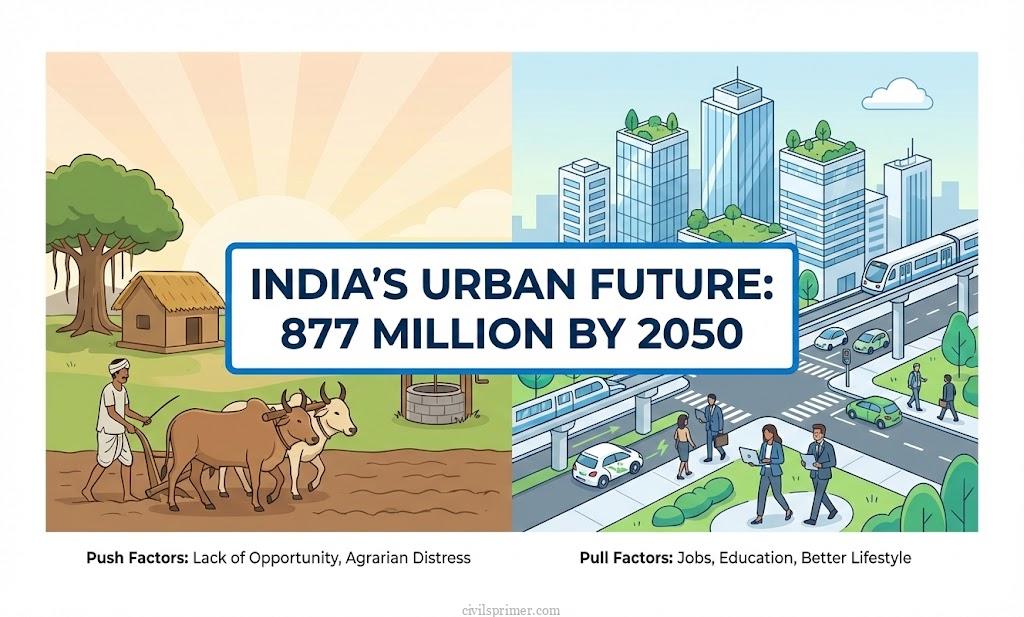
Historically, India has been a land of villages. However, a massive transition is underway. As per the 2011 Census, 31.1% of Indians (about 377 million people) lived in urban areas. While this percentage is moderate compared to China’s ~57% (World Bank, 2023), the absolute numbers are staggering. The United Nations estimates that India’s urban population will nearly double to 877 million by 2050.
For a UPSC aspirant, urbanization is not merely about building skyscrapers and roads. It is a profound social, economic, and environmental churn. It is the story of how millions of people are reshaping their identities, families, and livelihoods in the quest for a better life.
1. The Engine of Growth and the “Hidden” Cities #
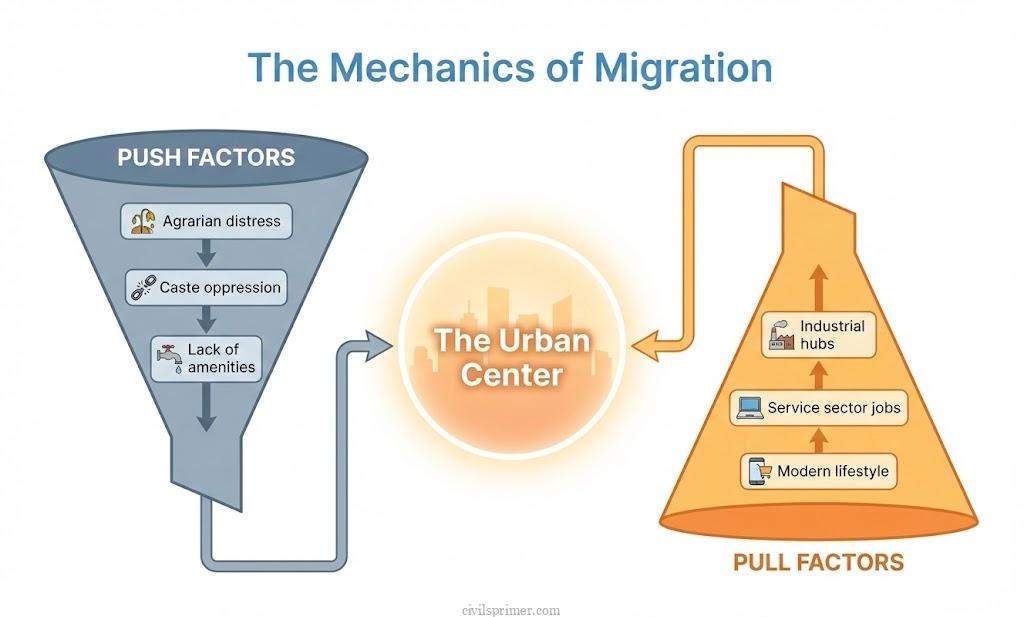
Why do cities grow? Sociologists classify the drivers into “Push” and “Pull” factors.
- Push Factors: Agrarian distress, shrinking landholdings, and a lack of rural jobs physically push people out of villages. For example, landless laborers frequently migrate from Bundelkhand to Delhi just to survive.
- Pull Factors: Cities pull people in with the promise of better wages, anonymity from oppressive rural caste structures, and superior education. The IT boom in Bengaluru in the 1990s is a classic example of “pull” migration, transforming it from a quiet pensioner’s paradise into India’s Silicon Valley.
The Phenomenon of “Hidden Urbanization” A fascinating concept for your exam is “Hidden Urbanization.” India has strict administrative definitions for cities (Statutory Towns). However, there are thousands of Census Towns—settlements that are functionally urban (high density, over 75% male workforce in non-agricultural jobs) but are still administratively governed as rural Gram Panchayats.
Between 2001 and 2011, the number of Census Towns in India skyrocketed from 1,362 to 3,894. This means millions of Indians are living an urban lifestyle but are deprived of urban infrastructure like planned sewage and piped water because their town is officially still a “village”.
2. The Growing Pains: Sprawl, Scarcity, and the Infrastructure Deficit #
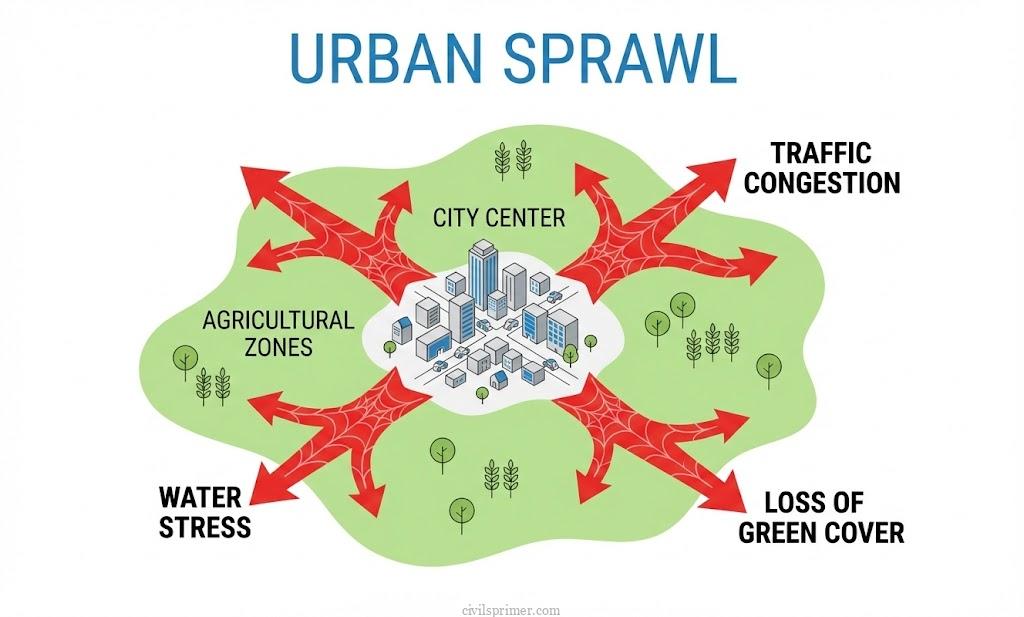
When a city grows faster than the government’s ability to plan for it, the result is “messy” urbanization. Instead of growing upwards systematically, cities expand outward haphazardly into agricultural lands—a process known as Urban Sprawl.
Look at the peripheries of Hyderabad or the NH-48 corridor between Delhi and Gurugram. You will see “leapfrog development” where shiny gated communities sit next to undeveloped, dusty villages. This sprawl leads to severe consequences:
1. The Commute Crisis: Bengaluru was ranked the most congested city in India in the Traffic Congestion Index 2023. Unplanned sprawl forces people to travel long distances, choking roads and polluting the air.
2. The Thirst of the City: Cities are running dry. The Chennai Water Crisis of 2019 shocked the world when a major metropolis completely ran out of water. Today, despite the shining facades, only 62% of urban households have access to piped water, and a shocking LocalCircles 2024 survey revealed only 6% receive safe, drinkable tap water directly.
3. The Choking Commons: Urban commons—lakes, wetlands, and open spaces—are being swallowed by real estate. In Delhi, nearly 75% of the Yamuna floodplains have been encroached upon, leading to severe flooding during monsoons.
3. Slums and Housing: The Shadow of the Skyline #
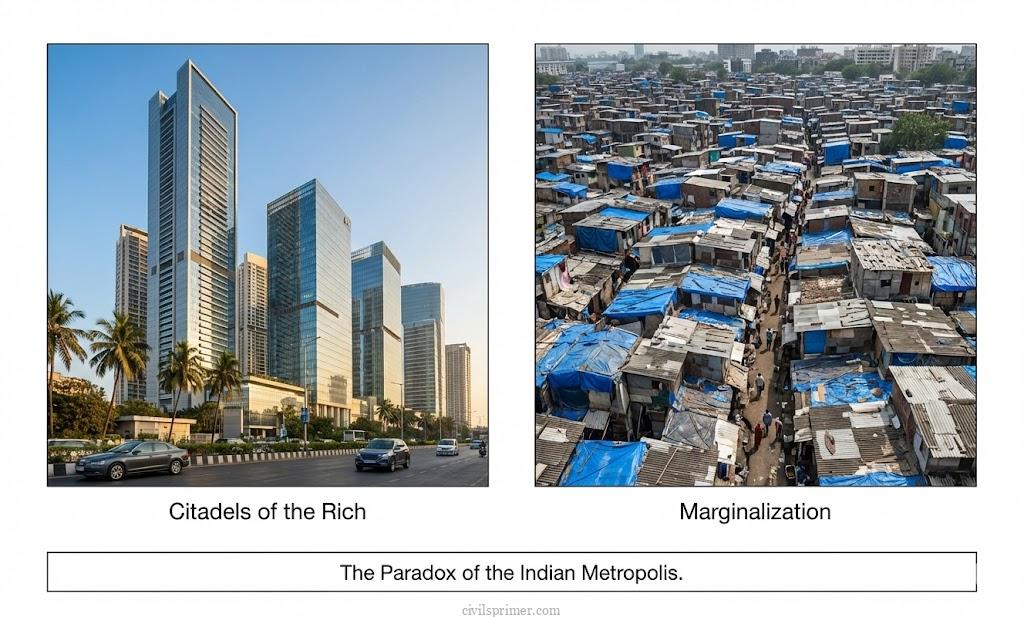
Urbanization creates a paradox: the people who build the city often have no place to live in it. This brings us to the acute Urban Housing Crisis. India faces an urban housing shortage of roughly 10 million units (Ministry of Housing, 2022). Because formal housing is exorbitantly expensive, the poor are forced into informal settlements. Today, approximately 65 million Indians live in slums. In Mumbai, a staggering 41% of the population resides in slums like Dharavi, living in cramped 10×10 foot rooms.
The Urban Poor and the “Culture of Poverty” The International Labour Organization (IER 2024) notes that the urban poverty rate stood at 12.55% in 2022. The urban poor are predominantly informal workers—waste pickers, street vendors, and gig workers. They suffer from what sociologist Oscar Lewis called the “Culture of Poverty”—living in constant insecurity, lacking basic sanitation, and facing the perennial threat of eviction by city authorities. Their vulnerability was heartbreakingly visible during the COVID-19 lockdowns of 2020, when millions of migrant workers, stripped of daily wages and unable to pay rent, were forced to walk hundreds of kilometers back to their villages.
4. Segregation and New Lifestyles: The Changing Social Fabric #
Urbanization does not just build roads; it rewires the human mind and social relationships.
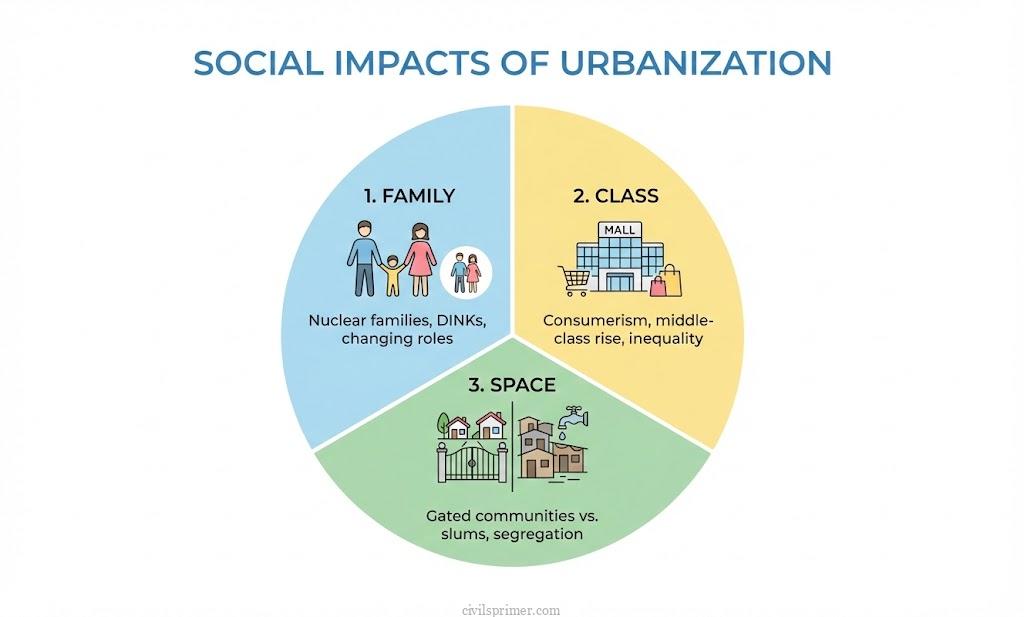
- The Rise of the New Middle Class and Consumerism The economic boom, especially in IT hubs and Tier-2 cities like Pune and Indore, has birthed a massive “new middle class”. Their lifestyle is defined by “conspicuous consumption”—buying goods not just for utility, but to signal social status. Shopping malls, branded clothing, and café culture have become the new markers of identity, replacing traditional markers like caste.
- Family and Marriage The traditional joint family is breaking down into nuclear families (now around 52% in urban areas) due to lack of urban housing space and the demands of modern careers. We are also seeing a rise in “DINK” (Double Income, No Kids) families, growing at 30% per annum, as urban couples prioritize careers and grapple with the high costs of raising children.
- Segregation: Ghettos vs. Citadels While cities are melting pots, they also feature severe spatial segregation.
- Ghettos: Marginalized groups (based on religion or caste) are often forced to live in specific, under-serviced areas due to housing discrimination or a search for safety (e.g., Mumbra near Mumbai).
- Citadels/Gated Communities: Conversely, the wealthy isolate themselves in heavily guarded “citadels,” complete with their own private water, power, and security systems, entirely disconnected from the civic realities of the city.
5. Remedies and Governance: Healing the City #
How do we fix our cities? The government has launched several flagship missions to transform urban governance and infrastructure.
1. Smart Cities Mission Launched to develop 100 cities into sustainable, citizen-friendly urban centers. It focuses heavily on “Area-Based Development” (retrofitting a specific part of the city) and using technology (like centralized command centers) for better traffic and waste management.
• The Critique: Critics point out that it often creates “islands of excellence.” For instance, Pune’s Smart City project improved a specific wealthy neighborhood (Aundh-Baner) but was criticized for neglecting the broader needs of the city’s informal settlements and affordable housing.
2. AMRUT (Atal Mission for Rejuvenation and Urban Transformation) While Smart Cities focus on tech, AMRUT focuses on the absolute basics. It aims to ensure that every household has access to a tap with an assured supply of water and a sewerage connection, while also developing green parks to reduce the Urban Heat Island effect.
3. PMAY-U (Pradhan Mantri Awas Yojana – Urban) The government’s ambitious plan to solve the housing crisis by building “Housing for All”. It uses concepts like In-situ Slum Redevelopment (using land as a resource to build pucca houses for slum dwellers right where they live) and Credit Linked Subsidy Schemes (giving interest subsidies to the middle class to buy homes).
• The Challenge: Tedious land acquisition processes and the sheer scarcity of land in city centers have pushed these affordable housing projects to the extreme outskirts, far away from where the poor actually work.
4. The Way Forward: TOD and Rurbanization To build the future, India must adopt Transit-Oriented Development (TOD)—planning high-density, walkable, mixed-use communities centered entirely around public transport like Metros to kill urban sprawl. Furthermore, we must embrace Rurbanization (making villages smart) to bridge the rural-urban divide, stop distress migration, and create a sustainable, balanced demographic distribution across the country.
Conclusion #
India’s urbanization is an unstoppable force. The transition from 377 million urbanites today to 877 million by 2050 is the greatest demographic shift the world will witness. If managed poorly, our cities will collapse under the weight of slums, pollution, and extreme inequality. However, if managed through inclusive planning, robust infrastructure, and empowered local governance, these very cities will become the engines that propel India into a developed, equitable superpower.
UPSC Mains Previous Year Questions (PYQs) #
- How does smart city in India, address the issues of urban poverty and distributive justice? (2025, 10 Marks)
- Why do large cities tend to attract more migrants than smaller towns? Discuss in the light of conditions in developing countries. (2024, 10 Marks)
- Does urbanization lead to more segregation and/or marginalization of the poor in Indian metropolises? (2023, 15 Marks)
- How is the growth of Tier-2 cities related to the rise of a new middle class with an emphasis on the culture of consumption? (2022, 10 Marks)
- What are the main socio-economic implications arising out of the development of IT industries in major cities of India? (2021, 15 Marks)
- With a brief background of the quality of urban life in India, introduce the objectives and strategy of the ‘Smart City Programme’. (2016, 12.5 Marks)
Related Latest Current Affairs #
| (December, 2025): The Urban Future and People-Centric Planning – Recent policy debates emphasized that while India’s urban population is rapidly expanding, the growth pattern suffers from peripheral sprawl and an infrastructure-centric “Smart City skew”. Experts recommend transit-oriented development and in-situ slum redevelopment under schemes like PM Awas Yojana (Urban) to build inclusive ecosystems. |
| (October, 2025): Need for Inclusive and Sustainable Urban Development – Reports highlighted that nearly half of India’s urban population lives in slums lacking safe drinking water and durable housing. While initiatives like the Smart Cities Mission and AMRUT aim to improve housing and basic amenities, experts stress better coordination to address the precarious living conditions of informal migrant workers. |
| (October, 2025): Reimagining Urban Planning in India – Acknowledging that urban areas will house 50% of the population by 2047, experts called for an urgent shift from outdated, land-use-centric planning to integrating economic and spatial strategies. Reforming Town Planning Acts and empowering Urban Local Bodies (ULBs) is crucial for developing resilient, well-planned urban centers. |
| (October, 2025): Overhauling Urban Fiscal Architecture – Analysis showed that Indian municipalities generate nearly two-thirds of the national GDP but control less than 1% of tax revenue. Providing ULBs with greater fiscal autonomy, such as the ability to raise municipal bonds and collect user charges, is vital for funding sustainable urban infrastructure and housing. |
| (September, 2025): Building Climate-Resilient Cities – With rising risks from flooding, extreme heat, and poor drainage, India’s expanding cities face severe climate vulnerabilities. There are urgent calls to embed climate resilience and green building standards into core urban infrastructure projects like the Smart Cities Mission, AMRUT, and PM Awas Yojana. |
| (August, 2025): Swachh Survekshan Awards 2024–25 – The Swachh Survekshan awards were conferred under the Swachh Bharat Mission-Urban (SBM-U), marking a shift toward improved urban sanitation. The initiative acts as a benchmarking tool to upgrade municipal service delivery, address legacy waste in dumpsites, and improve the overall cleanliness of growing urban centers. |
| (July, 2025): Gender Equity in Urban Bureaucracy – As India undergoes a massive urban transformation—projected to have over 800 million urban residents by 2050—reports highlighted the critical need for gender equity. Integrating women into urban governance and planning is necessary to ensure that the infrastructure of expanding cities is safe and inclusive. |
| (June, 2025): Urban Drainage Crisis and Flooding – Major metropolitan areas like Mumbai and Delhi faced severe urban flooding, exposing the failure of outdated stormwater drainage systems. This crisis underscores how unplanned urban expansion, concrete-heavy development, and the loss of natural water bodies are creating unsustainable and highly vulnerable urban environments. |